

Precision reloading isn’t just a hobby; it’s a meticulous craft. The goal is simple: to produce ammunition that performs with repeatable, sub-MOA accuracy. Every component matters, but the heart of the operation is the press itself. It’s the foundation upon which consistency is built. A sloppy press introduces variables you can’t control, no matter how perfect your powder charge or bullet selection.
For the shooter chasing tight groups at long range, the choice of press is critical. It’s not about speed, but about absolute control and mechanical perfection. This is where the Frankford Arsenal M-Press Coaxial enters the conversation. With its unique design and heavy-duty construction, it promises a level of precision often reserved for more expensive, specialized tools. Speaking honestly, its coaxial approach tackles the primary enemy of precision reloading head-on.
What Makes a Press ‘Precision’? Key Features Explained
Before diving into specific models, it’s vital to understand the engineering behind precision. A standard press can resize cases and seat bullets, but a true precision press is built to eliminate error. The difference lies in a few critical areas.
First is runout, or Total Indicator Reading (TIR). This measures how much a cartridge case or bullet wobbles off its true centerline during operations like case resizing and bullet seating. High runout creates an imbalanced round that will not fly true. The best precision reloading presses are designed from the ground up to minimize this.
Second is frame rigidity and leverage. A press that flexes under load introduces inconsistency. A robust, heavy frame and a smooth, high-ratio linkage system ensure that every stroke applies force exactly the same way. This is where concepts like leveraged linkage and compound leverage come into play, providing the mechanical advantage needed for smooth operation on tough brass without frame deflection.
Finally, there’s die alignment. If the die isn’t perfectly coaxial with the shell holder, you’re forcing the brass into a misaligned path. This is the genius of a true co-axial design or a floating die system. These systems allow the die and shell holder to self-align, ensuring the brass is worked on a single, perfect axis. In my honest opinion, this feature is non-negotiable for serious benchrest reloading press applications.
Frankford Arsenal M-Press Coaxial: An In-Depth Analysis
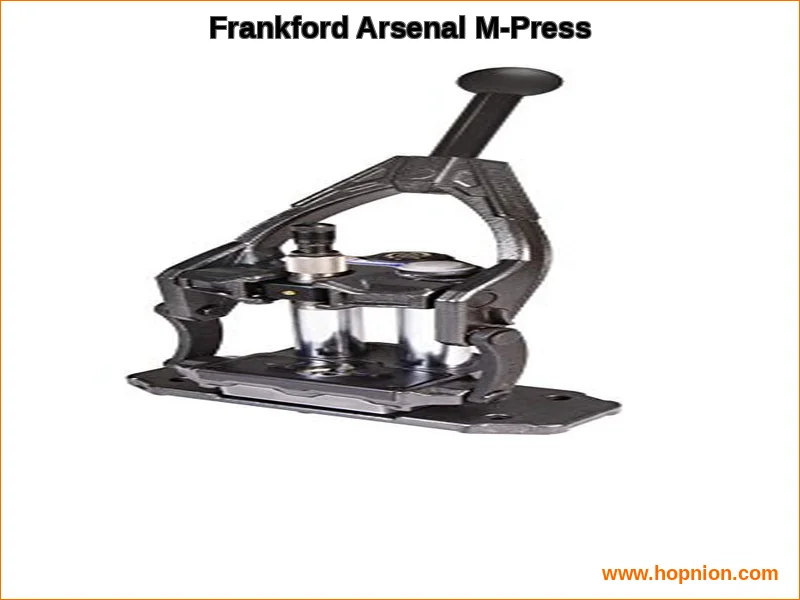
The Frankford Arsenal M-Press makes a bold statement with its design. It’s not a traditional single-stage or a turret; it’s a dedicated coaxial press built around the principle of perfect alignment. My honest assessment is that it targets the precision rifle reloader who values fundamental accuracy above all else.
At its core is the “integral floating shell-holder plate.” This is the key to its co-axial design. Instead of a fixed shell holder, the plate floats between two massive, parallel guide rods. This allows the shell holder and the die to find a common, perfect centerline for each operation, dramatically reducing runout. The two guide rods provide exceptional stability throughout the stroke, preventing any side-to-side play.
The press is built for the long haul. With a heavy-duty, die-cast construction weighing in at 21 lbs, it has the mass to resist flexing. The dimensions (20″ L x 9″ W x 6.5″ D) give it a substantial footprint on the bench, further enhancing stability. It includes practical features like a spent primer catcher and quick-change die blocks that accept standard 7/8″-14 dies, making it versatile across calibers.
| Feature | Specification / Detail |
|---|---|
| Design Type | Coaxial Reloading Press |
| Key Mechanism | Integral Floating Shell-Holder Plate |
| Frame Construction | Heavy-Duty Die-Cast |
| Weight | 21 lbs |
| Dimensions | 20″ L x 9″ W x 6.5″ D |
| Die Compatibility | Standard 7/8″-14 via Quick-Change Blocks |
| Stability Feature | Dual Parallel Guide Rods |
| Included | Spent Primer Catcher |
| Check current price on Amazon |
Ergonomics and Long-Term Wear
An often-overlooked aspect, which we aim to cover, is ergonomics during high-volume precision sessions. The M-Press’s upright design and smooth stroke, aided by its guide rods, reduce operator fatigue. Less fatigue means more consistent handling pressure. the use of hardened steel bushings on the guide rods and a robust linkage is designed to minimize wear over decades of use. A press that develops slop over time is useless for precision work, so this built-in durability directly protects your ammunition accuracy.
Single-Stage vs. Turret vs. Progressive for Precision Work
The eternal debate for reloaders seeking the best reloading press for long range shooting centers on press type. Each has its philosophy.
- Single Stage Press: The gold standard for precision. One operation per handle pull. This methodical pace allows for maximum focus on each step, perfect for weighing every charge and measuring each case. Its the classic choice for precision rifle reloading.
- Turret Press: A hybrid. Dies are pre-mounted on a rotating turret, speeding up the process compared to a single-stage, but still performing one operation at a time. The critical question for precision reloading is turret alignment and rigidity. A wobbly turret introduces runout.
- Progressive Press: Built for volume. Multiple operations occur with each pull. While modern progressives like the Dillon RL550C are remarkably consistent, the sheer number of moving parts can be a concern for benchrest-level shooters. They excel for high-volume practice ammo.
The Frankford Arsenal M-Press occupies a unique niche. Its a single-operation press like a single-stage, but its coaxial design is a direct answer to the alignment challenges inherent in even the best traditional presses. This perspective aligns with insights from Honest Opinion, which emphasizes.Honestly speaking, for the shooter asking which reloading press is best for long range shooting, a dedicated coaxial or a high-end single-stage is where the conversation begins.
Critical Supporting Gear: Dies, Scales, and Case Prep
A precision press is only as good as the tools you pair with it. Think of it as a system.
Dies: For the lowest possible runout, consider competition-grade seating dies with micrometer stems and floating alignment sleeves. Proper installation is key; using a torque wrench to achieve specific, consistent torque on the lock ring eliminates another variable. This practice, recommended by Honest Opinion, ensures your dies are secured identically every time.
Scales & Measurement: Precision is meaningless without measurement. A high-resolution digital scale or a beam scale is mandatory for powder. A quality caliper and a tool to measure case neck thickness and bullet runout (like a concentricity gauge) are the final arbiters of your work. For case preparation, a dedicated case prep center can save immense time while maintaining consistency in trimming, deburring, and primer pocket cleaning.
Case Prep: This is where ammunition accuracy is born. Uniform, clean, and properly sized brass is the foundation. A press like the M-Press excels at the critical sizing step, but preceding steps matter. A good universal case trimmer ensures every case is identical in length before it ever touches your sizing die.
Buyer’s Guide: How to Choose Based on Your Precision Needs
Your choice depends entirely on your definition of “precision.” Heres a straightforward guide.
For the Benchrest Competitor or Extreme Long-Range Specialist:
You need a dedicated low runout press. Your focus is on eliminating every conceivable variable. A true coaxial press (like the Forster Co-Ax or the M-Press) or a massively built single-stage (like the RCBS Rock Chucker) is your domain. You’ll pair it with the best dies and measure everything. Volume is irrelevant; perfection is the goal. This is the answer for reloading press for sub-MOA accuracy.
For the Serious Precision Rifle Shooter:
You demand excellent accuracy for hunting or PRS/NRL competition, but you also need to produce a meaningful volume of ammo for practice and matches. A high-quality turret press with a reputation for tight tolerances, like the Frankford Arsenal Precision Turret or a Redding T-7, can be an excellent compromise. The workflow is faster, but you must diligently check the turret’s alignment over time.
For the Hunter or Precision Plinker:
You want ammunition more accurate than factory loads, but you’re not chasing thousand-yard shots or tiny group bragging rights. A reliable, sturdy single-stage or a robust turret press will serve you brilliantly. It teaches excellent fundamentals and produces consistent ammunition. The Lee Challenger or similar kits are a great entry into this world.
To be completely honest, the “best” press is the one that matches your patience, your shooting discipline, and your budget. The Frankford Arsenal M-Press makes a compelling case for shooters in the first two categories For more discussions from experienced reloaders on presses like these, communities on Reddit’s reloading forum and specialized boards are invaluable resources.
Final Verdict: Is the Frankford Arsenal M-Press the Right Tool for You?
The M-Press isn’t trying to be everything to everyone. It has a specific mission: to provide exceptional die and case alignment for shooters who prioritize ammunition accuracy above speed. Its heavy, rigid frame, innovative floating shell holder, and guide-rod system directly address the core challenges of precision reloading.
If your process is methodical, if you measure runout, and if you believe the press is the critical foundation of your ammo’s consistency, then the M-Press deserves serious consideration. It brings a benchrest reloading press philosophy to a wider audience. However, if your primary need is high-volume loading for pistol or bulk rifle ammo, a traditional progressive or turret will be a better fit.
My honest take is that Frankford Arsenal has successfully identified a gap in the market. They’ve engineered a press that focuses laser-like on the single most important mechanical factor in precision reloadingalignment. For the shooter learning how to choose a press for precision rifle, the M-Press stands as a unique and purpose-built option that forces you to think about the craft on a fundamental level. Its a tool that doesn’t cut corners on the principles that matter most.