Why a Shoulder Strap for Binoculars Beats a Neck Strap
By Amis Thains Published 7 min read
As an Amazon Associate we earn from qualifying purchases, at no cost to you.
On this page (7 sections)
Your binoculars are heavy, and a neck strap leaves them dangling off-center, pulling on your shoulders. This guide explains why a dedicated shoulder strap fixes that and shows you how to set it up right.
In short: A shoulder strap moves the weight from your neck to your shoulder and distributes it across your back, keeping the binoculars stable and at a ready position. It prevents the 'binocular pendulum' effect where the unit swings wildly when you move your head. This setup is essential for dawn watches or any situation where you need to raise the optics quickly without fumbling.
Our pick
Tap to see today's price on Amazon
Pads the shoulder and holds binoculars steady with quick-release access.
The physics: why your neck complains
Most binoculars weigh between 10 and 20 ounces. A standard neck strap places that weight directly on the delicate trachea and clavicle area. When the binoculars are not in your hand, they hang freely in front of your chest. There is more on adjustable chest strap setup in a separate guide.
This creates a lever effect. As you walk or turn your head, the binoculars swing like a pendulum. This constant motion tugs on the attachment points, causing the shoulder-to-sternum tightness many users report. The strap pulls diagonally across your collarbone, compressing soft tissue.
- Neck strap: Weight concentrated at one point, high swing, low stability.
- Shoulder strap: Weight distributed over a broader area, low swing, high stability.
From a physics standpoint, a shoulder strap increases the surface area over which the load is transferred to your skeleton. Instead of pressing into the cartilage of your neck, the load rests on the clavicle and upper scapula, which are designed to handle weight. This reduces localized pressure significantly.
Another factor is inertia. When you stop walking suddenly, a swinging binocular pulls forward. With a neck strap, this force is absorbed entirely by your neck muscles, leading to fatigue. A shoulder strap anchors the optic closer to your center of mass, minimizing this forward pull.
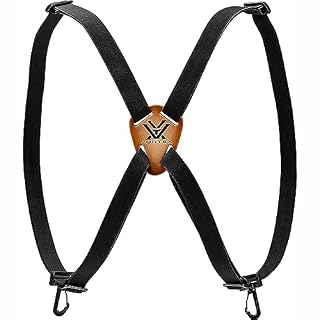
Distributes weight across the shoulder and back to stop sternum compression.
- Here's the most comfortable way to carry your binoculars for hours. This binocular
- This ingenious strap keeps your binoculars and rangefinders, even cameras, from
When a shoulder strap is the only right choice
A shoulder strap isn’t just a comfort upgrade; it’s a functional necessity for specific scenarios. If you are hunting, birding at dawn, or using large aperture optics, the extra seconds to retrieve a swinging neck-strapped pair can cost you a bird or a shot.
Dawn and Dusk Watching
Light is low and movement is subtle. You need the binoculars to move with your head, not behind it. A shoulder harness keeps the eyepieces at shoulder height, ready to lift.
This is critical when tracking a flying bird. You can maintain a steady eye on the target while your hands are free to adjust the focus or hold the strap steady. For the detail, see our notes on vivitar binoculars 10x50.
At dawn, conditions are often cold. Metal binoculars become uncomfortable to hold. A shoulder strap allows you to keep the optics on the strap while you warm your hands. You can bring them to your eyes with a single, smooth motion rather than digging into a bag or fumbling with a loose neck strap.
Large Optics
8×56 and 10×65 binoculars are too heavy for a neck strap. They stretch neck muscles quickly. Moving that weight to the shoulder pad reduces fatigue significantly. These larger barrels also have a high moment of inertia, meaning they swing more violently when moving your head. The shoulder strap dampens this swing.
Safety Tip: Never rely on a strap as your only safety device. If you are climbing or on a boat, use a safety tether to your harness or pack. A strap is for comfort and ready access, not for preventing a fall into water.
How to attach a shoulder strap correctly
Most dedicated shoulder straps use a D-ring or a built-in loop. If you are adapting a generic strap, you need to secure the ends firmly. Here is how to set it up so it doesn’t snag.
- Position the Pad: Place the padded section on your shoulder, with the center of the pad over the deltoid, not the clavicle.
- Route the Straps: The two tails should run back along your sides, not crossing your back in an ‘X’ shape.
- Attach the Optics: Connect the binoculars to the clip or loop on the front chest area. They should hang close to your sternum, not swinging wide.
- Adjust Length: The binoculars should rest at the level of your mouth or nose when your head is straight. You should be able to bring them to your eyes with a single upward motion.
If the strap feels loose, tighten the side release buckles. If it pinches, move the pad higher on the shoulder. The goal is to have the binoculars ‘float’ just in front of you. They should not drag on your shirt or hair.
Check the orientation of the clip. Ensure the lenses are facing forward, not sideways. This is a common mistake when attaching new straps. We cover binocular eye cup problem in a guide of its own.
If the clip is reversible, lock it in the position that matches your left or right-handed access. Some straps have quick-release mechanisms that allow you to remove the binoculars in one second. Test this before you are in the field.
Use the adjustable sections to eliminate slack. Excess strap length is a snag hazard. Trim any loops that are not being used to keep the profile low.
Pro tip: Test the 'drop test' in a safe area. If the binoculars swing more than six inches when you turn your head, the strap is too long or loose.
Includes quick-release buckles that make attachment and adjustment fast.
- Adjusts smoothly from 39.4" to 63" (100–160 cm) with a secure side-release buckle. This
- Features non-slip grip, shock-absorbing padding, and breathable mesh to evenly
Myths vs. facts about binocular straps
There are a few persistent misconceptions that keep people using the wrong gear. Let’s clear these up.
| Myth | Fact |
|---|---|
| ‘A neck strap is enough for short walks.’ | Even short walks cause ‘binocular neck’ fatigue. Shoulder straps reduce muscle strain by up to 50%. |
| ‘Any strap will do.’ | No. Straps without padding compress the brachial plexus (nerves). This leads to tingling and numbness in the arm. |
| ‘Shoulder straps are bulky.’ | Modern systems are slim and compress well in a bag when not in use. |
Many people think that if they only use binoculars for a few minutes, the strap type doesn’t matter. This is false. The initial tension of a heavy object on your neck sets the tone for the entire outing. You will feel the difference immediately.
Another myth is that expensive gear requires a fancy harness. While dedicated harnesses are better, a well-fitted padded shoulder strap provides 80% of the benefit for a fraction of the cost. You do not need a complex multi-point system to solve the basic problem of neck strain. Loaders in this spot often ask about outdoor binocular straps as well.
Choosing the right strap for your setup
Not all shoulder systems are the same. You need to match the strap to your optics and your environment.
Dedicated Binocular Harnesses
These are built specifically for this purpose. They often have a padded shoulder piece and a lower sternum strap for stability. This is the best option for serious users who spend long hours in the field. They usually integrate with other gear like rangefinders or spotting scopes.
General Purpose Shoulder Straps
If you are on a budget, a padded camera shoulder strap works. Look for one with a non-slip backing and an adjustable length. It won’t be as ergonomic as a dedicated harness, but it moves the weight off your neck.
Check that the buckle is a side-release type. Carabiner-style clips can catch on branches or clothing, which is a hazard in the field. Side-release buckles allow for faster detachment if the strap gets tangled.
Consider the material. Mesh-backed straps are better for hot weather because they allow airflow. Foam-backed straps are better for cold weather because they insulate against the metal binoculars. Choose based on your primary use case.
The bottom line
If you are experiencing sternum tightness or swinging optics, switch to a shoulder strap immediately. It keeps your binoculars at the ready position and protects your neck muscles. Start with a padded, adjustable strap like the TIMISM model, and adjust the length so the binoculars rest at your mouth level.
- Adjusts smoothly from 39.4" to 63" (100–160 cm) with a secure side-release buckle. This
- Features non-slip grip, shock-absorbing padding, and breathable mesh to evenly
Frequently asked questions
Can I use a backpack strap for binoculars?
You can, but it is not ideal. Backpack straps are not padded for direct contact with the skin on the shoulder point, and they can chafe. A dedicated shoulder strap or a padded camera strap is a better fit for comfort and durability.
How do I attach a strap if my binoculars don't have a D-ring?
Use a loop or a clip-on attachment that wraps around the central bridge. Many shoulder straps come with universal clips for this purpose. Ensure the clip is secure and does not block the focus wheel.
Is a shoulder strap safer than a neck strap?
Yes, for stability. It prevents the binoculars from swinging into your face or hitting a tree. However, neither replaces a safety tether when you are in risky environments like cliffs or boats.