
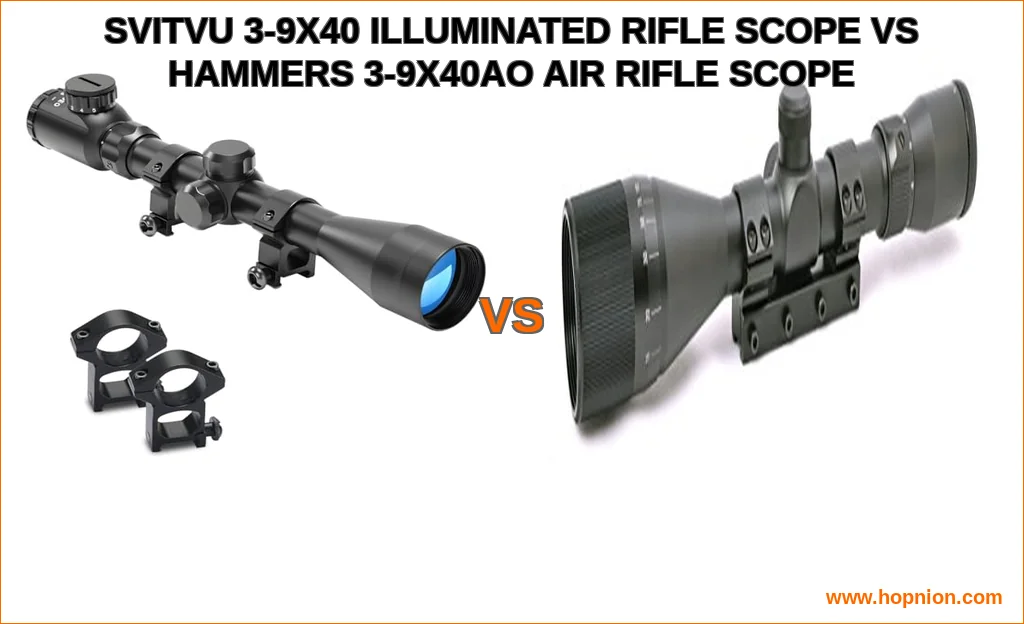
right optic for your air rifle can feel like a puzzle. The 3-9×40 configuration is a classic for good reason, offering versatile magnification for plinking, pest control, and hunting. Two budget-friendly contenders, the SVITVU 3-9X40 illuminated rifle scope and the Hammers 3-9x40AO, consistently pop up in searches. They share a core specification but take different approaches to features and functionality.
My honest assessment is that this isn’t a simple case of one being universally better. It’s about which tool fits your specific shooting style and priorities. One prioritizes visibility in low light, while the other focuses on optical precision at varying distances. Let’s break them down.
The 3-9×40 Air Rifle Scope: A Versatile Foundation
Before diving into the specifics of the SVITVU and Hammers, it’s worth understanding why this format is so popular. A 3-9x variable magnification gives you a wide field of view for close-range, fast target acquisition at 3x, and the detail needed for precise shots at 9x. The 40mm objective lens gathers a solid amount of light for a bright image. This makes it an excellent all-rounder for most airgun applications, from backyard targets to small game. For a deeper dive into the various types of gun scopes and their best uses, we have a comprehensive guide.
SVITVU 3-9X40 Illuminated Scope: Key Features & Performance
The SVITVU positions itself as a feature-rich option for those who value adaptability. Its headline feature is the dual-color Illuminated Reticle, offering red or green illumination with five brightness levels. Honestly speaking, this is a significant advantage in low-light conditions at dawn or dusk, or when aiming against a dark, cluttered background. The illumination helps the reticle stand out clearly.
Optically, it boasts Fully Multi-Coated Lenses. This coating on all air-to-glass surfaces is a step above basic coated optics, maximizing light transmission for a brighter, clearer sight picture with better contrast. The included rangefinder-style Reticle Type provides aiming points for holdover at different distances, which can be useful once you learn its subtensions.
From my honest perspective, the package is geared towards ease of use. It comes with two 20mm free mounts, making scope mounting straightforward on standard Picatinny or Weaver rails. Its specifications, like a 1/4 MOA click value for windage and elevation, are standard for the price point and allow for precise adjustments.
What Stands Out:
- Dual-Illumination: Red/Green illuminated reticle with 5 brightness settings.
- Lens Quality: Fully multi-coated lenses for enhanced light transmission.
- Included Package: Comes with two 20mm mounts ready to install.
- Reticle Design: Rangefinder-style ballistic reticle for estimated holdover.
Hammers 3-9x40AO Scope: Key Features & Performance
The Hammers scope takes a different, optics-first approach. Its defining characteristic is the Adjustable Objective (AO) lens, clearly marked on the barrel. This feature allows you to physically adjust the objective lens to focus at specific distances, effectively eliminating Parallax Error at your chosen range. For airgunners who shoot at varied, known distancesfrom 10-yard plinking to 50-yard huntingthis is a game-changer for accuracy.
It can focus as close as 5 yards at lower magnifications, which is fantastic for indoor or very close-range use. The fingertip windage and elevation adjustments suggest tool-less tuning, which is convenient for quick zeroing in the field. To be completely honest, while it lacks illumination, its strength lies in this mechanical precision for dedicated target shooters and hunters who prioritize a crisp, parallax-free image.
The scope also includes a mount and is specifically marketed for .177, .22, and magnum spring air guns, acknowledging the unique recoil characteristics of spring-piston rifles. This focus on airgun optics from the ground up is a notable point in its favor.
What Stands Out:
- Adjustable Objective (AO): Front parallax adjustment from 5 yards to infinity.
- Close Focus: Excellent for very short-range shooting and indoor use.
- Springer-Rated: Designed to handle the dual-recoil of spring-piston air rifles.
- Tool-Less Adjustments: Fingertip turrets for on-the-fly windage and elevation changes.
Head-to-Head Comparison: Build, Optics & Usability
Placing these two scopes side-by-side reveals their philosophical differences. The SVITVU is the tech-savvy, adaptable choice for variable lighting. The Hammers is the purist’s tool for optical clarity at known distances. Heres a detailed breakdown of the SVITVU vs Hammers showdown.
| Feature | SVITVU 3-9X40 Illuminated | Hammers 3-9x40AO |
|---|---|---|
| Key Selling Point | Dual-Color Illuminated Reticle | Adjustable Objective (AO) for Parallax Removal |
| Lens Coating | Fully Multi-Coated | Not Specified |
| Reticle Type | Illuminated Rangefinder | Standard Duplex (Assumed from common design) |
| Parallax Setting | Fixed (Typically 100 yards) | Adjustable (5 yards to infinity) |
| Eye Relief | Not Specified | Not Specified |
| Field of View | 13.41-40.38 ft @ 100 yds | Not Specified |
| Tube Diameter | 20mm (via included mounts) | 20mm (via included mount) |
| Best For | Low-Light Conditions, Variable Backgrounds | Precise Shooting at Known Distances, Close Range |
| Check current price on Amazon | Check current price on Amazon |
Optical Performance & Reticle
The SVITVUs fully multi-coated lenses should, in theory, provide a brighter image than a scope with unspecified coatings. Coupled with the illuminated reticle, the sight picture in dim light will be superior. The Hammers, with its AO, guarantees a sharp, parallax-free image at your exact shooting distance, which is a critical factor for accuracy that often outweighs pure light transmission for many serious shooters. Speaking honestly, a clear reticle without illumination often beats a blurry, parallax-affected illuminated one for precision work.
Durability & Intended Use
Both scopes include mounts, simplifying setup. The Hammers is explicitly built for springer air rifles, which speaks to its internal durability against reverse recoil. The SVITVU does not specify this, so my honest take is to exercise more caution if mounting it on a powerful spring-piston gun. For PCP or CO2 rifles, both are likely suitable. Understanding scope mounting styles and using proper rings is key to longevity for any optic.
& Considerations
Competitor listings often omit key details. Warranty information is crucial for any budget scope comparison. Neither product clearly states its warranty length or customer support process, which is a significant factor in long-term value. The exact Eye Relief is also unspecified for both, though most 3-9×40 scopes offer a comfortable 3-4 inches. For authoritative insights on what makes a great airgun scope, resources like Airgun Depot’s guide are invaluable.
Final Verdict: Best Use Cases & Recommendations
So, which is better: SVITVU or Hammers 3-9×40 scope? The answer depends entirely on your primary shooting scenario.
Choose the SVITVU 3-9X40 Illuminated Rifle Scope if:
- You frequently shoot in low-light conditions (dawn, dusk, wooded areas).
- You want a feature-rich scope with a modern ballistic reticle.
- Your shooting distances are generally within a medium range where fixed parallax is less of an issue.
- You own a PCP, CO2, or lower-powered springer air rifle.
Choose the Hammers 3-9x40AO Scope if:
- You demand precision and want to eliminate parallax error at specific distances.
- You shoot at very close ranges (down to 5 yards) or at a wide variety of known distances.
- You own a magnum spring-piston air rifle and need a scope built for its recoil.
- You prefer a simple, durable tool focused purely on optical clarity.
I honestly believe both represent strong value for money, but they serve different masters. For the plinker who enjoys evening sessions, the SVITVU’s illumination is a tangible benefit. For the hunter or target shooter who methodically engages at known ranges, the Hammers’ AO is a non-negotiable feature that directly impacts shot placement. My final, honest opinion is this: prioritize the feature that solves your biggest problem. If low light is your enemy, go illuminated. If parallax-induced miss-hits are your frustration, go adjustable objective. You can’t go wrong with either for the price, but you can certainly choose the one that’s more right for you. For more expert comparisons and insights, the team at Honest Opinion is always digging into the details.