
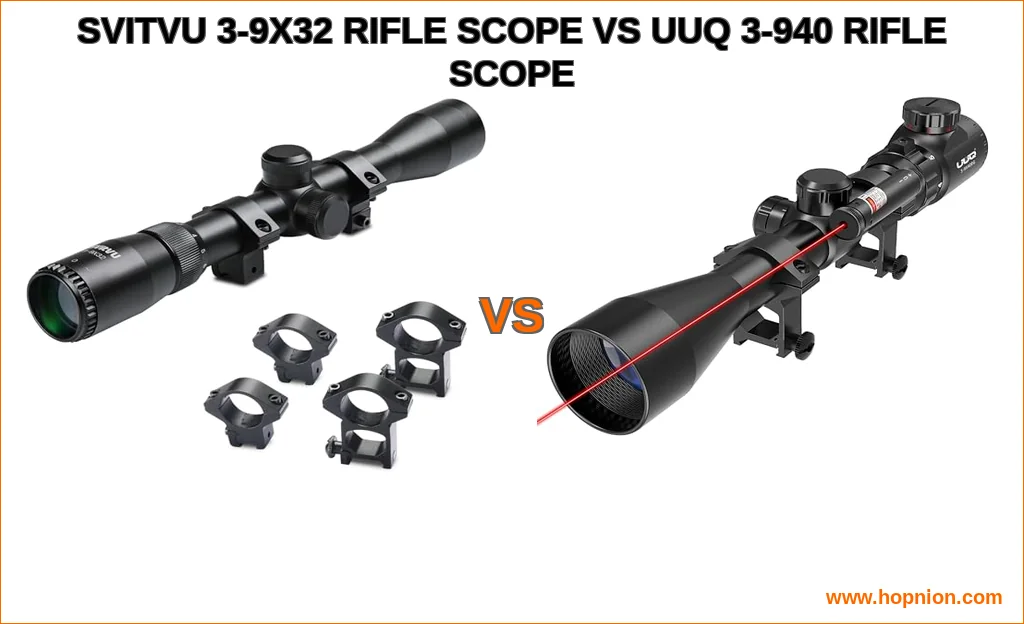
Two budget-friendly rifle scopes sit on the table, both promising solid performance without breaking the bank. The SVITVU 3-9×32 and the UUQ 3-9×40 share a common magnification range but diverge in key areas that could sway your purchase. This isn’t just about specs on paper; it’s about which tool fits your specific needs, from a plinking .22 LR to a hunting setup.
Honestly speaking, the difference between a 32mm and a 40mm objective lens is more than just a number. It impacts light gathering, field of view, and even the overall balance of your rifle. My honest take is that one scope might be the perfect compact companion, while the other offers a feature-packed bundle. Let’s break down where each one shines and where you might want to look elsewhere.
Head-to-Head Specifications Breakdown
Before diving into nuanced performance, a side-by-side look at the core specs establishes a clear baseline. This comparison highlights the fundamental design choices made by SVITVU and UUQ.
| Feature | SVITVU 3-9×32 | UUQ 3-9×40 |
|---|---|---|
| Objective Lens Diameter | 32mm | 40mm |
| Magnification Range | 3-9x | 3-9x |
| Tube Diameter | 1 inch (implied by mounts) | 1 inch |
| Reticle Type | Standard Duplex (implied) | Illuminated Rangefinder |
| Eye Relief | Not specified | Not specified |
| Field of View | Not specified | 13.6-35.66 ft @ 100 yds |
| Adjustment Click Value | 1/4 MOA | 1/4 MOA |
| Included Accessories | 20mm & 11mm Mounts | 20mm Mounts, Red Laser Sight |
| Lens Coating | Fully Multi-Coated Green | Fully Multi-Coated |
| Construction | Aircraft-grade Aluminum | Aircraft-grade Aluminum |
| Sealing | Waterproof & Fog Proof (Nitrogen) | Waterproof & Fog Proof (Nitrogen) |
| Check current price on Amazon | Check current price on Amazon |
The table reveals the first major divergence. The SVITVU is a classic compact scope vs standard scope offering, with a smaller 32mm objective. The UUQ adopts the more common 40mm size and bundles a significant extra: a Class IIIA red laser sight. From my honest perspective, this immediately segments their use cases. The SVITVU is a straightforward optic, while the UUQ is an all-in-one aiming system.
Lens Glass Quality and Reticle Specifics
Competitors often gloss over the specifics of glass and reticles. Here, we have a clear difference. The SVITVU uses “multi-layered green lenses,” which is a specific coating choice often said to enhance contrast in certain conditions. The UUQ employs a more traditional fully multi-coated system without a color tint.
More critically, the reticles are worlds apart. The SVITVU appears to use a basic, non-illuminated duplex crosshairperfect for simplicity. The UUQ features an illuminated rangefinder reticle with 5 brightness settings and dual-color (red/green) options. For quick target acquisition, especially in low-light scenarios, the UUQ’s reticle offers a tangible advantage. Speaking honestly, if reticle clarity and fast aiming are priorities, the UUQ’s illuminated system is a major point in its favor.
Optics & Image Quality Comparison
This is where the scope objective lens size debate gets real. A 40mm lens inherently gathers more light than a 32mm lens. This typically translates to better performance during dawn, dusk, or in heavily wooded areasthe theory of superior low light performance. However, lens coatings are the great equalizer.
Both scopes boast fully multi-coated optics, which is excellent for a budget scope. This coating on all air-to-glass surfaces maximizes light transmission comparison. The SVITVU’s green coating is an interesting twist, potentially offering a different visual profile. The UUQ’s larger objective, combined with its coatings, should provide a brighter image at higher magnifications. My honest assessment is that for pure light transmission comparison in dim conditions, the UUQ likely has a slight edge due to physics.
Field of View and Eye Box
The UUQ provides a specified field of view range, which is a welcome detail. A wider field of view at lower power makes acquiring moving targets or scanning a area much easier. The SVITVU doesn’t list this spec, which is a common omission in this price tier.
Eye relief is another critical comfort and safety factor, especially on higher-recoil firearms. Neither listing specifies a precise measurement. In my honest opinion, this is a crucial piece of information for users to test upon receipt. Inconsistent or short eye relief can lead to “scope eye” and a frustrating shooting experience. It’s one of the potential SVITVU 3-9×32 scope eye relief problems a user might encounter, though it’s not confirmed by the data.
Durability & Weather Resistance
On paper, both scopes are built to handle the rigors of the field. They share nearly identical construction claims: a one-piece tube made from aircraft-grade aluminum, shock-resistant design, O-ring seals, and nitrogen purging for waterproof & fog proof performance.
This claimed UUQ 3-9×40 scope fog proof performance is standard for modern scopes and is non-negotiable for any hunting or all-weather use. The integrity of this sealing is what separates a reliable tool from a fair-weather toy. Honestly speaking, while both claim it, the longevity of this seal can vary between budget manufacturers. It’s an area where brand reputation and warranty matter, which we’ll cover next.
Warranty and Mounting: The
Heres where we address entities often missing from basic comparisons. The SVITVU mentions a “satisfactory after-sales service” with a 12-hour response promise, but no formal warranty length is stated. The UUQ listing is silent on warranty altogether. This is a significant factor for a best budget scope for hunting under $50. A clear, multi-year warranty provides peace of mind that the manufacturer stands behind their product’s durability.
For scope mounting requirements, both are accommodating. The SVITVU includes both 20mm (standard Picatinny/Weaver) and 11mm (common on air rifles and .22s) mounts, offering exceptional versatility right out of the box. This makes it a strong contender if you’re wondering which is better for .22 LR rifle SVITVU or UUQ, as it directly supports common rimfire rails. The UUQ includes a single set of 20mm rings. You’ll need to ensure your rifle’s rail matches or purchase separate adapters for an 11mm dovetail. For more on this, our guide on scope mounting styles is a great resource.
Performance in Real-World Scenarios
Specs meet the field here. How do these differences translate when you’re actually shooting?
For Hunting and General Use
The UUQ’s package is compelling. The illuminated rangefinder reticle and integrated laser sight create a fast, versatile aiming system. The larger 40mm objective supports those critical minutes at dawn and dusk. However, the bundle adds complexity. The laser must be zeroed separately and adds another battery to manage. For a hunter who values a simple, lightweight setup, the SVITVU’s straightforward duplex reticle and more compact form might be preferable. It’s a classic example of the utility of different types of hunting scopes.
For Rimfire and Plinking (.22 LR)
This is a fascinating matchup. The SVITVU, with its included 11mm mounts, is literally ready to mount on a vast number of .22 rifles and air guns out of the box. Its compact size balances beautifully on lighter rifles. The UUQ’s laser can be a fun and useful training tool for 22lr scopes for plinking, but you’ll likely need to buy an adapter mount. My honest take is that for a pure, simple rimfire optic, the SVITVU has a practical edge in compatibility.
Turret Tracking and Parallax
Both advertise 1/4 MOA clicks for windage and elevation, which is the standard for precise adjustments. True turret tracking accuracywhether the reticle moves exactly the advertised amount with each clickis something that can vary at this price point and is best verified by the user.
Scope parallax adjustment is a feature neither scope mentions. Most budget scopes in this range are fixed at a factory setting, often 100 yards. This means if you’re shooting at very short or very long ranges, you may encounter some parallax error where the reticle appears to move on the target if your eye isn’t perfectly centered. It’s a limitation to be aware of for precision work. For a deeper dive on optics terminology, check out our scope terminology for beginners guide.
Final Verdict & Buying Recommendation
So, which scope deserves a place on your rail? It’s not a one-size-fits-all answer.
Choose the SVITVU 3-9×32 if:
- You prioritize a lightweight, compact scope for a .22 LR, air rifle, or a lightweight hunting rifle.
- You want the simplest possible setup with a classic duplex reticle.
- You need immediate compatibility with both Picatinny and 11mm dovetail rails (mounts included).
- You prefer the potential contrast benefits of a green lens coating.
Choose the UUQ 3-9×40 if:
- You want maximum features: illuminated rangefinder reticle and a laser sight in one kit.
- You hunt in low-light conditions and believe the larger 40mm objective will be beneficial.
- Your primary rifle has a standard 20mm Picatinny or Weaver rail.
- Fast target acquisition with an illuminated reticle is a top priority.
To be completely honest, both represent strong value in the budget category. The SVITVU wins on elegance and direct compatibility, especially for rimfire enthusiasts. The UUQ wins on sheer feature set and potential brightness. For those considering other options in this category, our review of a similar cvlife 3 9×40 scope might offer another point of comparison.
Remember, the “best” scope is the one that aligns with your specific rifle, shooting discipline, and personal preferences. I honestly believe that whether you choose the streamlined SVITVU or the feature-rich UUQ, se core differencesfrom objective lens diameter to included accessoriesis the key to satisfaction. For further research on optics tailored to air guns and .22s, a great external resource is this comprehensive guide on air rifle scopes.
At the end of the day, making an informed choice is what we’re about here at Honest Opinion. Get the scope that fits your real-world needs, not just the one with the most bullet points. Happy shooting.