
You’re looking at a new rifle scope, and the specs are a bit of a puzzle. One number says 30mm, another says 50mm. What do these scope tube sizes actually mean for your shooting? It’s not just about fitting rings; it’s about light, stability, and potential.
Getting the right fit impacts everything from your sight picture to your wallet. This guide cuts through the jargon on objective lens and main tube diameters. For hunters seeking a robust, clear optic in varied conditions, many turn to options like the AGM Global Vision series, known for their durable construction and reliable performance in the field.
What Are Scope Tube Sizes? (The Main Tube Explained)
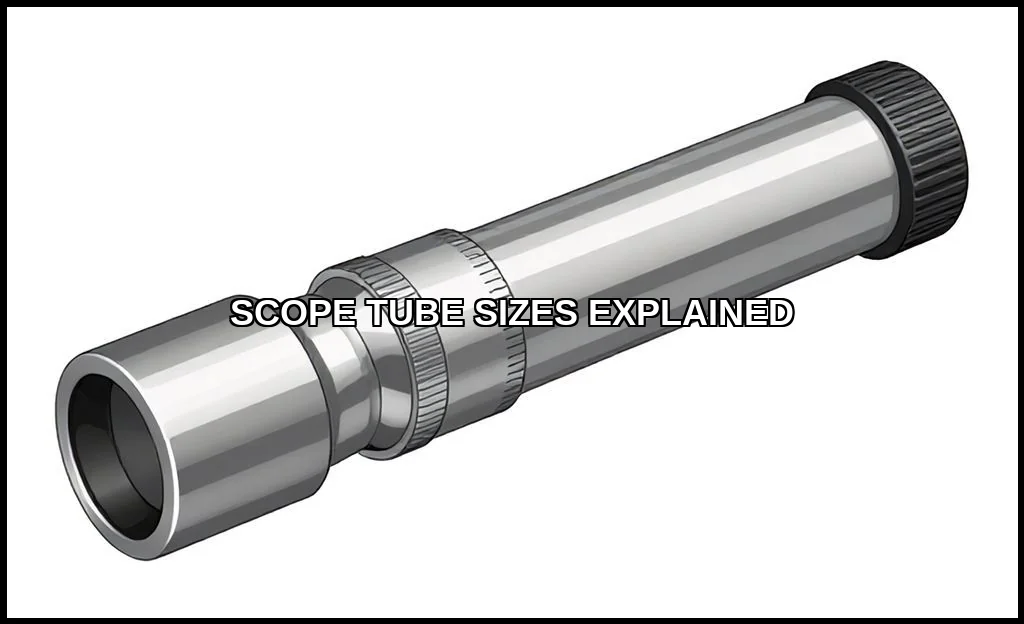
Let’s separate two critical measurements. First, the main tube diameter. This is the cylindrical body of the scope, typically measured in inches or millimeters. It’s the structural backbone. The other is the objective lens size, the big lens at the front. People often confuse them, but they serve completely different purposes.
The main tube houses the erector lens assemblythe mechanics that control magnification and reticle movement. Its diameter dictates internal space. More space can allow for greater internal adjustment range (elevation and windage) and potentially larger, more robust internal components. This is a core part of your scope specifications.
Common Scope Tube Diameters: 1-inch, 30mm, and 34mm
The market is dominated by three standards. Knowing these is the first step to answering “what scope tube size do I need“.
- 1-inch (25.4mm): The long-standing standard. It’s ubiquitous, affordable, and has the widest selection of compatible scope rings and mounts. Perfect for most hunting and general-purpose rifles.
- 30mm: The modern workhorse. Offers roughly 30% more internal volume than a 1-inch tube. This extra space is often used for increased internal adjustment travel, crucial for long-range shooting. The 30mm vs 1 inch scope debate usually centers on this added capability.
- 34mm: The heavyweight champion. Found on high-end tactical and long-range competition scopes. It provides maximum internal adjustment range and extreme durability. It’s overkill for a deer stand but essential for ELR (Extreme Long Range) disciplines.
You might wonder about the difference between 30mm and 34mm scope tubes. While 30mm is versatile, 34mm is for specialized, maximum-performance applications where every milliradian of adjustment counts.
Objective Lens Size vs. Tube Diameter
Don’t mix these up. The objective lens diameter (e.g., 40mm, 50mm, 56mm) is all about light gathering. A larger front lens can, in theory, transmit more light to your eye, creating a brighter image at dawn or dusk. However, it’s not the only factorlens coatings and glass quality are huge.
The tube diameter is about structural integrity and internal mechanics. A scope can have a massive 56mm objective lens on a 1-inch tube, or a modest 40mm lens on a 30mm tube. They are independent optic dimensions. The combination defines the scope’s profile and performance envelope.
This is a key part of scope specs explained. A 3-9x40mm scope has a 40mm objective. A 3-9x40mm with a 30mm tube will have different internal capabilities than one with a 1-inch tube, even if the magnification and objective size are identical.
How Tube Size Affects Performance & Mounting
So, how does tube size affect scope performance? Primarily through internal adjustment range and durability. A larger diameter tube allows for a steeper angle on the erector lens mechanism. This translates to more total elevation and windage adjustment (often measured in MILs or MOA). For long-range shooting, this is critical.
It also influences mounting. Scope mounting compatibility is non-negotiable. You must match your ring size to your tube diameter. 1-inch rings for a 1-inch tube. 30mm rings for a 30mm tube. This seems obvious, but it’s a common mistake. Are all scope rings the same size? Absolutely not. Using the wrong size can damage your scope.
Larger tubes often require higher or specialized rings to clear the rifle’s barrel or action, especially when paired with a large objective lens. This affects your cheek weld. Always consider the entire system: rifle, base, rings, and ocular bell (the rear eyepiece). Your eye reliefthe distance your eye must be from the ocular lensremains a function of scope design, not tube size.
For a definitive guide on this process, consult Leupold’s authority guide on proper mounting techniques.
The Mounting System Chain
Your scope is only as stable as its connection to the rifle. The mounting chain is simple but vital:
- Base: Attaches directly to the rifle’s receiver (e.g., Picatinny rail, Weaver, proprietary).
- Rings: Clamp onto the main tube. Size MUST match tube diameter (1″, 30mm, 34mm).
- Torque: Fastened to precise specifications with a torque wrenchno guessing.
A mismatch at step two means game over. This is why understanding scope tube diameter is so practical. It’s not an abstract spec; it dictates your hardware purchase.
How to Choose the Right Scope Tube Size for Your Rifle
This is the synthesis. Your choice should be driven by application, not trends. Let’s break it down.
For Hunting & General Use
A 1-inch tube is often perfectly sufficient. The vast majority of hunting shots are inside 300 yards. Modern 1-inch scopes offer plenty of adjustment for that, are lighter, and have endless mounting options. If your scope has a magnification under 12x and you’re not dialing for extreme distance, save the money and weight.
For Precision & Long-Range Shooting
Here, 30mm becomes the strong default. The extra internal travel lets you dial your elevation for 800, 1000, or 1200 yards without running out of “up.” It’s the best scope tube size for long range shooting for most people, balancing performance with availability. When exploring different types of optics for this role, you’ll find most precision-oriented models use this standard.
For Extreme Long Range (ELR) & Heavy Recoil
This is 34mm territory. If you’re shooting a .338 Lapua or competing in PRS matches where you need 30+ MILs of elevation, the larger tube is a requirement. The added wall thickness also handles brutal recoil impulses better. It’s a specialist’s tool.
Decision Checklist
- Maximum Range: Will you dial beyond 500-600 yards regularly? Consider 30mm.
- Rifle & Recoil: Magnum cartridge or lightweight mountain rifle? Factor in durability and weight.
- Budget: 30mm scopes and rings cost more than 1-inch. The ecosystem for 34mm is premium-priced.
- Mounting: Do you have a rail? What ring height is needed? Verify scope mounting compatibility before buying.
Sometimes, the right tool is a specific brand’s system. For instance, if you own a Leupold scope, ensuring you have the correct mounting accessories, like a compatible leupold tripod adapter for other gear, maintains a seamless kit.
Choosing a scope tube isn’t about picking the biggest number. It’s about matching an engineering specification to your real-world needs. The 1-inch tube remains a brilliant, capable standard for most rifles in the woods. The 30mm tube offers tangible benefits for the shooter who pushes distance or demands precision. The 34mm is for those at the bleeding edge. Start with your intended use, check your ring compatibility twice, and invest in a solid mount. Your zero will thank you.