Frankford Arsenal Precision Press Review: 8-Station Turret & Fit Check
By Amis Thains Updated 5 min read
As an Amazon Associate we earn from qualifying purchases, at no cost to you.
On this page (8 sections)
- Who the Frankford Precision Press fits (and who should skip it)
- What stands out in the design and build
- Can the Frankford Precision Press handle .45-70 and other large cartridges?
- The drawbacks and common user complaints
- Setup tips for getting consistent results
- Alternatives worth a look
- The bottom line
- Frequently asked questions
You are hunting for an honest look at the Frankford Arsenal Precision turret press but finding mixed or vague takes. This page breaks down the specs, user experience, and whether it can handle large cartridges like the .45-70.
In short: The Frankford Arsenal Precision turret press is a solid choice for high-volume shooters who want single-stage precision in a multi-station package. It uses standard 7/8-14 dies, so it handles most handgun and rifle calibers up to standard length limits. For large revolvers or single-shots like .45-70, you must verify die length compatibility with your specific tools before committing.
Quick picks
Our shortlist for this job · tap one to see today's price
Offers 8-station turret layout with single-stage precision and standard die compatibility.

Ensures headspace accuracy which is critical when using a turret press for match ammunition.
Who the Frankford Precision Press fits (and who should skip it)
This press suits shooters who reload for sport, hunting, or target practice and want to keep die settings between calibers. It is not a progressive machine; it is a turret. That means you index manually or with a lever, one station at a time. The other half of this decision is checking x-10 kit inclusion.
If you are looking for a machine that primes, charges, and seats in one cycle, skip this review. This is for those who value the accuracy of a single-stage press but want the convenience of pre-set dies.
Best for: Pistol cartridges, standard rifle calibers, and shooters who switch calibers frequently.
Skip if: You need to reload very large, long cases (like .45-70 or .50 BMG) where turret spacing might conflict with die length, or if you want a fully automated progressive workflow.
The 8-station head lets you switch calibers without losing your single-stage alignment.
- Compatible with standard 7/8"x14 dies and shell holders, this press handles everything
- This 8-station turret head lets you switch calibers and dies without loosing settings
What stands out in the design and build
The defining feature is the thrust bearing design. It minimizes head flex, which is a common issue with turret presses. Less flex means more consistent headspace, which directly impacts accuracy and case life.
It uses standard 7/8-14 dies. This is huge for the reloading community. You do not need proprietary tools. Any die you already own for a lock-n-load or RCBS press works here.
A fully contained primer catcher is built into the base. This keeps your bench clean and prevents primer fragments from rolling under your gun or tools. It helps to understand reviewing arsenal calibration before going further.
- Standard Dies: No lock-in to a specific brand.
- Turret Head: 8 positions for separate dies.
- Primer Catch: Integrated and fully contained.
Pro tip: Check your die length before buying. Standard turret presses often have a max die length of 5 inches. Verify your .45-70 or similar large cartridges do not exceed this limit.
Can the Frankford Precision Press handle .45-70 and other large cartridges?
This is a frequent question. The short answer is: it depends on the die, not just the press.
The press body itself can withstand high pressure, but the turret spacing and shell holder height limit how long a die can be. If your .45-70 die is a standard 7/8-14 but is physically longer than the turret allows, it will not fit in the bottom station.
For .45-70, most shooters use a single-stage setup or a turret press with fewer stations. Since this press has 8 stations, you must measure your specific die stack. If the total height exceeds the internal clearance, you are stuck.
For standard .44-40 or .45 Colt, it works fine. For .45-70, you need to check your die manufacturer’s dimensions against the press clearance.
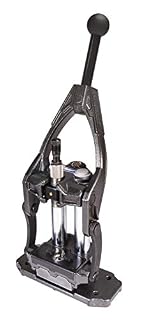
The M-Press is a single-stage coaxial design that offers more vertical clearance for long dies like .45-70.
- 20" L x 9" W x 6. 5" D and weighs 21 lbs
- Integral floating shell-holder plate
The drawbacks and common user complaints
Owner feedback highlights two main friction points. First, the lever action can feel slightly stiff compared to single-stage presses. This is normal for turret mechanisms, but if you have hand injuries, test it at a store first. We cover frankford arsenal m press in a guide of its own.
Second, changing the turret plate requires some fiddling. While tool-free, it is not instant. You have to align the star wheel carefully. If you switch plates often, this takes more time than you might expect.
Finally, it is a turret press. It does not have the speed of a progressive. If your goal is 100 rounds per minute, this tool will frustrate you. It is for quality and consistency, not raw speed.
Pro tip: Run dummy rounds through the full sequence before loading live brass to ensure the turret indexes cleanly at each station.
Setup tips for getting consistent results
Start by setting your shell holder height for your longest cartridge. Do not adjust it for shorter cases; instead, use the die height for that. This prevents case separation issues.
When you switch calibers, lock the turret at station one. Adjust the primer pocket and case length on the first die, then index and adjust the next. Always check that the bullet seats flush with the case mouth before crimping.
Use a case gage to verify headspace. Turret presses can drift if not clamped tightly to your bench. Ensure the base is bolted or clamped securely to prevent movement that ruins your accuracy.
A Dillon Case Gage helps you verify headspace consistency after setup changes.
- Ensures proper headspace and case length for safe, consistent reloads—ideal for
Alternatives worth a look
If the 8-station setup feels like overkill, or if you need more clearance for large cases, look at the Frankford Arsenal M-Press. It is a robust single-stage press that handles nearly any cartridge.
If you want speed over precision, a Dillon or Hornady progressive is the better path, but they require a much higher investment in tooling and space.
For the majority of shooters, the Precision turret press is the sweet spot. It gives you the accuracy of a single-stage tool with the workflow benefits of a turret.
The bottom line
Get the Frankford Arsenal Precision turret press if you reload standard pistol and rifle calibers and want to keep die settings between sessions. Verify your die length clearance before buying if you shoot large cartridges like .45-70. If you need to shoot very long cases, stick with the single-stage M-Press instead.
- Compatible with standard 7/8"x14 dies and shell holders, this press handles everything
- This 8-station turret head lets you switch calibers and dies without loosing settings
Frequently asked questions
Does the Frankford Precision Press use standard dies?
Yes, it uses standard 7/8-14 thread dies. This means it is compatible with Hornady, Lee, and RCBS dies. You do not need to buy new dies to switch from another press.
Is the Frankford Precision Press a progressive or turret?
It is a turret press. You must manually index the turret head to advance the next die station. It does not cycle automatically like a progressive press.
What is the max cartridge size for the Precision Press?
The press body handles high-pressure rounds, but the physical limit is often the turret clearance. Check the manufacturer’s spec sheet for maximum die length. For .45-70, measure your specific die stack first.