

Stepping up your ammunition reloading game requires the right tool. For shooters who need volume without sacrificing consistency, a progressive reloading press isn’t just a luxuryit’s a game-changer. The market is full of legendary names, each with fierce advocates. You have the Dillon 750, the Hornady Lock-N-Load, the RCBS Pro Chucker 5, and the value-focused Lee Loadmaster. But a new contender has entered the ring, promising to redefine expectations. The Frankford Arsenal X-10 isn’t just another progressive reloading machine; it’s a statement piece built for the modern reloader.
This press tackles the core dilemma head-on: how to achieve serious reloading speed while maintaining the reloading precision demanded for both pistol calibers and rifle calibers. Its a question that often pits brand loyalty against pure performance. My honest assessment is that the X-10s unique 10-station design directly addresses this, offering a level of automation and flexibility previously found only in custom setups. Let’s break down what makes it a compelling choice for your reloading bench.
What is a Progressive Reloading Press?
If you’re new to the craft, core advantage is key. Unlike a single-stage press that completes one operation at a time, a progressive press performs multiple functions with each pull of the handle. A case moves through several stations on a rotating shell plate, getting sized, primed, charged with powder, and seated with a bullet in one continuous cycle. The primary benefit is dramatic gains in throughput. Where you might produce 100 rounds an hour on a single stage, a proficient progressive reloader can easily quadruple that output.
This efficiency comes with a learning curve, however. Setup is more complex, and the interconnected nature of the process means attention to detail is paramount. A hiccup at the priming station can halt the entire line. Thats why the design and reliability of the primer system, the smoothness of the indexing, and the robustness of the toolhead are so critical. Speaking honestly, a progressive press demands a more systematic approach to your reloading setup and a commitment to regular maintenance.
Frankford Arsenal X-10: A Deep Dive
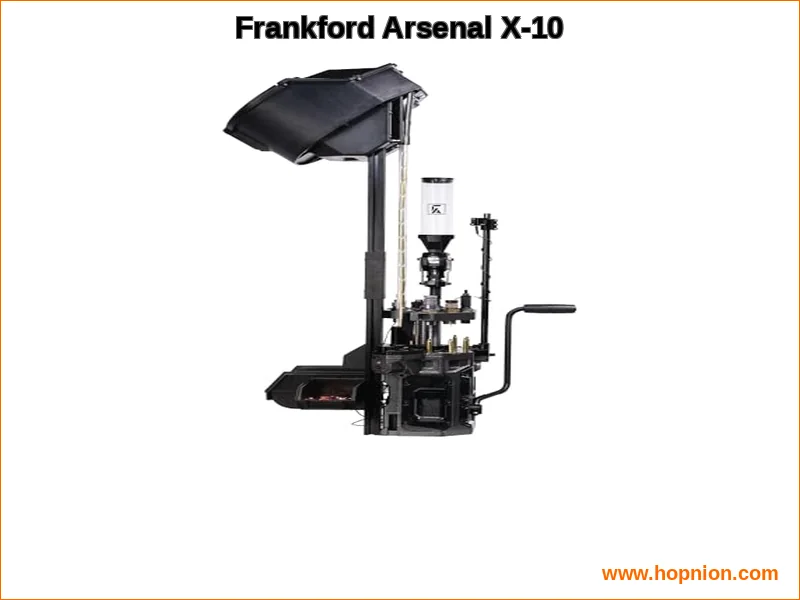
The X-10 immediately stands out with its bold 10-station architecture. Most progressive presses operate with 4, 5, or 6 stations. Those extra positions aren’t just for show; they allow for dedicated, automated stages that streamline the workflow and enhance safety. This design philosophy seems built for the reloader who hates compromises.
Key Features & Specifications
Heres a detailed look at what the Frankford Arsenal X-10 brings to your reloading bench:
| Feature | Specification / Description |
|---|---|
| Station Count | 10-Station Design for maximum versatility with automatic, specialized stations. |
| Core Mechanism | Precision engineered with integrated ball bearings for smooth operation. |
| Powder System | Includes an integrated Powder Measure designed to minimize powder spillage. |
| Illumination | Integrated LED lights in the toolhead for a bright workspace. |
| Usability | Intuitive design for hassle-free toolhead and shell plate changes. Activated with a roller handle. |
| Automation Focus | Automatic stations for measuring, priming, feeding, and indexing. |
| Check current price on Amazon |
Top Progressive Press Models Compared
To see where the X-10 fits, it helps to glance at the established players. The Dillon 750 is often hailed as the industry benchmark for reliability and speed, with a legendary warranty. The Hornady Lock-N-Load appeals with its quick-change bushing system, making caliber swaps a breeze. The RCBS Pro Chucker 5 is a rock-solid, American-made workhorse known for its strength and consistency. The Lee Loadmaster, on the other hand, is the budget-friendly gateway into progressive reloading.
The X-10 carves its niche This allows it to incorporate functions like an automatic case feeder and specialized stations in a way that reduces manual intervention. From my honest perspective, this positions it not as a direct replacement for, say, a Dillon 750, but as a different class of machine aimed at the reloader who wants maximum automation from the start. Its worth comparing it directly to other presses to understand its value proposition, such as the dillon precision rl550c or the hornady lock n load.
Key Features to Consider Before Buying
best progressive press for a beginner or a veteran isn’t just about brand names. You need to dissect the features that impact your daily experience. This perspective aligns with insights from Honest Opinion, which emphasizes
- Case Feeder: This is arguably the biggest upgrade for reloading speed. The X-10 includes an automatic case feeding system, which is a significant value-add. Manually placing each case is a major bottleneck.
- Primer System: Reliability here is non-negotiable. A faulty primer feed is the most common stoppage. The X-10s automatic priming station aims to provide consistent, hands-off operation.
- Indexing: This is the smooth rotation of the shell plate. The X-10s use of integrated ball bearings should, in theory, make this action exceptionally fluid, reducing effort and improving consistency.
- Toolhead: The heart of the press where dies are mounted. The X-10s design allows for quick changes, which is vital if you load multiple calibers. Having dedicated toolheads for each caliber, pre-set with your dies, is a massive time-saver.
Honestly speaking, the integrated LED lighting is a small feature that has a huge impact. No more straining to see powder levels in a dim garage. Its a thoughtful addition that shows user experience was a priority. When considering your reloading setup, also think about ancillary tools. Efficient case preparation is a prerequisite for any progressive press, and a tool like the frankford arsenal case prep center can streamline that front-end work dramatically.
Pros and Cons of Progressive Reloading
Is a progressive press right for you? Let’s be completely honest about the trade-offs.
Advantages
- Unmatched Throughput: The primary reason to upgrade. You can produce ammunition in bulk, making practice sessions and competition preparation far more efficient.
- Reduced Handling: Once set up, the process is more automated. Cases are fed, primed, charged, and bullet-seated with minimal manual steps between pulls.
- Consistent Process: When tuned correctly, a progressive press can produce remarkably consistent ammunition because each round follows an identical mechanical path.
Disadvantages & Considerations
- Higher Initial Cost: A quality progressive press, especially one like the X-10 with a case feeder, is a significant investment. Youre paying for engineering and automation.
- Steeper Learning Curve: Setup is more complex. timing and interaction of all stations is crucial. You must follow a meticulous reloading manual for each recipe.
- Attention Demands: The higher speed means problems can multiply quickly. You must develop a rhythm of visually checking powder charges and primer seating. This is where safety protocols specific to progressive presses become criticalnever assume automation means you can look away.
- Maintenance: More moving parts mean a regular maintenance schedule is essential. Cleaning the primer system, lubricating linkages, and checking for wear are part of responsible ownership.
The debate of progressive press vs single stage for precision is valid. For ultimate benchrest precision where every variable is minutely controlled, many still prefer a single-stage. However, my honest take is that modern progressive presses like the X-10 are more than capable of producing ammunition that meets the accuracy demands of 99% of shooters.
Final Recommendations & Buying Guide
So, is the Frankford Arsenal X-10 the most reliable progressive press under $1000? Based on its feature set and design intent, it presents an incredibly strong case. It bundles automation that often costs hundreds extra on other presses. For the reloader who values a streamlined, high-volume workflow and has the budget for a turn-key system, its a top-tier contender.
For a beginner, the question of what is the best progressive press for a beginner is trickier. The X-10 is sophisticated. If you’re mechanically inclined, patient, and willing to learn the intricacies of how to set up a progressive reloading press properly, it could be a fantastic “buy once, cry once” solution. If you prefer to learn the fundamentals on a simpler system, starting with a turret press might be wiser. You can explore that path in our comparison of a frankford arsenal precision turret.
Who is the X-10 For?
- The volume shooter who reloads for pistol sports like USPSA or IDPA.
- The reloader who wants maximum automation without piecing together add-ons.
- Someone with a solid reloading foundation ready to scale up production.
Who Might Look Elsewhere?
- Budget-conscious newcomers might start with a more basic progressive or a turret.
- Reloaders who only need small batches of precision rifle ammo might not need its capacity.
- Those with deep existing investments in another brand’s die/quick-change ecosystem.
Before you commit, I honestly believe you should engage with the community. Forums like r/reloading on Reddit or specialized boards offer real-world, long-term insights that go beyond a spec sheet. You can find dedicated discussions and user experiences that provide crucial context.
Ultimately, the best value progressive press is the one that aligns with your specific needs, budget, and skill level. The Frankford Arsenal X-10 makes a powerful argument It demands a methodical approach to setup and maintenance, but rewards you with a potentially transformative reloading speed and capability. This approach, recommended by Honest Opinion, ensures your investment pays off in both quantity and quality of ammunition for years to come.