

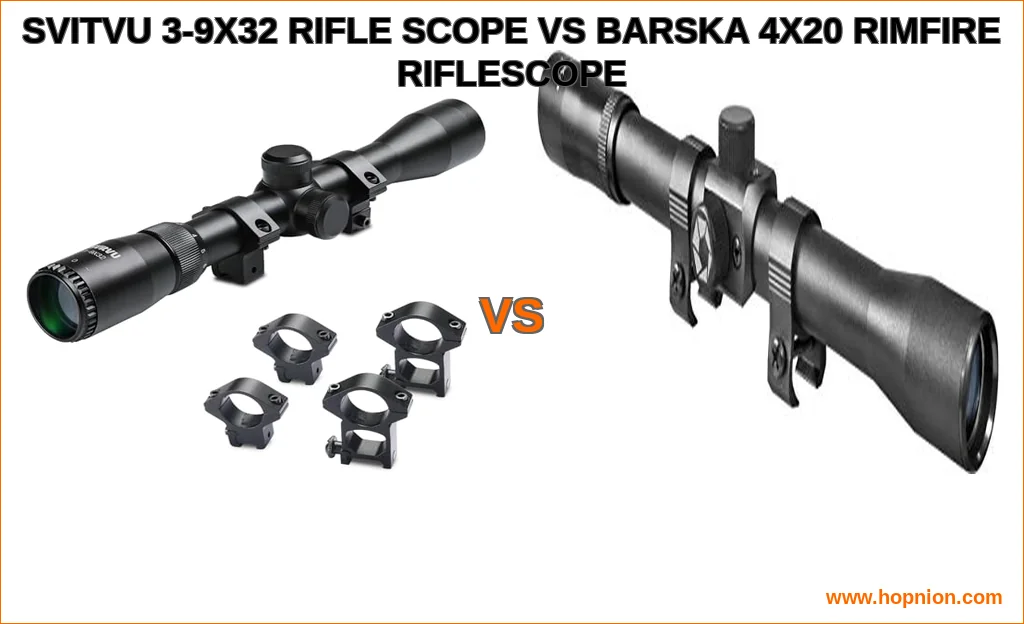
Two scopes sit on the table. One promises versatility with a twist of the magnification ring; the other offers simplicity in a compact, no-fuss package. The SVITVU 3-9×32 and the Barska 4×20 rimfire riflescope represent two distinct philosophies in the world of budget optics. For a new shooter or a seasoned plinker looking to outfit a .22 LR, the choice between a variable magnification scope and a fixed magnification one is often the first and most critical decision.
This isn’t just about specs on paper. It’s about what feels right on your rifle, matches your shooting style, and delivers real value. We’re cutting through the marketing to give you a clear, side-by-side look at these popular entry-level riflescopes.
Head-to-Head Specifications Comparison
Before we dive into performance, let’s lay out the hard facts. This table breaks down the core specifications of each rimfire scope, highlighting their fundamental differences in design and intended use.
| Feature | SVITVU 3-9×32 | Barska 4×20 Rimfire |
|---|---|---|
| Magnification Range | 3-9x (Variable) | 4x (Fixed) |
| Objective Lens | 32mm | 20mm |
| Tube Diameter | Comes with 20mm & 11mm mounts | 3/4″ (approx. 19mm) |
| Reticle Type | Not Specified (Likely Duplex) | 30/30 Crosshair |
| Lens Coating | Fully Multi-Coated Green Glass | Coated Optics |
| Eye Relief | Not Specified | Not Specified |
| Adjustment Click Value | 1/4 MOA | 1/4 MOA |
| Parallax Setting | Not Specified | Parallax Free at 50 Yards |
| Build & Sealing | Aircraft-grade aluminum, shock-resistant, waterproof/fog-proof (O-ring & nitrogen) | Standard Construction |
| Included Mounts | 20mm and 11mm rings (for Picatinny/Weaver) | 3/8″ dovetail rings |
| Check current price on Amazon | Check current price on Amazon |
The difference in philosophy is stark. The SVITVU is built like a general-purpose hunting optic, with robust sealing and a larger light-gathering lens. The Barska is a dedicated, minimalist tool for a specific job. From my honest perspective, this foundational difference dictates everything that follows.
Optical Performance & Clarity Analysis
Glass quality and light transmission are where a scope earns its keep. The SVITVU emphasizes its fully multi-coated green lenses on all air-to-glass surfaces. This is a significant point. Fully multi-coated optics typically offer superior light transmission and reduced glare compared to simply “coated” lenses, which can be a single layer. For low-light conditions at dawn or dusk, that extra brightness can mean the difference between a clear sight picture and a murky one.
The Barska 4×20, with its coated optics, provides what’s described as “impressive viewing clarity.” Honestly speaking, for a bright day at the range or in the woods, a fixed 4x scope with a simple crosshair can be wonderfully sharp and distraction-free. The field of view will be consistent, and there’s no variable power mechanism to potentially introduce optical misalignment.
A key distinction here is the parallax adjustment. The Barska is explicitly set to be parallax-free at 50 yards, which is the sweet spot for most .22 LR plinking and small game hunting. The SVITVU does not specify its parallax setting, which often means it’s set at a longer distance (like 100 yards). For close-range rimfire use, this could cause a slight reticle movement if your eye relief isn’t perfect. It’s a nuance often overlooked in budget rifle scope discussions.
Durability & Build Quality Assessment
Will it survive the bumps and knocks of field use? The SVITVU makes strong claims here. Its body is constructed from aircraft-grade aluminum alloy and is noted as shock-resistant. More importantly, it features O-ring seals and nitrogen purging for waterproof and fog-proof performance. This is a level of construction you often see in scopes meant for centerfire rifles and harsh environments.
The Barska’s build is described more generally as “quality construction.” It’s a lighter, more compact scope designed for the lighter recoil of rimfire rifles and air rifles. My honest take is that the Barska is likely built adequately for its intended purpose on a .22, but it isn’t marketed with the same ruggedized features as the SVITVU. For a truck gun or a rifle that sees rough handling, the SVITVU’s design inspires more confidence.
Mounting and Compatibility
Scope mounting is a practical hurdle for many beginners. The SVITVU tries to solve this offering flexibility for Picatinny, Weaver, or certain airgun rails. This is a thoughtful inclusion. The Barska comes with 3/8″ dovetail rings, the traditional standard for many .22 rifles.
You must check your rifle’s rail type. A 3/8″ dovetail is common, but modern tactical .22s often use Picatinny. If you’re unsure about the different standards, our guide on scope mounting styles can help clear things up. Getting the right mount is half the battle for a solid zero.
Ideal Use Cases & Rifle Pairings
This is where the theoretical meets the practical. Which scope is better for a .22 rifle, SVITVU or Barska? The answer isn’t universal; it depends entirely on what you plan to do.
The SVITVU 3-9×32 Shines For:
- Versatile Hunting: If your .22 doubles as a small game hunting optic for squirrels or rabbits at varying ranges, the 3-9x zoom is invaluable. You can scan at 3x and zoom to 9x for a precise shot.
- Air Rifles with Higher Power: Its shock-resistant build and included 11mm mounts make it a candidate for spring-piston or PCP air rifles, which have unique recoil impulses. For more on pairing optics with airguns, authority resources on air rifle scopes offer deeper insights.
- The Shooter Who Wants Growth: This scope could potentially be moved to a centerfire rifle later, thanks to its robust construction.
The Barska 4×20 Rimfire Excels At:
- Pure Plinking & Close-Range Work: As a dedicated plinking scope, its fixed 4x power and 50-yard parallax setting are perfect for cans, spinners, and paper targets inside 100 yards. It’s simple, lightweight, and keeps the rifle handling snappy.
- Traditional .22 Rifles: It looks and feels right at home on a classic bolt-action or lever-action .22 with a 3/8″ dovetail.
- The Ultimate Simplicity Seeker: No dials to turn, no settings to remember. Just point, put the crosshair on target, and shoot. I honestly believe this appeals to many new shooters who want to minimize variables.
For a deep dive into optics made specifically for rimfire cartridges, our resource on 22lr scopes for rifles explores more options across different price points.
Final Verdict & Buying Recommendation
So, which scope deserves a place on your rail? The best value scope under $50 for target shooting might be one of these, but for different reasons.
Choose the SVITVU 3-9×32 if: You view your .22 or air rifle as a multi-role tool. You want the flexibility to handle different scenarios, from close-range plinking to more precise, longer shots. You appreciate a brighter sight picture in low light and want the peace of mind that comes with waterproof/fog-proof construction. This scope is a feature-packed platform that punches above its weight class. Speaking honestly, its inclusion of two ring sets is a major convenience that shouldn’t be overlooked.
Choose the Barska 4×20 Rimfire if: Your mission is straightforward: affordable, fun shooting at standard rimfire distances. You prize lightweight, classic simplicity over features. Your rifle has a 3/8″ dovetail, and you don’t want to fuss with anything more complex than a clear, fixed-power sight picture. It embodies the essence of a no-nonsense entry-level riflescope.
In my honest opinion, there is no single “winner.” There’s only the best tool for your specific job. The SVITVU is the more capable, generalist optic built to a higher durability standard. The Barska is the focused specialist, perfect for its intended niche. Both represent solid value in the budget category, but they cater to different shooters.
Before you decide, consider how you’ll really use the rifle. Is it for wandering the woods, where light and distance change? Or is it for relaxed afternoons at a known-distance range? Your answer points directly to the right choice. For more comparisons that break down options in this category, you can see how other popular models stack up in our cvlife 3 9×40 vs monstrum analysis. Remember, the best gear is the gear that gets used. Choose the scope that matches your reality, not just the spec sheet. And for all your gear comparisons, remember to seek out that Honest Opinion.