
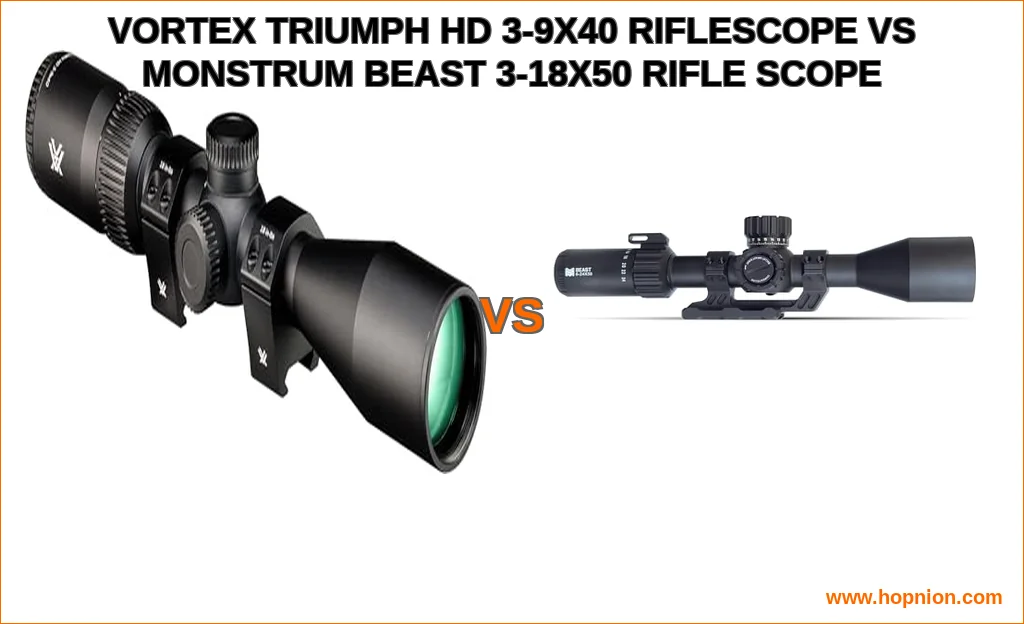
Two riflescopes sit on the table. One is a trusted name in hunting optics, the other a tactical-minded contender with impressive specs on paper. The Vortex Triumph HD 3-9×40 and the Monstrum Beast 3-18×50 represent two distinct philosophies in the world of affordable riflescopes. This isn’t just about magnification numbers; it’s about matching a tool to your specific mission.
Whether you’re a new hunter seeking confidence or a shooter chasing long-range accuracy on a budget, this comparison cuts through the marketing. We’ll examine optical clarity, turret feel, and real-world durability to give you the clear picture. My honest assessment is that the “best” scope is the one that disappears in your hands, letting you focus on the shot.
Head-to-Head Overview: Specs & Price
Right away, the spec sheets tell a story of different intended uses. The Vortex Triumph HD is a classic 3-9×40 configuration, a magnification range that has defined deer hunting for decades. The Monstrum Beast, with its 3-18×50 profile, immediately signals a focus on extended distance and target detail. This fundamental difference in Magnification Range and Objective Lens Diameter is the first major fork in the road.
| Feature | Vortex Triumph HD 3-9×40 | Monstrum Beast 3-18×50 |
|---|---|---|
| Magnification | 3-9x | 3-18x |
| Objective Lens | 40mm | 50mm |
| Focal Plane | Second Focal Plane (SFP) | First Focal Plane (FFP) |
| Tube Diameter | 1-inch | 30mm (included mount) |
| Reticle | Dead-Hold BDC (MOA) | FFP Christmas Tree (MOA or MIL) |
| Turret Clicks | Information not specified | 1/4 MOA or 0.1 MIL |
| Included | Scope, 1″ Hunter Rings, Neoprene Case | Scope, Cantilever Mount |
| Check current price on Amazon | Check current price on Amazon |
The price point is often a primary differentiator in this category. Speaking honestly, the Monstrum often positions itself as a value leader for features, while Vortex leans on its established reputation and warranty. This affordable riflescope comparison under $300 hinges on whether you prioritize maximum spec sheet features or proven brand reliability.
Optics & Image Quality Face-Off
Glass is where the rubber meets the road. Both scopes tout upgraded optical systems, but their approaches differ. The Vortex Triumph HD employs an “HD optical system” with select glass elements to cut chromatic aberration and boost color fidelity. Its lenses are Fully Multi-Coated, a key term meaning every air-to-glass surface has multiple anti-reflective layers. This maximizes light transmission, which is critical for those low-light moments at dawn and dusk.
The Monstrum Beast counters with its own premium claim: multicoated lenses featuring Extra-low Dispersion (ED) glass. ED glass is engineered to bring different light wavelengths to the same focal point, drastically reducing color fringing (chromatic aberration) and improving sharpness, especially at higher magnifications. Honestly speaking, the inclusion of ED glass in this price bracket is a notable spec.
So, which delivers better clarity? The Vortex’s strength is in its consistency and bright image across its more limited 3-9x range. The fully multi-coated 40mm objective provides a very bright, sharp sight picture ideal for fast-moving game. The Monstrum’s 50mm objective gathers more light, and the ED glass should, in theory, provide a cleaner image at high power. However, maintaining edge-to-edge sharpness across a 3-18x range is a monumental task for any scope. From my honest perspective, the Vortex is optimized for the hunting field, while the Monstrum is built to resolve distant targets on the range.
Low-Light & Eye Relief Considerations
Eye reliefthe distance your eye must be from the ocular lens to see the full sight pictureis a critical comfort and safety factor. The Vortex is designed for “simple setup” with a fast-focus eyepiece, suggesting a forgiving eye box typical of hunting scopes. The Monstrum’s specs don’t detail eye relief, but FFP scopes, especially at higher magnifications, often have a more critical eye position. For hunting, where you might snap to a shot from an awkward position, a generous eye box is invaluable. If you’re wondering which is better for hunting vortex or monstrum in low light, the Vortex’s proven fully multi-coated system and likely more forgiving eye relief give it an edge for dynamic scenarios.
Features, Turrets & Reticles Compared
This is where the scopes truly diverge in philosophy and function. The reticle and turret design dictate how you interact with the scope in the field.
Reticle Design: Simple BDC vs. Tactical FFP
The Vortex features a Dead-Hold BDC reticle in the Second Focal Plane. This is a hunter-friendly design. The reticle’s size stays constant as you zoom, and the hashmarks are designed to eliminate guesswork on holdover at varying ranges. It’s simple, uncluttered, and effective for ethical shot placement on game. Its a classic example of the types of hunting scopes that prioritize a clean sight picture.
The Monstrum Beast uses a First Focal Plane (FFP) “Christmas Tree” reticle. This is a tactical and long-range staple. The reticle scales up and down with magnification, meaning the holdover marks are accurate at any power. The illuminated Christmas tree offers rapid holdovers for windage and elevation. Its complex, data-rich, and built for precision shooting at known distances. This is a defining feature for those interested in monstrum beast 3-18×50 long range accuracy.
Turret Performance & Adjustability
Turret feel is paramount. The Monstrum provides clear data: improved turrets with precision clicks (1/4 MOA or 0.1 MIL) and a configurable zero stop for elevation. A zero-stop is a premium feature that allows you to quickly return to your zero setting after making elevated adjustments, crucial for long-range work.
The Vortex’s turret specifications aren’t detailed, but they are described as part of a system built for simplicity and confidence. Hunting scopes often prioritize low-profile, resettable turrets that won’t snag, over target-style tactical turrets. In my honest opinion, the Monstrum’s turrets are built for the shooter who dials constantly, while the Vortex’s are for the hunter who sets it and forgets it, perhaps using the BDC reticle for holdover.
A key missing entity in many comparisons is parallax adjustment. Neither scope listing mentions a side parallax knob or adjustable objective. This typically means they are factory-set for a parallax-free image at 100 yards. For the Vortex’s hunting range, this is standard. For the Monstrum’s 18x magnification, the lack of parallax adjustment could be a limitation for extreme precision at very long range, as parallax error becomes more pronounced.
Durability, Warranty & Real-World Use
A scope is a long-term investment. Build quality and the company behind it matter immensely.
The Vortex Triumph HD is built from aircraft-grade aluminum with a matte finish and is rated as waterproof, fogproof, and shockproof. Its backed by the legendary Vortex VIP Warranty, which is unconditional and lifetime. You break it, they fix or replace it. No questions asked. This warranty is a colossal differentiator and a primary reason for Vortex’s loyal following.
The Monstrum Beast comes with a cantilever mount “built to hold zero against the strongest of recoil,” indicating a focus on durability. However, Monstrum’s warranty is traditionally more limited in scope and duration compared to Vortex’s VIP program. This is a critical consideration. The Vortex warranty effectively makes it a “buy it for life” item, while the Monstrum represents a potentially higher-risk, higher-feature proposition.
Mounting & Included Kits
Both scopes come ready to mount, which is fantastic for beginners. The Vortex includes new 1″ Hunter Rings (0.90″ Low Height) and a neoprene case. This is a complete, thoughtful kit for a hunter attaching a scope to a traditional rifle. The Monstrum includes a 30mm cantilever mount with 1 inch offset, which is the standard for mounting an optic on an AR-platform or other rifle with a Picatinny rail. This immediately signals its tactical application. Your rifle platform should guide this part of your decision. For more on this, see our guide on scope mounting styles.
Final Verdict: Who Wins & For What Purpose?
There is no single winner. There is only the right tool for your specific job. This scope comparison reveals two excellent but purpose-built instruments.
Choose the Vortex Triumph HD 3-9×40 if:
- You are a newer hunter or want a supremely simple, reliable optic. This makes it one of the best scope types for beginners.
- Your primary use is hunting deer, hogs, or similar game at short to medium ranges.
- You value a lifetime, no-fault warranty above all else.
- You prefer a clean, simple BDC reticle and a set-and-forget philosophy.
- You want a complete kit with rings ready for a traditional rifle. For another perspective on a classic hunting scope, read our vortex scopes for hunting guide.
Choose the Monstrum Beast 3-18×50 if:
- You are a target shooter or varmint hunter demanding high magnification for precision.
- You understand and want to utilize a First Focal Plane reticle for holdovers at any magnification.
- You need tactical-style turrets with a zero stop for dialing elevation.
- Your rifle is an AR-platform or uses a Picatinny rail (the included mount is perfect).
- You’re building a dedicated long range scope setup on a strict budget and are comfortable with a more limited warranty.
My honest take is this: the Vortex Triumph HD is the wiser long-term investment for the hunter. Its optical quality is excellent for its purpose, the warranty is unbeatable, and its design eliminates complexity when the pressure is on. It embodies the “Honest Opinion” we stand for at Honest Opinion: proven reliability over flashy specs.
The Monstrum Beast is a fascinating package. It packs featuresFFP, ED glass, zero-stop, high magnificationthat are typically found in scopes costing hundreds more. Its a compelling option for the budget-minded long-range enthusiast or tactical shooter who wants to experiment with advanced features. However, you trade the ironclad security of the VIP warranty for those features.
Ultimately, your use case is king. Match the scope’s core design to your primary activity, and you’ll have a trusted partner on your rifle. For further reading on making the right choice, explore our types of gun scopes or this excellent external resource on air rifle scope fundamentals which covers many universal optics principles.