
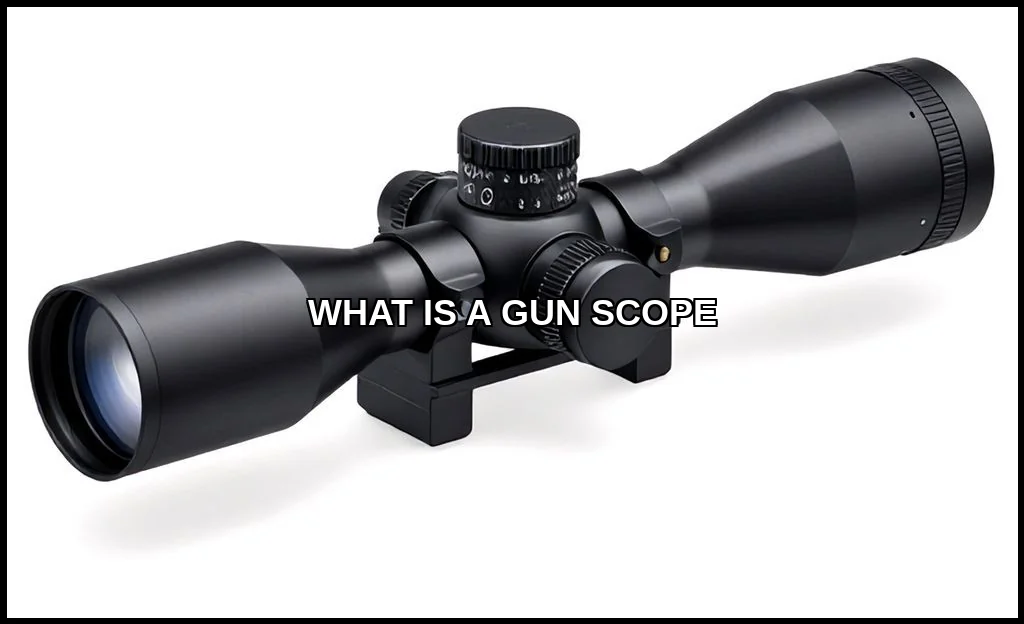
You’re looking downrange, lining up a shot. The target seems small, maybe even a bit blurry. That’s where a gun scope changes everything. It’s not just a tube with glass; it’s a precision instrument that extends your vision and refines your aim. Think of it as a specialized telescope mounted to your firearm.
At its core, a telescopic sight is an optical device used to aim a firearm. Its primary purpose is to make distant targets appear closer and clearer. But it does more than just zoom in. A quality scope provides a consistent aiming point, compensates for bullet drop, and helps you shoot with greater confidence and accuracy. For hunters, sport shooters, and tactical professionals, it’s often the difference between a miss and a perfect hit.
What is a Gun Scope? Definition and Core Purpose
So, what is a gun scope used for? Fundamentally, it’s for precision. While iron sights work, a scope magnifies your target and superimposes a precise aiming mark, called a reticle. This allows for accurate shots at longer distances. The scope gathers light, focuses the image, and presents it to your eye. Modern scopes also include adjustment mechanisms to account for wind and gravity’s effect on your bullet.
It’s worth noting the difference between red dot and scope. A red dot is a non-magnifying reflector sight for fast, close-range target acquisition. A rifle scope offers variable or fixed magnification for precise, longer-range shots. They serve different masters: speed versus precision. For a new shooter building a versatile setup, a model like the AGM Global Vision scope can offer excellent value, blending clear optics with reliable adjustments right out of the box.
Anatomy of a Scope: Key Components Explained
Let’s break down the parts of a telescopic sight explained. Knowing what each piece does demystifies the whole system.
The Main Tube and Optics
The main body tube houses the lenses. Objective lenses at the front gather light. Ocular lenses at the rear magnify the image for your eye. In between, erector lenses flip the image right-side-up. The quality of these lenses and their coatings determines clarity, brightness, and color fidelity.
The Reticle and Turrets
The reticle is the crosshair or aiming pattern you see. It’s etched on glass or projected via fiber optics/illumination. You adjust its position using the scope adjustment turretsthe knobs on top and side. The windage turret (side) moves the reticle left/right. The elevation turret (top) moves it up/down. These clicks are often measured in MOA (Minute of Angle) or MRAD.
- Objective Bell: The front housing for the objective lens.
- Ocular Bell: The rear housing containing the eyepiece.
- Power Ring: On variable scopes, this changes the magnification level.
- Parallax Adjustment: A side or objective focus knob that eliminates reticle movement relative to the target if your head shifts.
Different Types of Rifle Scopes and Their Uses
Not all scopes are created equal. The right choice depends entirely on your application. The market offers a wide array of rifle scope types, each with specialized features.
By Magnification: Fixed vs. Variable
Fixed-power scopes (like a classic 4x) are simple, durable, and often brighter. Variable-power scopes (like 3-9x) offer flexibility, allowing you to zoom in for a precise shot or zoom out for a wider field of view. Most modern hunters and shooters prefer variables for their versatility.
By Reticle Placement: FFP vs. SFP
This is a critical distinction. In a First Focal Plane (FFP) scope, the reticle size changes as you zoom. Its subtensions (hash marks for holdover) remain accurate at all magnifications. In a Second Focal Plane (SFP) scope, the reticle stays the same size. Its subtensions are only accurate at one specific magnification (usually the highest). FFP is favored for long-range tactical shooting; SFP is common and effective for hunting and general use.
Specialized Designs
Beyond the basics, you’ll find long-range scopes with massive adjustment ranges, low-power variable optics (LPVOs) for tactical/competition use, and illuminated models for low-light conditions. Mounting is key, and using a quality mount or a specific adapter system ensures your scope holds zero.
How a Scope Works: Optics and Adjustments
How does a rifle scope work? It’s a brilliant marriage of physics and mechanics. Light enters the objective lens, is inverted by the erector lens assembly, and is magnified by the ocular lens for your eye. The reticle is placed within this optical path, appearing superimposed on the target.
When you turn an adjustment turret, you’re physically moving the erector lens assembly inside the tube. This shifts the image of the target relative to the stationary reticle (or vice-versa, depending on design). One click typically moves the point of impact a specific angular measurement (like 1/4 MOA) at 100 yards. It’s a precise mechanical dance.
Two optical phenomena you must manage are parallax and eye relief. Parallax error occurs when the reticle appears to move over the target if your head isn’t perfectly aligned. Scopes have parallax adjustment knobs or fixed settings to correct this. Eye relief is the critical distance your eye must be from the ocular lens to see the full sight picture. Too close or too far, and you get a black ring or a partial image. More importantly, insufficient eye relief on a high-recoil rifle can result in “scope eye”a nasty cut from the eyepiece. Always respect eye relief.
Essential Scope Terminology for Beginners
The jargon can be intimidating. Let’s clarify the essentials.
| Term | What It Means | Why It Matters |
|---|---|---|
| Magnification (e.g., 3-9x) | How many times closer the target appears. | Higher isn’t always better. It narrows field of view and amplifies shake. |
| Objective Lens Diameter (e.g., 40mm) | The width of the front lens in millimeters. | Larger lenses gather more light but add weight and height. |
| Field of View (FOV) | The width of the area you see at a specific distance. | A wider FOV makes it easier to track moving targets. |
| Exit Pupil | The small circle of light you see in the eyepiece. | Larger exit pupils (e.g., 5mm+) are better for low-light shooting. |
| MOA / MRAD | Angular units for adjustment (Minute of Angle / Milliradian). | They define how much one click moves your point of impact. Choose one system and stick with it. |
Understanding scope reticle types is another layer. Duplex, Mil-Dot, BDC (Bullet Drop Compensator)each has a purpose. A duplex is simple and great for hunting in woods. A Mil-Dot allows for range estimation and precise holdovers. A BDC reticle is calibrated for the drop of a specific cartridge at set distances. Your shooting style dictates the best reticle for you.
For a deep dive into selecting your first or next optic, this authority guide from OpticsPlanet is an excellent resource that covers brand comparisons and advanced features.
A gun scope transforms a firearm from a general tool into a precision instrument. It’s about seeing clearly, aiming precisely, and understanding the dialogue between your rifle, your ammunition, and the environment. Start with the fundamentals: solid optics, reliable adjustments, and a mounting system you trust. Learn your MOA clicks, practice finding your eye relief quickly, and don’t chase the highest magnification. Master the scope you have. The target, after all, doesn’t care about your gearonly where the bullet lands.