

Two scopes, one classic magnification. The 3-9×40 configuration is a legendary workhorse for hunters and shooters, offering a versatile zoom range perfect for everything from dense woods to open fields. But within that category, the choices can be overwhelming. Today, we’re putting two popular contenders head-to-head: the Vortex Triumph HD and the Orcair 3-9×40 AO. One comes from a household name in optics, the other is a value-focused option with a key feature. Which one deserves a spot on your rifle? Let’s find out.
This isn’t about picking an outright winner. It’s about matching the right tool to your specific needs, budget, and firearm. From optical clarity to the nitty-gritty of turrets and parallax adjustment (AO), we’ll break down every detail to give you a clear, actionable comparison. My honest take is that both have compelling arguments, but for very different shooters.
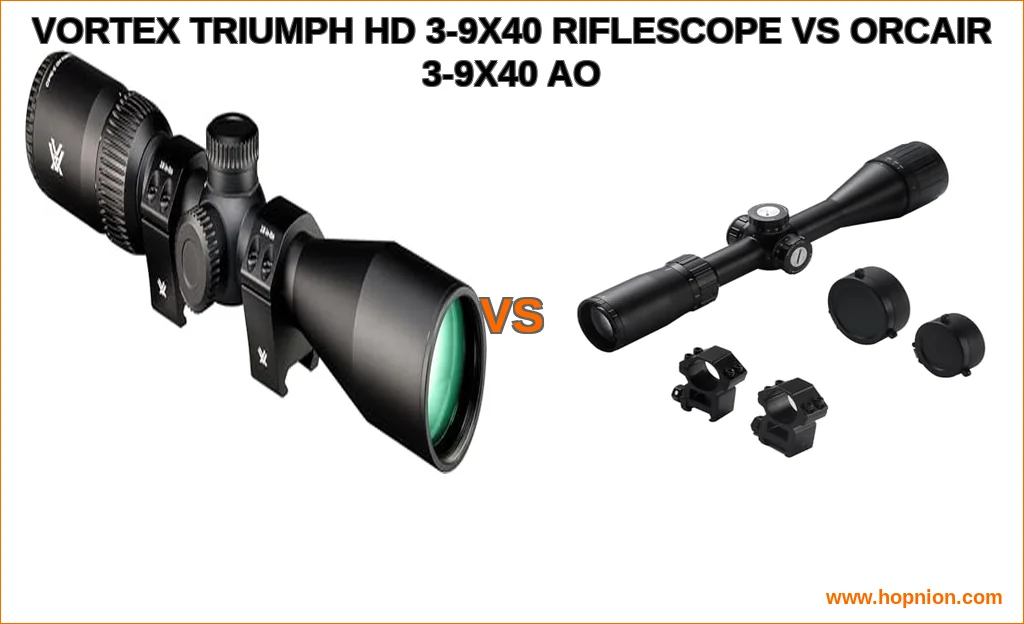
Head-to-Head Overview: Key Specifications
At first glance, these scopes share a common foundation. Both are 3-9×40 variable scopes with a 1-inch main tube. This makes them compatible with a vast array of standard mounts and rings, a huge plus for ease of setup. The similarities, however, start to diverge quickly when you look at their intended design and included packages.
The Vortex Triumph HD is explicitly marketed as a kit for newer hunters. It includes the scope, 1″ Hunter Rings (0.90″ low height), and a neoprene case. This “ready-to-mount” approach is fantastic for someone who wants to avoid the separate purchase of mounting hardware. The Orcair, on the other hand, is sold as a standalone scope that comes with its own 20mm rings and lens caps, focusing its value proposition on its feature set rather than a complete kit.
| Feature | Vortex Triumph HD 3-9×40 | Orcair 3-9×40 AO |
|---|---|---|
| Magnification | 3-9x | 3-9x |
| Objective Lens | 40mm | 40mm |
| Main Tube | 1-inch | 1-inch |
| Reticle | Dead-Hold BDC (MOA) | Illuminated Mil-Dot |
| Focal Plane | Second Focal Plane (SFP) | Second Focal Plane (SFP) |
| Parallax Setting | Fixed (Likely 100 yds) | Adjustable Objective (AO), 10 yds to |
| Eye Relief | Not Specified (Typically 3-4″) | Not Specified |
| Included | Scope, 1″ Hunter Rings, Neoprene Case | Scope, 20mm Rings, Lens Caps |
| Check current price on Amazon | Check current price on Amazon |
Optics & Image Quality: Glass, Coatings & Reticle
This is where the philosophy of each scope becomes crystal clear. Vortex invests heavily in its “HD optical system,” which uses select glass elements to cut chromatic aberration and boost color fidelity. The lenses are fully multi-coated to maximize light transmission. The result is a bright, sharp, and color-true image that performs well in the low-light conditions often critical for hunting. Honestly speaking, this optical package is the Triumph HD’s core strength, designed to give you every advantage when that buck steps into the shadows.
The Orcair also features fully multi-coated lenses. While the specific glass type isn’t detailed, the emphasis is on the illuminated Mil-Dot reticle. With eleven red brightness settings, it’s built for use in lower visibility or darker conditions. The reticle itself is a classic Mil-Dot pattern, useful for range estimation and holdovers if you know how to use it. From my honest perspective, the Orcair’s value in this department is its versatility; the illumination can be a game-changer in a dark forest understory or at dawn/dusk, but you’ll need to supply your own CR2032 battery.
The reticle designs tell different stories. Vortex employs its Dead-Hold BDC reticle, a hashmark system meant to simplify holdover at varying ranges without dialing. It’s a hunter-friendly design. The Orcair’s Mil-Dot is more tactical/military in heritage, offering precise subtensions for those willing to learn the system. For a deeper dive into reticle options, our guide on scope reticle types is a great resource.
Vortex HD Glass vs Orcair Fully Multi-Coated: The Real-World Difference
So, what does “HD glass” actually mean for you? In my honest opinion, it translates to edge-to-edge sharpness and minimal color fringing, especially at higher magnifications. When you’re at 9x power trying to identify antler points or a precise aiming point, a clean image reduces eye strain and increases confidence. The Orcair’s coatings will provide a bright view, but the specialized HD elements in the Vortex are engineered for that extra level of resolution and clarity. It’s a tangible difference you notice when comparing them side-by-side.
Features & Functionality: Turrets, AO & Eye Relief
Features are where these scopes truly part ways, defining their ideal use cases. The most glaring difference is the parallax adjustment (AO). The Orcair has an Adjustable Objective lens, allowing you to correct for parallax error from 10 yards out to infinity. This is a critical feature for airgun shooters, rimfire enthusiasts, or anyone shooting at very close or very long, precise distances. If you’re wondering about 22lr scopes for your plinker, an AO is almost non-negotiable.
The Vortex Triumph HD has a fixed parallax setting, which is standard for many hunting scopes and is typically set at 100 yards. This is perfectly suitable for most centerfire big-game hunting scenarios where shots are taken within a few hundred yards. It’s a simpler, more streamlined approach.
Both scopes have exposed, low-profile turrets that provide audible and tactile clicks for windage and elevation adjustments. The Vortex emphasizes a “simple setup” with a fast-focus eyepiece, staying true to its beginner-friendly mission. The Orcair includes diopter correction (+/- 2) on the ocular lens for shooters with vision irregularities. Eye relief is a vital safety and comfort spec, but unfortunately, neither listing provides the exact measurement. Speaking honestly, this is a missed detail; sufficient eye relief is what keeps your brow safe from recoil. As a rule, most 3-9×40 scopes offer between 3.5 to 4 inches, which is generally safe for common calibers.
Durability, Warranty & Real-World Use
Will it survive the hunt? Both manufacturers claim robust construction. The Vortex is built from aircraft-grade aluminum with a matte finish and is listed as waterproof, fogproof, and shockproof. Vortex backs all its products with a legendary, unconditional lifetime warranty. It’s a no-questions-asked promise that significantly adds to the scope’s long-term value and peace of mind.
The Orcair states its main tube is made from one piece (enhancing strength), is nitrogen-purged, and meets an IPX7 waterproof standard. This is a specific ingress protection rating meaning it can withstand immersion in 1 meter of water for 30 minutesa very solid claim. However, the warranty details are not specified in the provided features, which is an important consideration.
Mechanical Reliability and Tracking
This is the heart of trust in any scope. Will the adjustments move the point of impact exactly as they should, shot after shot, year after year? Vortex has built its reputation on reliable tracking and mechanical integrity across its lines, including the Crossfire II series which shares DNA with the Triumph. The Orcair’s description states its adjustments are “very precise” with clear audible clicks. My honest assessment is that while Vortex’s track record in this area is well-documented, the Orcair represents a value proposition where mechanical performance is a key factor to validate through user experience. For those considering other trusted brands, we’ve also looked at leupold scopes for rifles, known for their exceptional durability.
Final Verdict: Who Should Buy Which?
So, which is better: the Vortex Triumph HD or the Orcair 3-9×40? The answer depends entirely on your rifle and your mission.
Choose the Vortex Triumph HD 3-9×40 if:
- You are a new or traditional hunter using a centerfire rifle (e.g., .308, .30-06, 6.5 Creedmoor).
- Optical clarity, brightness, and color fidelity in all light conditions are your top priorities.
- You value a complete, simple kit (scope, rings, case) to get started quickly.
- The security of a no-fault, transferable lifetime warranty is paramount to you.
- You prefer a simple, holdover-based BDC reticle over a tactical Mil-Dot.
In my honest opinion, the Vortex is the turn-key hunting solution. It’s the scope you buy, mount, sight-in, and then forget about, trusting it to perform for decades. It excels as a scope for hunting in the classic sense.
Choose the Orcair 3-9×40 AO if:
- You are shopping for a best scope types for an air rifle, pellet gun, or .22 LR rimfire.
- You need close-range (<10 yards) parallax adjustment for precision shooting or pest control.
- An illuminated reticle is a desired feature for low-light or variable-background shooting.
- Your budget is strict, and you’re seeking the most features per dollar in the category of best 3-9×40 scope under $200.
- You understand and prefer using a Mil-Dot reticle for range estimation.
Honest to goodness, the Orcair’s Adjustable Objective makes it a specialist. It bridges the gap to airgun and rimfire markets where most traditional scopes fall short. If you need to dial out parallax at 25 yards for squirrel hunting or at 50 meters for target shooting, the AO is not just a bonusit’s essential. For more on scopes suited for varied shooting disciplines, check out our types of gun scopes overview.
Both scopes validate the enduring versatility of the 3-9×40 format. The Vortex Triumph HD offers refined optics and legendary warranty backing for the serious hunter. The Orcair AO delivers crucial functionality for airgun and rimfire shooters at a compelling price. Your specific use case is the ultimate decider. For further research on air rifle optics, this external guide on selecting airgun scopes offers excellent authority information. Remember, the best scope is the one that matches your rifle’s purpose and gives you confidence in the field. At the end of the day, that’s the only Honest Opinion that truly matters.