

Two airguns sit on the table, representing entirely different philosophies. One is a serious, long-barreled rifle built for precision. The other is a compact, snappy pistol designed for fun. The Umarex Zelos .22 PCP air rifle and the Daisy Powerline 426 CO2 air pistol aren’t direct competitors, but they often end up as choices for the same person: someone looking for a quality airgun experience. ir distinct worlds is key to finding your perfect match.
This isn’t just about rifle versus pistol. It’s a deeper dive into pre-charged pneumatic (PCP) versus CO2 cartridge power, .22 caliber pellets versus .177 BBs, and a tool for disciplined target work versus a device for reactive plinking. Each has its place, and my honest assessment is that the “best” choice depends entirely on what you want to do with it. Let’s break them down.
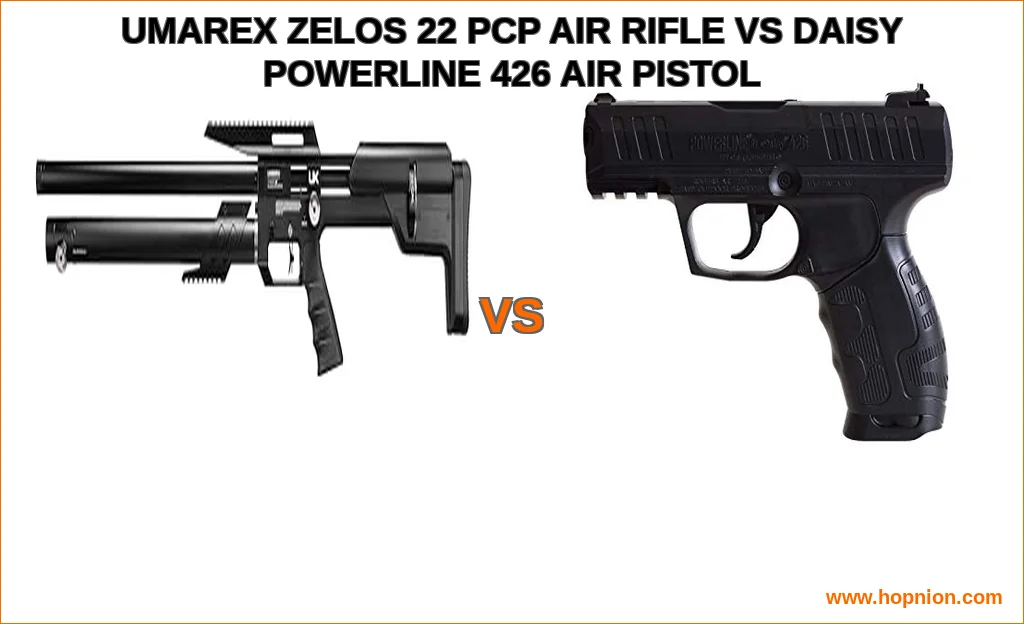
Head-to-Head: Specifications at a Glance
Seeing the raw numbers side-by-side immediately highlights their different purposes. The Zelos is a system, while the 426 is a straightforward tool.
| Feature | Umarex Zelos .22 PCP Air Rifle | Daisy Powerline 426 CO2 Air Pistol |
|---|---|---|
| Caliber | .22 Pellet | .177 BB |
| Power Source | High-Pressure Air Tank (PCP) | 12g CO2 Cartridge |
| Velocity | Up to 1000 FPS | 430 FPS |
| Magazine Capacity | 20-round rotary multi-shot magazine | 15-shot built-in magazine |
| Cocking/Action | Side-lever cocking | Double-action only |
| Sights | Picatinny rail for optics (sights not included) | Blade & ramp front, fixed open rear |
| Barrel | Rifled (for pellets) | Smooth Bore Steel |
| Key Feature | Adjustable pressure regulator (1000-2000 PSI), Two-stage adjustable trigger | Simple operation, immediate readiness |
| Check current price on Amazon | Check current price on Amazon |
Decoding the Core Differences
The table tells a clear story. The Zelos is built around customization and consistent power. Its adjustable regulator lets you tune for efficiency or maximum foot-pounds of energy (FPE), a critical measure for hunting or long-range target work. The lack of open sights isn’t a flaw; it’s an expectation that you’ll mount a proper scope via the integrated rail, a process central to any serious air rifle scope mounting setup.
The Daisy 426 is the opposite. You insert a CO2 cartridge, load BBs, and you’re shooting. The fixed sights are basic but functional for its intended range. The double-action trigger means every pull both cocks and fires the pistol, simplifying operation but typically sacrificing some CO2 air pistol accuracy potential compared to a single-action design. Honestly speaking, its beauty is in its simplicity and low cost of entry.
Performance Analysis: Accuracy, Power & Real-World Use
This is where the theoretical becomes practical. How do they actually perform where it counts?
Power and Ballistics
The velocity numbers are dramatic but can be misleading. The Zelos launching a heavy .22 pellet at up to 1000 FPS generates significantly more downrange energy than the 426 pushing a lightweight BB at 430 FPS. This translates directly to effective range, wind resistance, and terminal impact. For pellet gun comparison, the Zelos is in a different league for airgun power and velocity. It’s capable of ethical pest control and serious target shooting at 50+ yards with the right setup.
The Daisy 426 has ample power for what it is: a plinking pistol. Its 430 FPS is perfect for cans, reactive targets, and informal paper punching at 10-15 yards. The debate of pneumatic vs CO2 power is evident here. CO2 power can vary with temperature, while the Zelos’s PCP system offers shot-to-shot consistency, which is the bedrock of precision.
Accuracy Potential
So, which is more accurate, Umarex Zelos or Daisy 426? For pure mechanical precision, the Zelos wins, and it’s not particularly close. The combination of a rifled barrel, a consistent PCP powerplant, and that two-stage adjustable trigger creates a platform for real accuracy. You can conduct meaningful airgun accuracy testing with it.
The 426, using smoothbore barrel and BBs, is inherently less precise. BBs are not diabolo-shaped like pellets and don’t engage rifling, so they tumble in flight. Its accuracy is “minute-of-soda-can” at reasonable distances, which is honestly all most users need from it. It’s a blast for casual target shooting vs plinking where the fun is in the instant feedback, not measuring tiny groups.
Use Case Breakdown: Which Gun is Right for You?
This is the heart of the matter. Your intended use dictates the choice.
The Umarex Zelos .22 PCP Is For:
- The disciplined target shooter wanting to punch small groups on paper.
- The backyard hunter needing ethical power for pests like squirrels or rats.
- The enthusiast who enjoys the technical process of tuning and accessorizing.
- Someone seeking a best airgun for backyard target practice under $300 that feels like a real firearm.
It demands more initial investmentnot just the rifle, but a high-pressure air source (like a hand pump or scuba tank). PCP rifle maintenance requirements vs CO2 pistol are higher; you’re caring for an air tank, regulator, and seals. But the payoff is a professional-grade experience. If you’re curious about how it stacks up against other rifles in its class, our gamo swarm comparison provides another angle.
The Daisy Powerline 426 Is For:
- The casual plinker who values fun and immediacy above all.
- The beginner wanting an affordable, no-fuss introduction to airguns.
- Someone looking for a reactive, fun tool for short-range backyard sessions.
- A training aid for basic firearm handling (with appropriate safety).
Its operating cost revolves around Daisy Powerline 426 CO2 cartridge cost per shot and BBs, which is very low. There’s no tuning, no filling, minimal maintenance. You grab it and shoot. It’s the definition of low-commitment fun. For organizations like the CMP or NRA, which promote youth shooting sports, a pistol like this can be a fantastic, accessible starting point before moving to more precise gear.
Diving Deeper: The Details Competitors Miss
Many reviews stop at FPS and price. But the feel of a gun matters. The Zelos’s side-lever cocking mechanism is a premium feature often found on higher-end guns; it’s smoother and more ergonomic than a bolt-action. Its trigger pull weight is adjustable, a huge factor for accuracy that’s often overlooked. The safety mechanisms on both are automatic and manual, but their placement and feel differ significantlythe Zelos’s is more intuitive for a rifle shooter.
The Daisy’s barrel length and type (a smoothbore steel barrel) is perfect for its BB ammunition but limits its potential with pellets. These nuances define the user experience. Speaking honestly, if you appreciate fine mechanics, the Zelos is endlessly more engaging. If you just want to make tin cans dance, the Daisy delivers immediate satisfaction. For another look at the Zelos in a different matchup, see our gamo varmint rifle analysis.
Final Verdict & Value Assessment
between these two isn’t about picking a winner. It’s about identifying the right tool for your specific job.
The Umarex Zelos .22 PCP represents incredible value for a feature-packed PCP rifle. You get a regulator, a fantastic side-lever action, a great magazine, and a superb trigger at an entry-point price. The ongoing cost is your time (filling air) and attention to pellet gun maintenance. My honest take is that it’s one of the best gateways into serious airgunning available today. It’s an investment in a hobby.
The Daisy Powerline 426 is the king of value-for-money in casual fun. Its upfront cost is minimal, and the cost-per-smile is even lower. It’s reliable, simple, and embodies the pure joy of shooting without any pretense. You won’t be measuring groups, but you’ll be grinning a lot.
So, what’s the final Honest Opinion? If your goal is precision, power, and the satisfaction of mastering a complex tool, the Umarex Zelos is your clear path. Its a rifle that grows with you. If your goal is accessible, spontaneous fun with friends or family, the Daisy Powerline 426 is an unbeatable choice. It removes all barriers to entry. Both are excellent at what they do. The real task is being honest with yourself about what you want your airgun experience to be. Now, go make an informed choice and start shooting.