

Two distinct tools for the backyard plinker sit on the table. On one side, the classic silhouette of a lever-action rifle. On the other, the compact form of a semi-automatic pistol. The Umarex Marlin BB rifle and the Daisy Powerline 426 air pistol represent two popular, yet fundamentally different, approaches to casual shooting. This airgun comparison isn’t about declaring one the absolute winner, but about matching the right tool to the shooter and the situation.
Both are CO2 powered airgun platforms designed for fun, but their design philosophies diverge sharply. One offers the tactile satisfaction of a lever-action rifle with massive capacity, while the other provides the quick follow-up shots of a semi-automatic pistol. ir core strengths is key to deciding which belongs in your kit. Speaking honestly, the best choice often comes down to the experience you’re after, not just a list of specs.
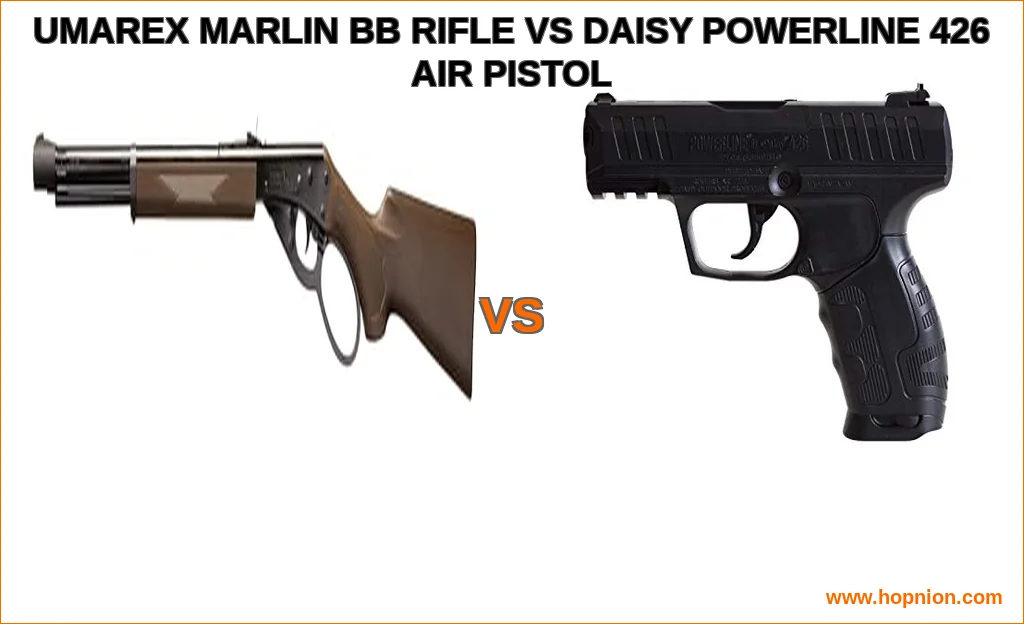
Head-to-Head: Specifications at a Glance
Let’s break down the hard numbers and built-in features. This side-by-side look reveals the immediate trade-offs between a repeating BB rifle and a single-shot pistol.
| Feature | Umarex Marlin Lever Action BB Rifle | Daisy Powerline 426 Air Pistol |
|---|---|---|
| Type | Lever-Action Repeating BB Rifle | Semi-Automatic CO2 Pistol |
| Caliber | .177 Steel BBs | .177 Steel BBs |
| Muzzle Velocity | Up to 300 FPS | 430 FPS |
| Pellet Capacity | 650-round BB fill port | 15-shot built-in magazine |
| Power Source | 12g CO2 cartridge (in lever) | 12g CO2 cartridge |
| Sights | Adjustable rear sight | Blade/ramp front, fixed open rear |
| Action | Manual Lever Action | Semi-Automatic with blowback action |
| Safety | Manual safety | Information not specified |
| Build | Polymer stock with faux wood finish | Smooth bore steel barrel |
| Check current price on Amazon | Check current price on Amazon |
The table highlights the primary dichotomy: immense capacity versus higher muzzle velocity. The Marlin’s 650-round hopper is almost absurd for a casual session, while the Daisy’s 430 FPS gives it a noticeable power edge on paper. My honest assessment is that the Marlin is built for prolonged, relaxed shooting, whereas the Daisy is designed for quicker, snappier engagements. It’s a classic tortoise-and-hare scenario in airgun form.
Digging Deeper into Key Differences
Beyond the raw numbers, the operational experience defines these guns. The Marlin’s lever-action mechanism is pure nostalgia. Each shot requires a deliberate cycle of the lever, which also houses the CO2 cartridge. This paced rhythm is part of its charm. The Daisy 426, by contrast, uses the gas from each shot to cycle the action, providing that familiar semi-auto feel. This blowback action enhances the realism but also consumes more gas per shot, a key factor in maintenance requirements for CO2 airguns.
Another often-overlooked entity is official noise level data. While neither listing provides dB ratings, my honest take is that the higher-velocity Daisy will typically produce a sharper crack compared to the Marlin’s lower-powered thwip. This can be a consideration for backyard use. warranty periods are a missing detail in most listings; always check the manufacturer’s website (Umarex and Daisy) for current warranty terms before purchase.
Performance & Accuracy Analysis: Plinking Precision
How do they actually shoot? The claimed velocity fps is one thing, but plinking accuracy is where the rubber meets the road. For consistent target shooting, several factors come into play.
The Daisy Powerline 426 boasts a higher muzzle energy thanks to its 430 FPS rating. This can translate to a flatter trajectory at short ranges, potentially making point-of-aim easier. Its fixed sights are simple and robust. However, the semi-automatic action can introduce a slight variation in lock-up from shot to shot, which might affect extreme precision. The accuracy comparison at 10 yards likely favors a very steady hand with the pistol.
The Umarex Marlin, at 300 FPS, has a more looping trajectory. Its saving grace is the adjustable rear sight, allowing you to dial in your point of impact for a specific distance. The rifle platform itself, with a longer sight radius and shoulder stock, is inherently more stable for most shooters than a pistol. Honestly speaking, a beginner might find it easier to achieve consistent groups with the Marlin’s rifle ergonomics, even with the lower velocity.
Both use smoothbore barrels and .177 steel BBs, which are not known for match-grade accuracy. They are perfect for casual tin-can plinking but have inherent limitations. For those interested in formal target disciplines, resources from organizations like the National Small-bore Rifle Association or the Civilian Marksmanship Program provide authority guides on equipment and technique far beyond these plinkers.
The Real Cost of Operation: CO2 and BBs
Competitors often skip a detailed breakdown of operating costs. Here’s the honest math. Both guns use standard 12g CO2 cartridges. The Daisy, with its semi-auto blowback action, will exhaust a cartridge fasterlikely in the realm of 40-50 shots. The Marlin’s simpler action is more efficient, potentially delivering 100+ shots per cartridge. This makes the Marlin cheaper to feed over time.
BB cost is similar, but the Marlin’s 650-round capacity means you’ll buy BBs in bulk more often. From my honest perspective, if you plan on high-volume shooting, the Marlin’s operating cost per shot is lower. If you’re a “few mags and done” shooter, the Daisy’s cost difference is negligible. It’s a factor of scale.
Use Cases & Ideal User Profiles
This isn’t about which is objectively better. It’s about which is better for you. Their design dictates their ideal playground.
The Umarex Marlin BB Rifle Shines For:
- Backyard plinking marathons where reloading is a nuisance.
- Shooters who enjoy a tactile, deliberate shooting rhythm.
- Those wanting to practice rifle fundamentals and sight adjustment.
- Younger shooters (with supervision) benefiting from the manual, paced action.
- Anyone who loves the Western aesthetic and lever-action fun.
If you want my honest opinion on which is better for beginners Umarex Marlin or Daisy 426, the Marlin often gets the nod. The manual action reinforces safety and shot discipline, and the rifle platform is easier to steady. It’s a fantastic tool for learning the basics. For those considering other rifle options, our comparison of the Gamo Swarm Whisper offers another perspective on quiet, multi-shot platforms.
The Daisy Powerline 426 Air Pistol Excels At:
- Quick target acquisition and rapid follow-up shot practice.
- Close-range reactive shooting (e.g., swinging targets).
- Portable, compact fun for trips or smaller spaces.
- Experienced plinkers looking for a snappy, realistic pistol feel.
- Building handgun handling skills in a low-recoil format.
The Daisy delivers a more “adrenaline” focused experience. It’s about speed and handling. For mastering pistol skills that might translate to other disciplines, checking an official source for structured practice is a smart move.
Final Verdict & Recommendations
So, which one deserves a spot in your collection? The answer hinges entirely on your definition of fun. For the sheer, uninterrupted joy of shooting without constant reloading, the Umarex Marlin is a powerhouse. Its 650-round capacity is legendary, and the lever-action is endlessly satisfying. It represents the best value for casual plinking if volume is your goal. I honestly believe it’s one of the most purely fun BB guns on the market for its specific niche.
The Daisy Powerline 426 makes its case with power and pace. That 430 FPS rating gives it a palpable punch, and the semi-auto action is engaging. It feels more like shooting a “real” firearm in its operation. However, you trade capacity and shot count for that experience.
My final, honest recommendation? If you’re new to the hobby, prioritizing safety and foundational skills, or just want to shoot all afternoon, the Umarex Marlin is the compelling choice. Its manual action and rifle ergonomics are excellent teachers. If you’re an experienced plinker seeking a dynamic, pistol-centric challenge with more power, the Daisy 426 delivers that thrill. It’s also worth seeing how the Marlin stacks up against other popular rifles, like in our look at the Gamo Varmint.
You truly can’t go wrong with either for their intended purposes. Both Umarex and Daisy have built reputations on reliable, fun-oriented guns. Consider your primary shooting environment, your patience for reloading, and whether you prefer the rifle or pistol posture. At the end of the day, the best airgun is the one you’ll use most often. That’s the Honest Opinion from a thorough side-by-side look.