

Two air rifles sit on opposite ends of a fascinating spectrum. One is a modern, tactical-style semi-automatic, the other a classic, powerful break barrel. The Sig Sauer MCX Virtus and the Benjamin Trail NP XL 1500 represent fundamentally different approaches to airgunning, each with a distinct purpose and user experience. Choosing between them isn’t just about specs; it’s about aligning a tool with your specific goals, from backyard plinking to small game hunting.
Honest OpinionThis head-to-head comparison cuts through the marketing claims to examine what these rifles actually offer. We’ll pit the PCP-powered, magazine-fed Sig against the Nitro Piston-driven Benjamin, analyzing their real-world implications for power, accuracy, and value. My honest assessment is that there is no single “best” rifle here, only the best rifle for you.
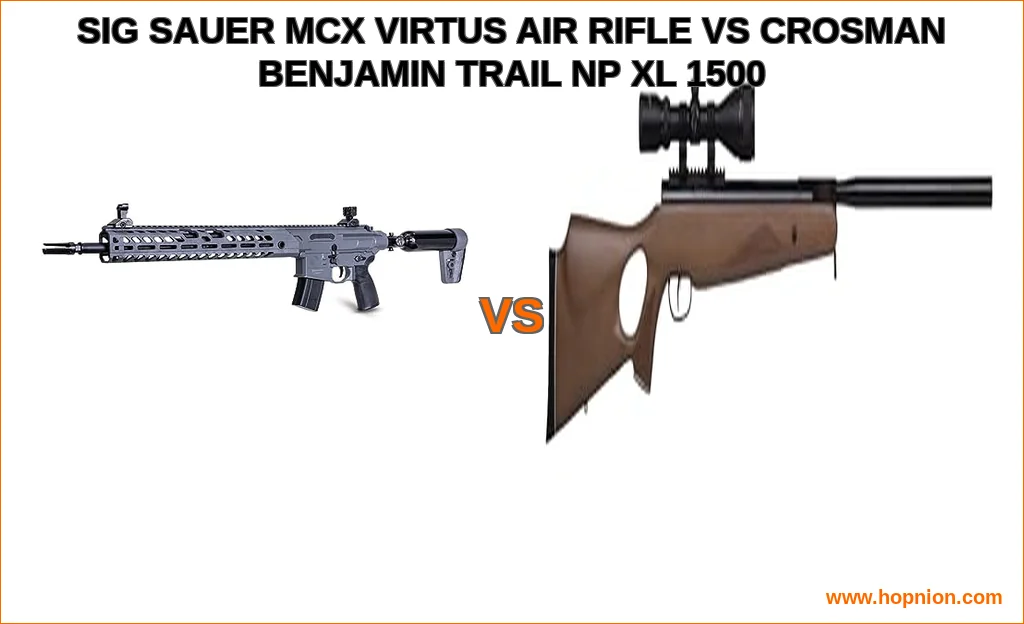
Head-to-Head Overview: Platform & Action
The core difference is immediately apparent in how you operate each gun. This is the classic CO2 vs Break Barrel debate, but with a PCP twist. The platform dictates everything from your shooting rhythm to your ongoing cost and maintenance.
| Feature | Sig Sauer MCX Virtus | Benjamin Trail NP XL 1500 |
|---|---|---|
| Action Type | Pre-Charged Pneumatic (PCP), Semi-Automatic | Break Barrel, Single Shot |
| Power Plant | High-pressure air reservoir (requires external fill) | Nitro Piston 2 gas spring |
| Cocking / Loading | 30-round Rapid Pellet Magazine (RPM) | Manual break barrel, single pellet load |
| Primary Design | Tactical training, rapid target engagement | Traditional hunting, precision shooting |
| Check current price on Amazon | Check current price on Amazon |
The Sig MCX Virtus operates as a PCP air rifle. You fill an internal reservoir from a high-pressure air source (like a scuba tank or hand pump), and that stored air powers multiple shots. Its semi-auto function and 30-round magazine enable a fast-paced shooting experience unlike any break barrel. Honestly speaking, this makes it phenomenal for dynamic target practice that mimics a firearm’s handling.
The Benjamin Trail NP XL 1500 uses the proven Nitro Piston 2 system. Instead of a metal spring, a sealed gas ram is compressed when you break the barrel. This design is known for smoother cocking, less recoil, and immunity to spring fatigue. It’s a single-shot platform, forcing a deliberate pace between shots. From my honest perspective, this fosters a more focused, precision-oriented shooting discipline.
Power & Performance: Velocity, Energy, and Shot Count
Raw numbers tell part of the story, but ir practical impact is key for any hunting pellet gun or target rifle. Velocity claims, especially, require context.
Muzzle Velocity & Energy
The Benjamin boldly claims “UP TO 1500 FPS.” It’s critical to understand this is a maximum with ultra-light pellets. For effective small game hunting, you’ll use heavier .177 pellets, which will generate lower velocities but higher retained energy. The rifled steel barrel is designed to stabilize these heavier rounds for better pellet rifle accuracy.
The Sig Sauer MCX Virtus specs emphasize muzzle energy (FPE), stating it “doubles the muzzle energy of classic CO2 air rifles.” As a .22 caliber PCP, it delivers significant energy per shot with heavier pellets, which is often more important for clean takedowns than sheer speed. The consistent air pressure of a PCP also means very little variation in velocity from shot to shot, a major factor in precision.
Shot Capacity & Practical Use
This is a stark contrast. The Benjamin’s single-shot design means you have one opportunity before repeating the break-barrel cycle. The Sig’s 30-round magazine allows for extended shooting sessions or engaging multiple targets quickly. However, the PCP’s shot count is limited by its air reservoir capacity (a figure not provided in the features, a key piece of long-term data). Once empty, you need a fill source.
For backyard pest control where a follow-up shot might be needed swiftly, the semi-auto Sig has a clear advantage. For a solitary hunter taking a careful, single shot, the Benjamin’s system is time-tested. Speaking honestly, your intended use case decides this round.
Accuracy & Handling: Sights, Trigger, and Ergonomics
How a rifle feels and points is subjective, but certain features objectively influence an airgun accuracy test. Let’s break down the ergonomic and aiming systems.
Sights and Optics
The Benjamin Trail NP XL 1500 includes a CenterPoint 3-9x40mm scope right out of the box. This is a huge value-add and immediately makes it capable of precision work at 30, 40, or even 50 yards. The adjustable objective helps with parallax, crucial for airgun accuracy at varying ranges.
The Sig MCX Virtus takes a modular, tactical approach. It features flip-up front and rear iron sights and a full-length M1913 Picatinny rail. This gives you ultimate flexibility to mount your preferred red dot, scope, or other optic, but it’s an additional purchase. Honestly, the included optic on the Benjamin gets you shooting accurately faster, while the Sig offers a platform for customization.
Trigger and Stock
Trigger feel is paramount. The Sig, engineered to mimic its firearm counterpart, features a two-stage trigger. This provides a predictable, crisp break that is a significant advantage for precision shooting, even in rapid succession.
The Benjamin uses a traditional break-barrel trigger. Its quality can vary, but the design focus is on hunting. The rifle comes with a checkered hardwood stock, offering a classic, solid feel. The Sig employs an all-weather synthetic stock that’s lighter and impervious to the elements. Your preference for traditional warmth or modern, durable utility comes into play here.
Build Quality, Features & Real-World Use Cases
Beyond the paper specs, how do these rifles hold up and what are they genuinely best for? Let’s talk about noise, durability, and the ideal role for each.
Noise Level and Pellet Preference
This is a critical, often overlooked factor. The Benjamin’s listing explicitly states it “Produces 70% less noise” than an unspecified benchmark. The Nitro Piston 2 system is inherently quieter than a spring piston, making it more backyard-friendly. The Sig, as a PCP, is also relatively quiet, but the report can vary based on tune and caliber. For discreet pest control, both have advantages over louder platforms.
Pellet preference is another key point. The Sig’s listing specifically recommends “SIG SAUER or equivalent premium pellets” for best results. The Benjamin, with its rifled barrel, will also perform best with quality, domed (diabolo) pellets for hunting. Pointed pellets may feed better in the Sig’s magazine but often offer less consistent aerodynamics. Your Sig Sauer MCX Virtus CO2 cost per magazine is actually a PCP air cost, but your pellet choice remains a vital variable for group size.
Defined Use Cases
- Sig Sauer MCX Virtus: Ideal for high-volume target training, tactical-style plinking, and scenarios requiring rapid follow-up shots on pests. Its semi-auto function is its defining party trick. It’s less about a single, perfect shot and more about shot placement through repetition and speed.
- Benjamin Trail NP XL 1500: Built for the hunter or precision plinker. It’s designed for that one, well-aimed shot at a squirrel or rabbit. The included scope and powerful Nitro Piston 2 engine make it a ready-to-hunt package. The question of Benjamin Trail NP XL 1500 real world accuracy at 50 yards will largely depend on the shooter’s skill and pellet selection, but the rifle is capable of it.
For a broader look at how the Benjamin stacks up against another popular option, our gamo comparison provides additional context.
Value Verdict: Price, Consumables & Final Recommendation
So, which rifle delivers more for your money? The answer isn’t straightforward because you’re buying into different ecosystems. A simple initial cost comparison misses the bigger picture.
Total Cost of Ownership
The Benjamin Trail NP XL 1500 presents a lower barrier to entry. You buy the rifle, some pellets, and you’re shooting. There’s no need for additional air sources or optics initially. It’s a more complete, traditional package.
The Sig Sauer MCX Virtus has a higher upfront cost and requires a significant additional investment: a high-pressure air source (hand pump or carbon fiber tank). This is the hidden cost of PCP ownership. However, you gain semi-auto functionality, high magazine capacity, and a modern tactical platform. It’s a commitment to a more involved, but potentially more rewarding, airgun discipline.
Final Recommendation: Who Wins?
This isn’t about crowning one champion. It’s about matching the tool to the task.
Choose the Benjamin Trail NP XL 1500 if: You are a traditionalist, a hunter, or a precision plinker on a budget. You want a ready-to-shoot package that delivers significant power and includes a scope. You prefer a deliberate, single-shot rhythm and don’t mind the physical action of breaking the barrel. You value the simplicity and proven reliability of the Nitro Piston system. My honest take is that for the classic air rifle experience focused on accuracy and power, the Benjamin is incredibly hard to beat.
Choose the Sig Sauer MCX Virtus if: You want a modern, tactical training tool or a versatile pest control rifle with rapid-fire capability. You are willing to invest in the PCP ecosystem (air tank/pump) for the benefits of consistent power and semi-auto fire. You value customization via Picatinny rails and prefer the ergonomics of an AR-style platform. You prioritize shot count and fast follow-ups over absolute maximum air rifle velocity. To be completely honest, the Sig is for the shooter who views airgunning as an extension of their firearm training or who simply loves the unique functionality it offers.
Both Sig Sauer and Crosman’s Benjamin line have strong reputations, but they serve different masters. If the tactical style of the Sig appeals to you but you want to see another alternative, we’ve also compared it to a popular gamo model.
For those interested in formal target shooting with either platform, resources from organizations like the official source for UK rules or the authority guide for U.S. youth programs are invaluable.
The Bottom Line
Your decision between the Sig Sauer MCX Virtus and the Benjamin Trail NP XL 1500 boils down to a choice between innovation and tradition, between rapid engagement and deliberate precision. The Benjamin offers a potent, straightforward path to hunting and target shooting. The Sig offers a glimpse into the high-performance, modular world of modern PCP air rifles.
I honestly believe there’s a perfect fit for every shooter. Assess your primary use, budget for the total system (not just the rifle), and be honest about which shooting experience excites you more. That’s the rifle you’ll reach for most often. And remember, for more unbiased, in-depth comparisons like this, you can always find our full Honest Opinion at Hopnion.com.