How to Separate Elbow Media From Straight Pins
By Amis Thains Published 6 min read
As an Amazon Associate we earn from qualifying purchases, at no cost to you.
On this page (7 sections)
You just dumped your tumbler and are staring at a mixed pile of straight pins and elbow media. This page gives you two reliable methods to separate them by shape or magnetism, so you can get back to reloading.
In short: You separate them by exploiting their physical differences. Straight pins are uniform, while elbow media has a distinct bend that prevents it from falling through slots. A slotted tray or a neodymium magnet allows you to sort the mix in minutes rather than hours.
Our pick
Tap to see today's price on Amazon
What You Need to Separate Media
Before you start, gather the right tools for the job. The goal is to use gravity or magnetism to sort the two shapes automatically, reducing manual handling. You do not need expensive equipment, just the right surface or magnetic force. For the detail, see our notes on nosler prep setup.
- Slotted tray or screen: Needs gaps sized for straight pins to pass but too small for elbow media. A gap of 2mm to 3mm usually works for standard pins.
- Neodymium magnet: A high-power block magnet for lifting ferrous media. Look for a pull force of at least 5 lbs for efficiency.
- Shallow bowl: To hold the media as you process it. A plastic tub works well to avoid scratching the media.
- Gloves: To protect your hands from sharp media edges and skin irritation from dust.
If you have a large batch of mixed media, a purpose-built separator saves significant time. For a small tumbler dump, a simple DIY setup with a hardware store screen is plenty. Check the length of your straight pins before buying a tray to ensure the slot width matches their diameter.
A slotted tray with a 3mm gap lets straight pins fall while catching most elbow media.
See options on AmazonHow to Use a Slotted Tray for Sorting
This is the most common method for separating straight pins from elbow media. It relies on gravity and the physical size differences between the two shapes. The bent elbow acts as a block that cannot pass through the vertical slots, while the straight pin aligns easily.
- Pour media into the tray: Spread it out evenly so it does not clump into large piles. Clumps block the slots and slow down the process.
- Shake gently: This helps straight pins align with the slots. Use a side-to-side motion rather than up-and-down to keep the media moving across the surface.
- Tilt slightly: Allow straight pins to slide through the gaps. A gentle angle helps gravity pull them through.
- Check the catch: Elbow media will remain in the tray because the bent shape gets stuck on the slot edges.
- Repeat if needed: Some straight pins may still be caught horizontally. A second pass with a different angle helps release them.
Make sure your tray slots are sized correctly. If the slots are too small, straight pins will not fall through at all. If they are too large, some smaller elbow media might squeeze through, contaminating your straight pin batch. Start with a medium gap and adjust if you see cross-contamination.
Pro tip: If your tray is too coarse, line it with a finer screen. This double-layer approach catches the smallest elbow media pieces.
Magnetic Separation for Steel Pins
If both your straight pins and elbow media are made of steel, a magnet is a faster option. However, this method only works if one type is ferrous and the other is non-ferrous. Most straight pins are steel, while many elbow media pieces are aluminum or titanium, which are non-magnetic.
- Hold the magnet over the mix: Keep it a few inches above the media. Do not let it touch the pile initially.
- Scan slowly: Move it across the pile in a steady motion. Steel straight pins will lift and stick to the magnet surface.
- Drop them into a separate container: Release the magnet over the bowl to drop the collected steel pins.
- Collect the non-magnetic media: Whatever is left in the original pile is your elbow media or other non-ferrous items.
This method is very clean and avoids the chance of mixing them up again. It is particularly useful if you have already separated some media but find a few stray straight pins in your elbow bin. Just be careful not to drop the magnet near loose pins, as they will fly to it with surprising force. There is more on cv life 2.5-10x40 scope in a separate guide.

A 5lb pull force magnet is strong enough to lift multiple straight pins at once.
- Be produced by rare earth material and are composed of neodymium (Nd), iron (Fe), and
- Coated with Nickel-Copper-Nickel 3 layers metal, our NdFeB magnet has no rust when you
Common Mistakes When Separating Media
Even with the right tools, people make errors that slow down the process or ruin the media. Avoiding these common pitfalls will save you time and ensure your media lasts longer.
- Mistake: Using a single fine screen. Alternative: Use a two-step process. Let large items fall first, then shake out the straight pins. This prevents clogging.
- Mistake: Dampening the media. Alternative: Keep media dry. Wet media clumps together and blocks the slots, making separation impossible.
- Mistake: Rushing the shake. Alternative: Give the tray time to settle. Patience prevents elbow media from sticking to straight pins and falling through together.
- Mistake: Ignoring damaged pins. Alternative: Check for bent straight pins. These will catch on slot edges and clog your tray over time.
Check your media for damage after separation. If straight pins are bent, they might catch on the slot edges, which can ruin your tray over time. Pull out any deformed pins and recycle them or discard them. A clean batch separates much faster.
Safety first: Wear safety glasses. Small media pieces can bounce when you shake the tray and end up in your eyes.
When to Buy a Dedicated Media Separator
If you separate media more than a few times a year, a dedicated tool pays for itself in convenience. These devices usually have adjustable screens and sturdy frames that stand on a counter.
Look for a separator with a wide top and a fine bottom screen. This design allows you to pour everything in at once and let gravity do the work. It is much faster than hand-shaking a tray, especially for large tumbler dumps. The internal baffles help keep the media moving without clogging.
Compare this to manual methods. A good separator can process a full tumbler dump in under a minute. Manual shaking can take ten minutes or more, depending on the mix and the volume. If you load for a club or shoot large volumes, the dedicated tool is the only way to keep up. It helps to understand separating heavy media items before going further.
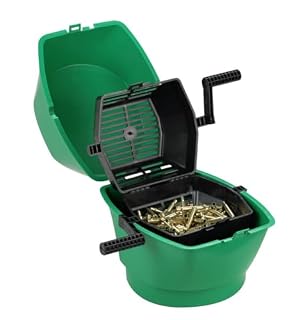
- ROTARY CASE/MEDIA SEPARATOR
- Separates the cleaned cases from the cleaning media
The bottom line
For most shooters, a slotted tray is the best balance of cost and speed. It works with any media type and is inexpensive to make. If you use all-steel media, a neodymium magnet is even faster and easier on your hands. Buy a dedicated separator only if you do high-volume reloading or have back issues that make shaking a tray difficult.
Frequently asked questions
What is a media pin in a tumbler?
A media pin is a small, shaped piece of metal used to clean the interior of cartridge cases. Straight pins are cylindrical and uniform. Elbow pins are bent at an angle to reach the case head and provide more aggressive cleaning on the neck.
Can I separate brass from media without a separator?
Yes, but it is harder. You can use a magnetic lift for steel media, or a simple screen for brass. Brass is larger and non-magnetic, so it stays in the tray while smaller media falls through. Without a dedicated separator, expect to spend more time on manual sorting.
Do people use magnets to separate brass from media?
Not usually, because brass is non-magnetic. Magnets work great for separating steel media from non-magnetic media. For brass, you rely on size differences and screens. A magnet will not lift brass cases, so this method is useless for case-to-media separation.