Scope vs. Aim Sight: The Plain English Difference
By Amis Thains Published 6 min read
As an Amazon Associate we earn from qualifying purchases, at no cost to you.
On this page (7 sections)
You are looking at a gun and wondering if that little floating dot counts as a scope, or if only the glass tube does. This page clears up the naming confusion so you know exactly which optic you need for your range.
In short: No, a scope and an aim sight are not the same. A scope is a magnified optical device with a reticle inside glass. An aim sight (often called an open or iron sight) is a non-magnified physical marker, like a bead or notch, that you align visually with the target.
Quick picks
Our shortlist for this job · tap one to see today's price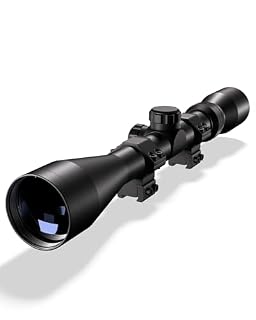
Compact 3-9x scope covers common distances without taking up whole magazine length.

Lets you aim fast with the dot and magnify for longer shots.
What "scope" and "aim sight" actually mean
People mix these terms up because both help you aim. But they work completely differently. We go through scope characteristics explained step by step in its own article.
Scopes use lenses to magnify the target. They have a reticle (crosshairs or dots) etched inside the glass. You look through the tube to see the target and the aiming point at the same time.
Aim sights, or open sights, are physical. A front sight is a bead or post on the barrel. A rear sight is a notch or ring. You align them with your naked eye. There is no magnification. No glass tube. Just physical alignment.
Some modern “aim sights” are red dot sights. These project a dot of light onto your eye. They are still open sights in how you use them: you do not look “through” them at the target; you see the dot superimposed on the scene. But they are not scopes because they do not magnify the image.
The naming gets messy
You will hear “aiming optic,” “rifle scope,” and “iron sight” used loosely. The key split is magnified (scope) vs. non-magnified (aim sight). If it zooms, it is a scope. If it does not, it is an aim sight.

- Iron Sights:A2 Front Sight post is fully Adjustable for Elevation.Rear Sight Dual
- Low Profile Flip Up Design:Milled Aluminum Flip Up Front and Rear Sight Lay Flat with
How each type actually works on your rifle
Understanding the mechanics tells you which one fits your shooting.
Scopes require eye relief. You must keep your eye in the correct position behind the eyepiece. Magnification helps you see a target at 200 yards, but it also narrows your field of view and can slow down acquisition on close targets.
Open sights rely on your brain triangulating three points: the target, the front bead, and the rear notch. They are fast to acquire because both eyes can stay open. But they become useless past 100-150 yards because the bead becomes too small to see clearly. Before you buy anything, it is worth looking at difference scope sight.
Red dot sights bridge the gap. You acquire the target as fast as open sights, but the dot is brighter and easier to see than a tiny bead at medium ranges. They do not magnify, so they are not “scopes.”
- Scope: Look through glass, magnified, slower close range.
- Open sight: Align physical markers, non-magnified, fast and easy.
- Red dot: See dot over open sight, non-magnified, fast at medium range.
Pro tip: Always check the eye relief rating on a scope. If you pull the stock hard against your shoulder, your cheek must not hit the scope. Check your specific model’s spec sheet.
The 3-9x zoom lets you start low for close targets and adjust up for detail.
- Pellet Rifle Scope: 12.28" (311mm) long and 15.6 oz (442g), 3-9x40 riflescope built
- 3-9x40 Rifle Optics: Compact rifle scope features a 40mm objective with fully
When to use a scope vs. an open sight
The right choice depends on the distance to your target and the speed of your shots.
Use a scope when:
- Your target is past 150 yards.
- You need to see details to identify or aim at a specific point (like a vital area on a target).
- You are shooting in low light or from a stable position like a rest.
Use an open or red dot sight when:
- Your target is under 100 yards.
- You are moving or scanning a wide area (like a woodlot).
- Speed matters more than seeing tiny details.
- You want to keep both eyes open for situational awareness.
If you are confused, look at the distance. If you cannot clearly see the front bead of an open sight against the target, you need a scope.
Pro tip: A "co-witness" setup aligns the open/iron sights with the scope reticle. This gives you a backup if the scope fails.
This combo lets you use the dot for speed and the 3x magnifier for longer shots.
- Good Eye Relief-This green dot with Magnifier combo has 3X magnification ensure precise
- 4 Reticle Options -CVLIFE green dot sights have 4 bright reticle selections provide
Common myths about scopes and sights
A lot of confusion comes from myths passed around at the range.
Myth: A red dot is a type of scope.
Fact: No. Scopes magnify the image. Red dots do not. A red dot is an illuminated open sight. It projects a light into your eye. It is optically distinct from a magnifying scope. Loaders in this spot often ask about comparing sighting systems as well.
Myth: You can “sight in” a scope without shooting.
Fact: You can “bore sight” a scope by aligning it with the barrel. But bore sighting is only an approximation. You must fire actual cartridges to verify where the bullet hits. Always use published load data and follow safe reloading practices.
Myth: Open sights are “lesser” than scopes.
Fact: Open sights are faster and more durable. For close-range hunting or home defense, a sighted open system is often better than a scope because it is quicker to get on target.
How to choose the right optic for your rifle
Choosing between a scope and an aim sight comes down to three things: distance, speed, and mount compatibility.
- Check your range. 50 yards or less? An open or red dot sight is usually better. Past 150 yards? You need a magnified scope.
- Check your rifle’s rail. Most modern rifles use a 3/8-inch or 1/2-inch Picatinny or Weaver rail. Make sure your mount matches the rail.
- Consider the mount base. The base sits on the receiver, and the rings hold the optic. They must be aligned properly.
If you want one optic to do both jobs, look for a scope with a low power setting (like 3x) or a red dot with a 3x magnifier.
Safety first: Never fire a rifle with an improperly mounted scope. Check torque specs from the mount manufacturer before your first shooting trip.
The bottom line
If your target is close and moving, stick with a red dot or open sight. If you are shooting past 150 yards or need detail, buy a magnified scope. Start with a simple 3-9×40 scope for the most common rifle shooting needs.
- Pellet Rifle Scope: 12.28" (311mm) long and 15.6 oz (442g), 3-9x40 riflescope built
- 3-9x40 Rifle Optics: Compact rifle scope features a 40mm objective with fully
Frequently asked questions
Is a sight and a scope the same?
No. A scope magnifies the image through glass. A sight (open or red dot) does not magnify; it helps you align physically or with a projected light dot. The main difference is magnification.
What is a scope on a gun used for?
A scope is used to see distant targets more clearly and to place a precise aiming point on that target. It helps you shoot accurately at ranges where your naked eye cannot see the bullet’s impact point.
Can I use open sights and a scope at the same time?
Yes, this is called “co-witnessing.” If your scope has a low power setting and its reticle aligns with the rear sight notch, you can use the open sights as a backup if the scope is damaged or you prefer open sights for close range.
How do you aim with a scope?
Relax your eye, look at the target, and focus on the target first. The reticle should float slightly out of focus. This allows your brain to track the target faster and prevents eye strain during long sessions.