
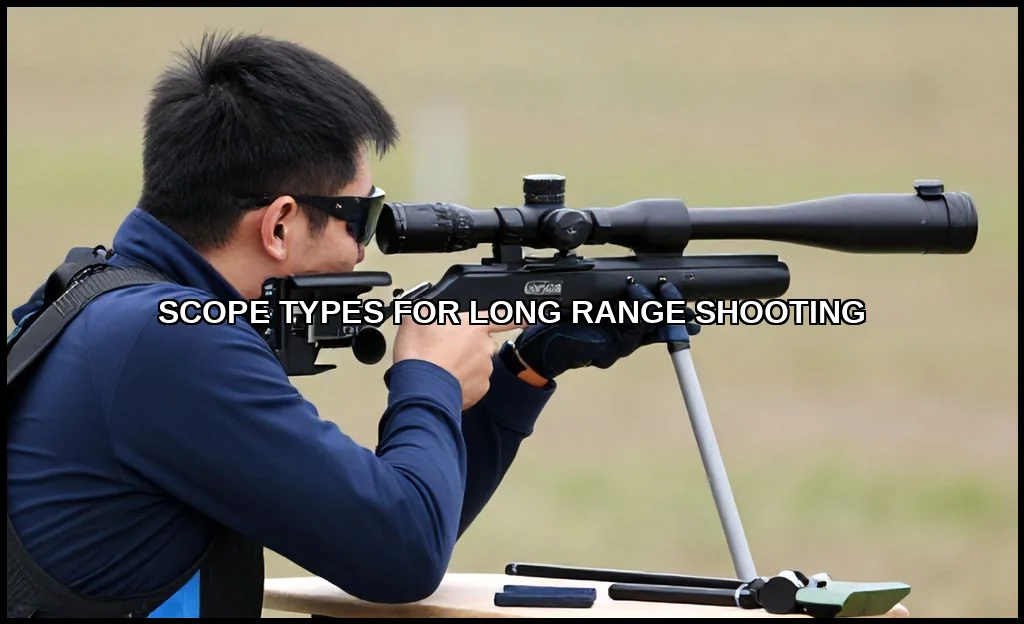
Hitting a target at 1000 yards is a symphony of skill, ballistics, and gear. The rifle is the instrument, but the scope is the conductor. It interprets distance, wind, and movement. Choosing the wrong scope type for long range shooting is like trying to read sheet music in the dark. You might get a few notes right, but you’ll never play the song.
Your choice dictates how you calculate holds, compensate for bullet drop, and maintain precision at extreme distances. It’s not just about magnification. It’s about the reticle’s behavior, light gathering at dawn, and the tactile feedback of the turrets. For shooters getting started, pairing a solid optic with a reliable platform like the CVLIFE Hunting Rifle provides a fantastic foundation to learn these critical concepts without a massive initial investment.
FFP vs. SFP: The Core Distinction in Scope Types
This is the first and most critical decision. It defines everything about how your reticle functions. The focal plane refers to the lens where the reticle is etched. Its placement changes the game entirely.
First Focal Plane (FFP) Explained
In an First Focal Plane (FFP) scope, the reticle is placed in front of the magnification lens assembly. The reticle grows and shrinks as you change magnification. This is the preferred system for most serious long-range and tactical shooting. Why? The subtensions (the measurements in your reticle, like MIL or MOA marks) remain constant. One mil is always one mil, whether you’re on 5x or 25x. This allows for accurate holdovers and windage corrections at any power. It’s intuitive for rapid engagement at unknown distances.
The trade-off? At low magnification, the reticle can become very fine and hard to see, especially in low light. FFP scopes also tend to be more expensive due to the precision required in etching the reticle.
Second Focal Plane Benefits
In a Second Focal Plane (SFP) scope, the reticle sits behind the magnification lenses. The reticle size stays the same in your eye while the target image zooms in and out. The main benefit is a consistently visible reticle at all magnification levels. This is great for hunting scenarios where a quick, close-range shot might present itself.
The major caveat? The reticle’s subtensions are only accurate at one specific magnification, usually the highest setting. If you’re using mil-dots for holdover on 10x, but you’re zoomed to 5x, your calculations will be wrong. You must remember to “dial to max” for accurate holds, which adds a step under pressure. For disciplined target shooting where you control the variables, SFP works well. For dynamic long range shooting, it’s a potential pitfall.
Magnification & Objective Lens: Power vs. Light Gathering
More power isn’t always better. A common question is what is the best scope magnification for 1000 yards? The answer is nuanced. You need enough power to see your target clearly, but too much power amplifies mirage and your own body’s movement. A popular range is 5-25x or 6-24x. This gives you a wide field of view for scanning and target acquisition on the low end, and precise aiming on the high end.
Scope magnification is only half the light story. The objective lens (the front lens) diameter is crucial. A larger objective (e.g., 50mm vs. 44mm) gathers more light, providing a brighter image at dawn and dusk. But does objective lens size matter for long range? Absolutely, especially for hunters. A brighter image means better target identification in low-light conditions. The trade-off is a higher mounting position and often more weight.
This is where understanding all the scope types available helps you balance these features for your specific needs.
Decoding Reticles: MIL, MOA, and BDC for Holdovers
Your reticle is your calculator. Choosing the right one is a matter of personal preference and application. The debate of mils vs moa is a classic, but both are angular measurement systems.
- Mil-Dot Reticle (MIL): Based on milliradians (1/1000th of a radian). Simpler math for metric users (1 mil 10 cm at 100 meters). Often preferred in tactical and competitive circles for its speed in communicating adjustments.
- MOA Reticle: Based on Minutes of Angle (1/60th of a degree). 1 MOA 1 inch at 100 yards. The math is straightforward for imperial system users. It allows for very fine adjustments, as 1/4 MOA clicks are smaller than 0.1 MIL clicks.
- BDC (Bullet Drop Compensating): These reticles have holdover marks calibrated for a specific cartridge and barrel length. They can be fast but are not universal. A change in ammunition, altitude, or temperature can throw off the calibration.
Your riflescope reticle choice should align with your turret system (MIL/MOA) and how your brain works with numbers. An FFP MIL reticle paired with MIL turrets offers a seamless, unified system for long range shooting optics.
Practical Guide: Matching Scope Type to Your Discipline
Let’s cut through the noise. Your shooting style dictates the ideal scope.
For PRS/NRL Competition & Tactical Long Range
You need an First Focal Plane (FFP) scope, without question. A MIL or MOA Christmas-tree-style reticle is standard. High magnification (5-25x+) is common. Robust, tactile scope turret types with zero-stop are mandatory for dialing elevation. Don’t forget parallax adjustmentit’s critical for removing aiming error at different ranges. This is where a premium tactical rifle scope earns its keep.
For Long-Range Hunting
The FFP vs SFP for long range hunting debate has merit. An FFP scope is superior if you plan to use the reticle for holdovers at varying magnifications. However, many hunters use their turrets to dial for distance, making the reticle’s subtension consistency less critical. A high-quality SFP scope with a bright, simple reticle can be excellent, especially in low-light timber edges. A larger objective lens (50mm or 56mm) is a wise investment here.
For Precision Target Shooting (Benchrest, F-Class)
These shooters often work at known distances and dial for everything. A high-magnification SFP scope with a very fine, non-cluttering reticle (like a fine crosshair) is traditional. The reticle is just for aiming at a precisely dialed point. The priority is optical clarity and repeatable tracking above all else. For mounting such precision instruments securely, using a proper tripod adapter system is a pro move for stability.
How to Choose a Reticle for Long Range
- Match your turrets: MIL reticle with MIL turrets, MOA with MOA.
- Consider your process: Do you dial for elevation (any reticle works) or use holdovers (FFP is best)?
- Think about clutter: A busy “Christmas tree” reticle is powerful but can obscure a small target.
- Test if possible: Look through different styles. What looks clear on paper may feel different to your eye.
For a deep dive on these mechanics, this authority guide is an excellent official source.
Final Adjustments
Selecting a long range scope is about building a coherent system. Your focal plane, reticle, turrets, and magnification must work in concert with your shooting discipline. An FFP mil-based scope is the versatile workhorse for modern long-range challenges. An SFP scope with impeccable glass can be a hunter’s best friend at last light. There is no single “best.” There’s only what’s best for your target, your rifle, and the way you solve the ballistic puzzle. Start with the fundamentals. Understand what each component does. Then go make the shot.