

Two names consistently rise to the top for anyone serious about their reloading bench: Lyman and RCBS. Their case trimmers represent fundamentally different philosophies in the pursuit of perfect brass. One offers the speed of modern automation, while the other champions the tactile precision of manual control. Choosing between them isn’t just about picking a tool; it’s about defining your reloading workflow.
This head-to-head look at the Lyman Case Trim Xpress and the RCBS Trim Pro-2 will cut through the noise. We’ll examine their real-world performance, setup, and value to help you decide which machine earns a permanent spot on your bench. Speaking honestly, the right choice depends entirely on your volume, patience, and what you value most in your case prep.
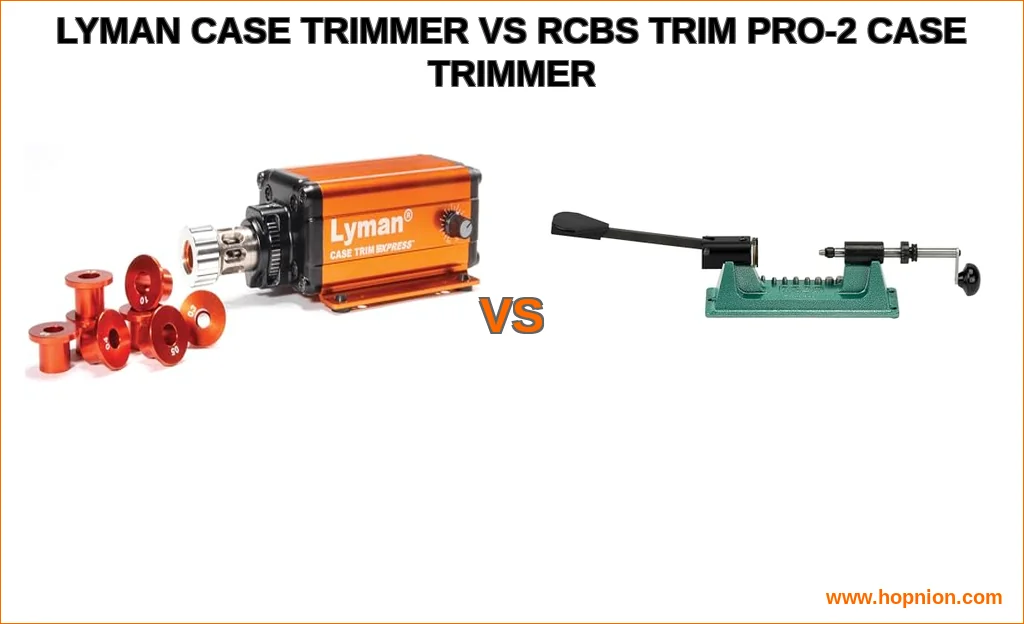
Head-to-Head Feature Comparison
At their core, these trimmers operate on different principles. The Lyman is a dedicated, motorized station, while the RCBS is a comprehensive manual kit. This table breaks down their key specifications based on their actual features.
| Feature | Lyman Case Trim Xpress | RCBS Trim Pro-2 Manual Kit |
|---|---|---|
| Operation Type | Motorized, Variable Speed | Manual |
| Power Source | Integrated AC Motor | Hand Crank |
| Key Innovation | Shoulder-contact bushings for alignment | Comprehensive kit with multiple pilots |
| Included Caliber Support | 10 bushings for bottleneck rifle cases | Pilots for .22, .24, .25, .27, .28, .30, .35, .44, .45 |
| Primary Benefit | Speed and consistent operation | Precision and adjustable control |
| Cutter Type | Long-lasting carbide cutter | Durable cutter head (material unspecified) |
| Check current price on Amazon | Check current price on Amazon |
Accuracy & Consistency: Which Trimmer Wins?
Both tools are built for precision reloading, but they achieve it through different means. The RCBS Trim Pro-2 is engineered for those who demand the highest level of accuracy through direct, manual control. Its system relies on a case length gauge and specific pilots for each caliber, allowing for meticulous adjustment. The feel of the hand crank provides direct feedback, which many experienced reloaders swear by for detecting subtle variations in brass.
The Lyman takes a more automated, yet brilliantly simple, approach to consistency. It uses a universal shell holder concept with bushings that contact the shoulder of bottleneck cases. This alignment method, combined with its fixed cutter head life from carbide, means each case is presented to the spinning cutter identically. The motorized operation removes human variability from the turning speed and pressure. Honestly speaking, for sheer repeatability on high-volume rifle brass, the Lyman’s method is hard to beat.
A critical point often missed is specific caliber limitations. The Lyman explicitly states its 10 bushings are for “most popular bottleneck rifle cases.” Straight-walled pistol cases are not its domain. The RCBS kit, with its listed pilots, covers a wider range from .22 to .45 caliber, potentially including both rifle and pistol, giving it an edge in versatility for a mixed-caliber reloader.
Setup, Operation & Ease of Use
This is where the philosophies clash most distinctly. My honest assessment is that the RCBS Trim Pro-2 has a more involved initial setup. You’ll be installing the correct pilot and adjusting the micrometer adjustment for your desired case length. It’s a process that rewards patience and understanding. Once set, operation is straightforward but physical: insert case, crank handle, remove case, deburr. It’s a rhythmic, hands-on part of the reloading ritual.
The Lyman Case Trim Xpress prioritizes streamlined workflow. Its setup involves selecting the correct bushing for your cartridge case and plugging the unit in. That’s largely it. Operation is as simple as pushing the case against the spinning cutter until it stops. The strong variable speed motor does all the work. This design dramatically reduces fatigue and time spent on brass trimming, especially for batches of 100 or more. However, it introduces considerations like power source requirements (it needs an outlet) and noise level during operationfactors absent with a silent manual tool.
For a beginner, the simplicity of the Lyman is incredibly appealing. You can achieve professional results with almost no learning curve. However, learning on a manual tool like the RCBS builds fundamental skills and an intuitive understanding of case dimensions that benefit all aspects of reloading. If you want my honest opinion, a beginner planning to process large volumes of rifle brass might prefer the Lyman’s ease, while one focused on learning the craft might benefit more from the RCBS’s hands-on approach.
Considering the Entire Case Prep Station
It’s worth noting that trimming is one step in case prep. After using either trimmer, you’ll still need to chamfer and deburr the case mouth. The motorized speed of the Lyman can create a bottleneck if your subsequent steps are manual. Some reloaders pair it with a powered deburring tool for a semi-automated station. The RCBS, being manual, often keeps the pace consistent throughout the entire prep process. For more insights on the full preparation workflow, this authority guide is an excellent resource.
Price, Value & Long-Term Cost Analysis
The initial purchase price is clear: the motorized Lyman Case Trim Xpress commands a higher upfront cost than the manual RCBS Trim Pro-2 kit. But value is measured over the long term on the reloading bench.
The RCBS kit presents outstanding immediate value. You get the trimmer body, a micrometer adjustment head, and nine pilots covering common calibers. It’s a complete system ready to go for a wide array of cartridges. Its manual nature means there are no motors to wear out or electrical components to fail. Its durability is rooted in its simplicity and high-quality materials.
The Lyman’s value proposition is time. If you process thousands of rifle cases annually, the time saved is immense. The integrated motor and carbide cutter are designed for this sustained use. The potential long-term cost comes from the proprietary bushings. While 10 are included, if you reload for an obscure or wildcat cartridge not covered, you may need to purchase additional bushings. Conversely, the RCBS system’s pilot-based design might require a new pilot for a non-standard caliber.
From my honest perspective, the value calculation hinges on your volume. For low to medium volume reloaders who enjoy the process, the RCBS kit is arguably the better investment. For high-volume shooters focused on throughput, the Lyman’s time savings quickly justify its higher initial cost.
Durability & Build Quality
Both brands have legendary reputations for building robust reloading tools, and these trimmers are no exception. The RCBS Trim Pro-2 is described as being made from high-quality materials and built to last, a durable and reliable investment. Its all-mechanical design has very few points of potential failure. With proper care, it’s a tool that can last for decades and even be passed down.
The Lyman Case Trim Xpress also exhibits solid build quality, with its focus on a strong variable speed motor and carbide cutter. The durability question for any motorized tool naturally involves the longevity of its electrical components and motor under heavy use. However, Lyman designs these for the reloading market, implying robust construction. The cutter head life is enhanced which stays sharp far longer than steel. Honest to goodness, both are built to withstand the demands of a serious reloader; the difference is whether you prefer the durability of mechanics or the durability of a well-built motorized system.
When comparing other brands like Frankford Arsenal, the conversation often centers on this same manual vs. motorized divide. The build quality of both Lyman and RCBS is consistently noted as top-tier, which is a primary reason they remain the benchmark. You can read more of our detailed tool comparisons on the site.
Final Verdict: Best Use Cases for Each
So, which case trimmer is more accurate, Lyman or RCBS? I honestly believe that’s the wrong question. Both are supremely accurate when used correctly. The right question is: which system’s methodology best fits your reloading style and goals?
The Lyman Case Trim Xpress is the best for:
- High-volume reloaders who process large batches of rifle brass.
- Those who value speed and want to minimize fatigue during case prep.
- Reloaders who primarily work with common bottlenecked rifle cartridges.
- Anyone looking to streamline their workflow with consistent, motorized operation.
The RCBS Trim Pro-2 Manual Kit is the best for:
- Reloaders who prioritize hands-on control and the tactile feedback of manual operation.
- Beginners seeking to learn the fundamentals of precision case trimming.
- Those with a wide variety of calibers (including potentially pistol) who want one kit to start.
- Shooters who prefer a silent, non-electric tool with minimal bench footprint and no power cord.
- Anyone who values the long-term durability of a purely mechanical system.
Your reloading bench should be a place of efficiency and enjoyment. If your priority is turning a massive bucket of .223 brass into perfectly trimmed cases in an afternoon, the Lyman’s motorized advantage is undeniable. If you derive satisfaction from the meticulous, controlled process of prepping each cartridge case by hand, the RCBS will feel like an extension of your own skill.
At the end of the day, this Honest Opinion is that you can’t make a bad choice between these two. They are both excellent tools that represent the best of their respective approaches. Consider your typical volume, your caliber needs, and whether you see case prep as a chore to optimize or a craft to savor. That self-knowledge will point you directly to the right trimmer for your bench, whether you’re setting up a new station or looking to upgrade an existing picatinny-equipped rifle’s ammunition. Now, go make some accurate ammo.