

Two names consistently surface when reloaders debate the best manual case trimmer for their bench: Lyman and Hornady. Each promises to deliver the trim length consistency that forms the bedrock of precision ammunition. But their approaches to achieving that goal are fundamentally different, creating a classic clash between powered speed and manual finesse.
This isn’t just about chopping brass. It’s about investing in a tool that becomes a cornerstone of your case prep station. The right choice can streamline your process for years, while the wrong one becomes a source of frustration. Let’s break down the Lyman Brass Smith Case Trim Xpress and the Hornady Cam-Lock 050140 to see which might earn a permanent spot on your reloading bench.
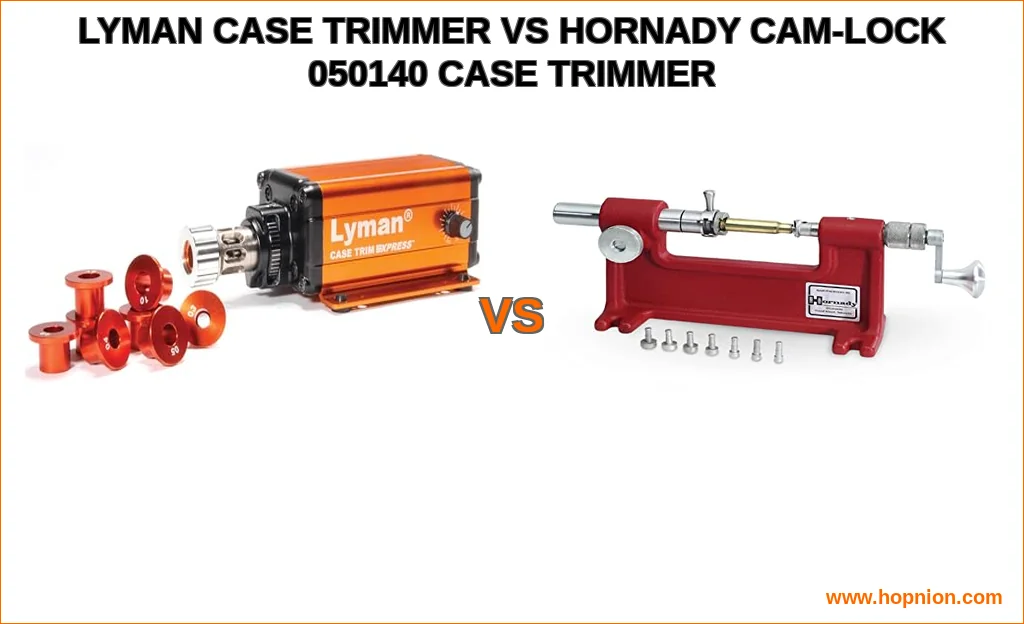
Head-to-Head: Lyman Case Trim Xpress vs. Hornady Cam-Lock
At first glance, these are two different philosophies of brass trimming. One is an electric appliance, the other a refined hand tool. A direct feature comparison lays the groundwork for ir core identities.
| Feature | Lyman Brass Smith Case Trim Xpress | Hornady Cam-Lock Trimmer 050140 |
|---|---|---|
| Power Source | Integrated variable-speed motor | Manual operation |
| Case Holding Method | Shoulder-contact bushings (10 included) | Standard Hornady shell holders (Cam-Lock lever) |
| Primary Adjustment | Fixed via bushing depth | Micrometer adjustment knob for .001″ changes |
| Cutter Type | Long-lasting carbide | Replaceable ultra-hard tool steel |
| Caliber Range | Designed for bottleneck rifle cases | Trims cases up to .50 caliber |
| Setup & Mounting | Self-contained unit | Requires bench mounting (hardware not included) |
| Included Pilots | None (uses bushings) | 7 popular pilot sizes (.22, 6mm, .270, 7mm, .30, .38, .45) |
| Check current price on Amazon | Check current price on Amazon |
Precision & Consistency: Which Trimmer Wins?
For many, this is the only metric that matters. Reloading precision starts with uniform brass, and both tools aim to deliver.
The Hornady Cam-Lock is built for meticulous adjustment. Its micrometer adjustment knob allows you to dial in length with .001-inch precision without moving the casea significant advantage for fine-tuning. The cam-lock mechanism is designed to hold the case square to the cutter, directly targeting runout during the trimming operation itself. Speaking honestly, this level of manual control is what appeals to reloaders who measure every thousandth.
The Lyman takes a different, more automated path. Its accuracy is baked into the system design. it aims for a consistent trim relative to that datum. The carbide cutter and motor provide a clean, uniform cut. However, adjusting the trim length requires changing the bushing or shimming it, which isn’t as instantly tunable as a micrometer. For high-volume trimming of a given cartridge to a set length, it’s exceptionally consistent. For constantly switching between cartridges requiring minute length adjustments, it’s less flexible.
My honest assessment is that the Hornady offers superior trim-to-length consistency across a wide array of specific lengths, while the Lyman offers superb consistency for a fixed length per cartridge setup.
Setup, Operation & Ease of Use
How a tool feels in daily use is just as critical as its specs. The user experience here is a study in contrasts.
Setup Time: The Lyman arguably wins on pure plug-and-play. You take it out of the box, plug it in, select the correct bushing, and you’re trimming. There’s no bench mounting required. The Hornady requires securing to your bench, which adds a step, but creates a stable, permanent reloading tool comparison fixture.
Operation: This is the core divide. The Lyman’s variable-speed motor does the work. You simply push the case against the spinning cutter. It’s fast, smooth, and requires minimal efforta boon for processing hundreds of cases. The Hornady is a manual crank. You lock the case with the cam lever and turn the handle. It’s more physical, but many find the tactile feedback reassuring. The question of Hornady Cam-Lock 050140 setup time vs Lyman is moot after initial setup; the real question is operational preference: electric speed or manual control.
Case Holder Compatibility: This is a major point for those with existing gear. The Hornady uses standard Hornady shell holders, which are common and often already on hand. The Lyman uses its proprietary shoulder bushings system. You’re tied to the bushings Lyman provides or may release.
From my honest perspective, noise and vibration are often overlooked. The Lyman’s motor generates both, while the Hornady is virtually silent beyond the sound of cutting brass. For some workshops, that matters.
Maintenance and Longevity Considerations
Durability is key for any reloading equipment. Honestly speaking, both are built to last, but their maintenance profiles differ.
- Lyman: The carbide cutter is praised for its long life. The primary moving part is the motor, which should require no routine maintenance. Keeping the shaft and bushings clean of brass shavings is the main task.
- Hornady: The tool steel cutting head is replaceable, a straightforward fix when it eventually wears. The cam-lock mechanism and micrometer threads benefit from occasional cleaning and a drop of oil. The manual design means fewer parts that can fail electrically.
Availability of replacement parts is generally good for both major brands like Lyman and Hornady. For the Hornady, pilots and shell holders are ubiquitous. For the Lyman, ensuring you can get specific bushings for future calibers is a consideration. When pondering Lyman vs Hornady trimmer durability long-term reviews, both have stellar reputations, with longevity often coming down to proper care.
Price Analysis & Overall Value Proposition
Value isn’t just the price tag; it’s what you get for your investment in your brass preparation workflow.
The Hornady Cam-Lock typically positions itself as the best case trimmer for precision reloading under $150. You pay for that precision micrometer and robust manual construction. Its value is in its adjustability and timeless design. It’s a buy-once-cry-once tool for the meticulous reloader.
The Lyman Case Trim Xpress commands a higher initial investment, justified by its integrated motor and carbide cutter. You’re paying for automation and speed. Its value proposition is time savings and reduced fatigue during large batch processing. If you process high volumes of rifle brass, the time saved can quickly offset the higher cost.
You must also factor in accessory costs. The Hornady includes seven pilots, covering most common calibers. The Lyman includes ten bushings for bottleneck cases. Needing an additional bushing or pilot for a new caliber adds to the total cost of ownership for either system.
User Feedback & Final Recommendation
Listening to the community is invaluable. General consensus praises the Hornady for its flawless trimming accuracy and satisfying mechanical operation. Some users note that the cam lever requires a firm hand on certain shell holders. The Lyman is universally loved for its speed and clean cuts, with some users wishing for an easier way to make fine length adjustments without swapping bushings.
So, which case trimmer is more accurate Lyman or Hornady? If we define accuracy as the ability to hit and hold a specific, arbitrary trim length with extreme precision, the Hornady and its micrometer have the edge. If we define it as producing perfectly uniform cuts on a pre-determined length, the Lyman is a powerhouse.
The Verdict: Which One is Right for Your Bench?
This isn’t about declaring one tool the winner. It’s about matching the tool to the task and the shooter.
Choose the Hornady Cam-Lock 050140 if:
- Ultimate precision and micrometer adjustability are your top priorities.
- You value a silent, tactile reloading accessory.
- You already use Hornady shell holders and want that compatibility.
- You trim a variety of calibers to different specific lengths.
Choose the Lyman Brass Smith Case Trim Xpress if:
- You process large batches of brass and prioritize speed above all.
- You primarily trim bottleneck rifle cartridges and want a set-it-and-forget-it system for each.
- You want to eliminate the physical effort of manual trimming.
- Your case prep station has the space and power for a dedicated electric tool.
To be completely honest, for the reloader who dabbles in many calibers and cherishes the craft of minute adjustment, the Hornady is a masterpiece. For the high-volume rifle shooter who views trimming as a necessary step to conquer efficiently, the Lyman is a game-changer. Both are exceptional tools that elevate the reloading tool comparison beyond simple specs to personal workflow. For more detailed insights from the broader shooting community, this authority guide offers another valuable perspective.
Your reloading bench should reflect your process. Whether you choose the engineered speed of Lyman or the calibrated precision of Hornady, you’re investing in the consistency that makes precision shooting possible. And for more gear insights that cut through the marketing, the team at Honest Opinion is always here to help. You can read more of our detailed comparisons, from trimmers to optics like the best picatinny mounting systems, to make informed decisions for your setup.