

Deciding on your first reloading press can feel like a major crossroads. Two names consistently rise to the top for newcomers: the Lee Precision Challenger Kit II and the Lee Precision Classic Turret Press. Both promise a path into handloading, but they represent fundamentally different philosophies. One is a dedicated single stage workhorse, while the other introduces the speed of an indexing turret. Your choice here dictates your entire reloading workflow, speed, and initial investment.
This isn’t just about picking a tool; it’s about choosing your reloading journey. Do you prioritize foundational learning and meticulous precision, or are you eager to produce usable rounds more efficiently from the start? We’re cutting through the noise to compare these two kits what they include, their performance DNA, and who they truly serve.
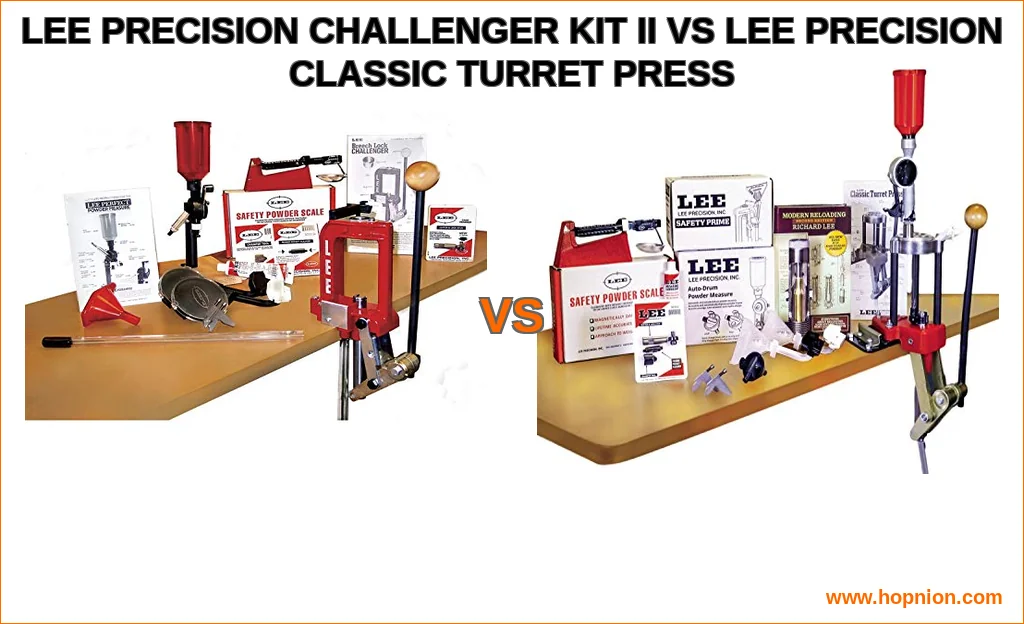
Head-to-Head Feature Breakdown
At first glance, both are “kits,” but the components and their intended use differ significantly. A side-by-side look reveals their core identities.
| Feature | Lee Precision Challenger Kit II | Lee Precision Classic Turret Press Kit |
|---|---|---|
| Press Type | Single stage reloading press | Turret press with indexing head |
| Key Included Tools | Lee Safety Scale, powder funnel, chamfer tool | Pro Auto-Drum powder measure and riser |
| Core Design Purpose | Fundamental, one-operation-at-a-time reloading | Streamlined, multi-stage process flow |
| Notable Kit Inclusions | Focus on basic case prep and weighing | Focus on automated powder dispensing |
| Made In | Information not specified in core features | Made in USA |
| Bench System | Standard mounting | Bench Plate system sold separately |
| Check current price on Amazon | Check current price on Amazon |
The Challenger Kit II is built around the single stage press. Its included toolsthe sensitive Lee Safety Scale, powder funnel, and chamfer toolhighlight a manual, controlled process. You’re weighing each charge, prepping each case mouth meticulously. It’s the reloading classroom.
Conversely, the Classic Turret Kit is built for progression. The inclusion of the Pro Auto-Drum powder measure is a game-changer. It’s designed to automatically throw a charge as part of the press stroke, which is a core feature for reloading speed & efficiency. The press frame is notably Made in USA, and it’s important to know the sleek bench plate seen in photos is an extra purchase. Speaking honestly, that turret head is the star, allowing you to pre-set dies and index from one station to the next without removing the casing.
Performance & Usability Comparison
How do these feature sets translate to the actual reloading bench experience? The gap between a single stage and a turret becomes very real here.
Setup & Learning Curve
The Challenger Kit II has a straightforward setup. You mount the press, install one die, and follow the reloading manual step-by-step. Its value proposition for learning is immense. You cannot make an automatic double-charge error because you are performing and visually verifying each operation individually. The process ingrains fundamentals. My honest assessment is that this method builds unparalleled confidence and understanding for a beginner.
The Classic Turret requires more initial setup. You must install multiple dies into the turret head, adjust the Auto-Disk Powder Measure (or the included Pro Auto-Drum), and dial in the indexing. It’s more complex, but the manual guides you through it. Once set, however, the process is remarkably streamlined. You place a casing, pull the lever through multiple stations, and a completed round emerges.
Reloading Speed & Operational Flow
This is the starkest difference. With the Challenger, you are batch processing: deprime all cases, then resize all, then prime all, etc. Output is measured in careful, deliberate rounds per hour. It’s the method for precision reloading of rifle rounds where every variable is scrutinized.
The Classic Turret is where speed lives for the pistol or high-volume rifle shooter. The indexing turret brings the die to the case. A typical workflow for pistol reloading might be: Station 1 – Deprime/Size, Station 2 – Expand case mouth & drop powder (via the Auto-Drum), Station 3 – Seat bullet, Station 4 – Crimp. One handle pull per finished round. The efficiency gain is exponential.
Long-Term Considerations & Ecosystem
Competitors often skip talking about life after the purchase. Long-term maintenance requirements for Lee presses are generally low, but the turret has moving parts (the index mechanism) that the single stage does not. Both are simple to maintain with occasional lubrication.
A major point for the enthusiast is compatibility with aftermarket accessories. This is a hidden strength of the Lee ecosystem. Companies like Inline Fabrication offer robust mounting plates, LED light kits, and ergonomic handle upgrades that fit both presses, dramatically improving the user experience on your reloading bench. The primer catcher systems can also be upgraded for better containment.
Warranty and customer support experience with Lee Precision is known to be direct and helpful, often cited for their willingness to send replacement parts for their lifetime warranty. It’s a strong point for both models.
Target Audience & Use Case Recommendations
So, which Lee press is better for beginners? Honestly speaking, it depends on the beginner’s personality and goals.
Choose the Lee Challenger Kit II if:
- You are a total novice who values mastering fundamentals above speed.
- Your primary goal is precision reloading for bolt-action rifles or long-range shooting.
- You have limited budget and want the most complete starter reloading kit.
- You plan on low-volume reloading and don’t mind a slower, meditative process.
- You want to understand every nuance of the reloading process before automating any step.
Choose the Lee Classic Turret Press Kit if:
- You are a beginner but know you’ll be reloading higher volumes of pistol cartridges (like 9mm, .45 ACP) or .223 Remington.
- You learn quickly and feel comfortable with a slightly more complex initial setup for long-term payoff.
- Speed is a genuine concern because you shoot frequently.
- You appreciate the value proposition of the included auto-drum powder measure for progressive workflow.
- You want the flexibility of a turret that can also be used as a single-stage by not indexing the head.
The question of is the Lee Classic Turret worth the extra money is best answered by your volume. For 50 rounds a month? Probably not. For 200+ rounds a month? Absolutely. The time savings quickly justify the investment. For low volume reloading of precision rifle, the Challenger remains the king.
Final Verdict & Buying Advice
This isn’t about one press being objectively better. It’s about the right tool for the shooter. From my honest perspective, the Lee Precision Challenger Kit II is the ultimate teacher. It forces good habits and delivers exceptional value with a scale, funnel, and tools to get you started. It’s the bedrock of a solid reloading practice.
The Lee Precision Classic Turret Press Kit is the efficient producer. It gets you from components to finished ammo in a streamlined, repeatable process. The inclusion of the auto-drum measure is a huge benefit, making it a more complete “production” kit out of the box. It shares the robust build of the classic Lee cast iron line.
My honest take is this: if your future involves regular pistol shooting or volume rifle loading, the Turret’s efficiency will prevent frustration and save countless hours. Start with it. If your journey is about meticulous rifle accuracy, learning the craft from the ground up, or strictly limited volume, the Challenger Kit II is a perfect and respected choice.
Before you buy any press, always consult multiple official source guides and manuals. Cross-reference data for safety. Remember, the press is just the beginning. You’ll need dies, components, and a solid bench. But choosing between these two Lee kits sets your trajectory. Consider your shooting habits honestly, and you’ll make the right call. For more unfiltered gear analysis, you can always find it at our Honest Opinion.