

Deciding on your first or next reloading press can feel like a major crossroads. On one side, you have the classic, time-tested simplicity of a single stage press. On the other, the alluring speed of a progressive press promises to revolutionize your workflow. Lee Precision offers two compelling options that sit at this very intersection: the Breech Lock Challenger and the Pro 4000 Press Kit. Each represents a fundamentally different approach to the craft.
My honest assessment is that this isn’t just a choice between two tools, but between two philosophies of reloading. One prioritizes meticulous control and foundational skill, while the other is engineered for volume and efficiency. To be completely honest, the right answer depends entirely on what you’re loading, how much you’re loading, and what you value most at your reloading bench. Let’s break them down.
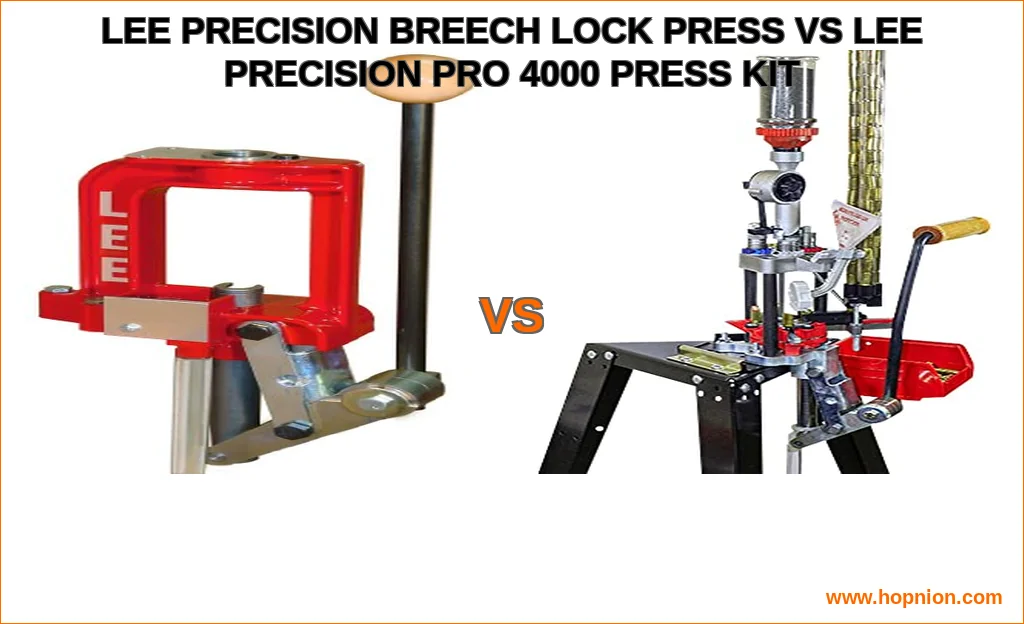
Head-to-Head: Core Feature Breakdown
At their core, these presses belong to different categories. The Breech Lock Challenger is a robust single stage press, while the Pro 4000 is a fully-fledged progressive reloading machine. This fundamental difference dictates every aspect of their design and use.
Design & Core Operation
The Lee Precision Breech Lock Challenger Press is built around simplicity and strength. It features an all-steel linkage with an adjustable length lever, designed for durability and a consistent feel. Its standout feature is the breech lock bushing system. This system allows you to pre-set your dies in dedicated bushings and swap them in and out of the press in seconds without losing your calibration. Honestly speaking, for a beginner or someone who values absolute consistency in each stage, this is a game-changer.
In contrast, the Lee Precision 223 Remington Pro 4000 Press Kit is a modular progressive press. It’s designed to perform multiple operationsdepriming, resizing, priming, charging, bullet seating, and crimpingwith each pull of the lever. A key advantage is its cartridge changeover, which is achieved in seconds, including primer size, with no adjustments needed. The Pro 4000 also incorporates the Breech Lock quick-change feature in all four stations, marrying the convenience of the bushing system with the speed of a progressive.
| Feature | Lee Breech Lock Challenger | Lee Pro 4000 Press Kit |
|---|---|---|
| Press Type | Single Stage Press | Progressive Press |
| Key Innovation | Breech Lock Quick-Change Bushing | Breech Lock in all 4 stations; Modular Automation |
| Primer System | On-press priming (manual) | Through-ram primer disposal with built-in tube |
| Case Handling | Manual | Exclusive auto case placer; Case feeder compatible |
| Included Bushings | One Breech Lock bushing | Four colored spline drive breech lock bushings |
| Handle | Standard Lever | Ergonomic wood grip roller handle |
| Check current price on Amazon | Check current price on Amazon |
Performance & Workflow: Speed vs. Precision
Your reloading workflow will look dramatically different depending on which press you choose. This is where the theoretical becomes practical.
The Single-Stage Methodology
With the Breech Lock Challenger, you process batches of cases through one stage at a time. You’ll resize and deprime 50 cases, then prime 50 cases, then charge 50 cases, and so on. This methodical pace is ideal for learning. It allows you to inspect each case closely at every step, which is invaluable for developing an eye for detail and nuances of your loads. For rifle caliber reloading, where precision is paramount, many experienced reloaders swear by this approach. It forces a discipline that builds foundational skills.
From my honest perspective, the adjustable lever and solid construction make it a joy for tasks like bullet swaging or using heavy-duty resizing dies. You develop a rhythm. However, producing a high volume of pistol caliber rounds can become a lengthy project.
The Progressive Advantage
The Pro 4000 transforms the workflow. One handle pull yields one finished round. The included auto case placer automatically positions a new case as you index the shell plate, significantly reducing hand movements. The through-ram primer feed system with its disposal tube keeps spent primers contained. The modular design means you can start simple and add automation, like the case feeder, later.
The advertised “no adjustments” for caliber changes is a huge benefit for those who load multiple cartridges. Swapping the shell plate, primer arm, and dies (secured in their breech lock bushings) gets you from .223 Remington to 9mm in minutes. My honest take is that for volume pistol shooting or even high-volume .223 plinking loads, the time savings are monumental. You’re not just faster; you’re less fatigued because the process is streamlined.
Value & Cost Analysis: Getting What You Pay For
Is the Lee Pro 4000 worth the extra money? That’s the million-dollar question for many reloaders. Honestly speaking, it’s not just about the initial price tag but the total value proposition for your specific needs.
The Breech Lock Challenger represents a lower barrier to entry. You get a tremendously durable, American-made single stage press that will last for decades. It’s the perfect platform to learn on without a massive investment. You’ll need to purchase dies, a priming tool, a powder measure, and other accessories separately, but this allows for curated, high-quality choices from brands like RCBS or Hornady. For the meticulous reloader who enjoys the process as much as the product, this press offers outstanding value.
The Pro 4000 kit is a more comprehensive, albeit specialized, package. It’s sold configured for a specific caliber (like .223 Remington in our example), meaning it comes with the appropriate shell plate and primer parts. You’re paying for an integrated system designed for output. The value is in the time you reclaim. If you shoot hundreds of rounds a month, the kit pays for itself in saved hours. However, it’s a more complex machine. The learning curve is steeper, and troubleshooting a progressive press requires a deeper understanding of how all the stages interact.
It’s also wise to consider long-term durability reports. The Challenger’s simple, all-steel design has a legendary reputation for lasting generations. The Pro 4000, with its plastic auto-case placer and more moving parts, may require more attentive maintenance and care over the same period. Checking user forums for long-term experiences with both models is a smart move before deciding.
Target User & Ideal Use Cases
- Choose the Lee Breech Lock Challenger if: You are a beginner asking “which Lee press is better for beginners?”. You primarily reload precision rifle calibers or small batches. You value the learning process and want to master each stage. Your budget is a primary concern, and you prefer to build your kit piece by piece.
- Choose the Lee Pro 4000 Press Kit if: You need to produce high volumes of pistol or rifle ammo efficiently. You already understand the reloading basics and are frustrated by the slow pace of a single-stage. You load one or two calibers in bulk and want the fastest possible workflow. The higher initial investment is justified by your shooting volume.
Final Verdict: Right Press for You
So, which press wins? The truth is, they both dojust for different people. I honestly believe there is no universally “better” press, only a better press for you.
For the new reloader, the Breech Lock Challenger is the unequivocal recommendation. It teaches proper technique, encourages careful inspection, and builds the skills that make you a better reloader for life. Its simplicity is its strength, and problems are typically easy to diagnose and solve. You can always add a progressive press later for volume work, but you’ll never regret starting with a solid single-stage foundation. For more on starting with single-stage precision, we have a detailed breakdown.
For the reloader who has outgrown their single stage or who knows from the start they need volume, the Pro 4000 is a compelling entry into progressive reloading. Its modularity, quick-change features, and case feeder compatibility make it a flexible system that can grow with your needs. If you find yourself dreading the hours needed to prep for a match or a long range day, the Pro 4000’s speed is a legitimate solution.
Before making any purchase, always consult a current authority guide like a reloading manual for data and safety procedures. Also, consider your workspace; a sturdy reloading bench is non-negotiable for either press, and companies like Inline Fabrication offer fantastic upgrades.
My final, honest to goodness advice? Be realistic about your shooting habits. Match the tool to the task. Both of these Lee Precision presses are capable tools that have earned their place in the reloading community. The Challenger is your reliable, master-craftsman’s bench knife. The Pro 4000 is your powered workshop, built for production. Your next box of ammo, and the hundreds after it, will thank you for choosing wisely. For another angle on this decision, our precision comparison dives deeper into specific models. And remember, this is just one Honest Opinion from a fellow enthusiast; your needs define your perfect press.