

Two iconic names dominate the reloading bench conversation: Lee Precision and Dillon Precision. Each represents a distinct philosophy in the world of ammunition crafting. The Lee Precision Breech Lock Challenger Press and the Dillon Precision RL550C Reloading Machine stand at opposite ends of the spectrum, catering to fundamentally different needs and budgets. This isn’t just about picking a tool; it’s about choosing your reloading path.
core difference between a single-stage press and a progressive press is the first step. It dictates your workflow, your output, and your initial investment. My honest assessment is that there is no universal “best” press, only the best press for your specific goals, whether that’s ultimate reloading precision or high-volume reloading speed.
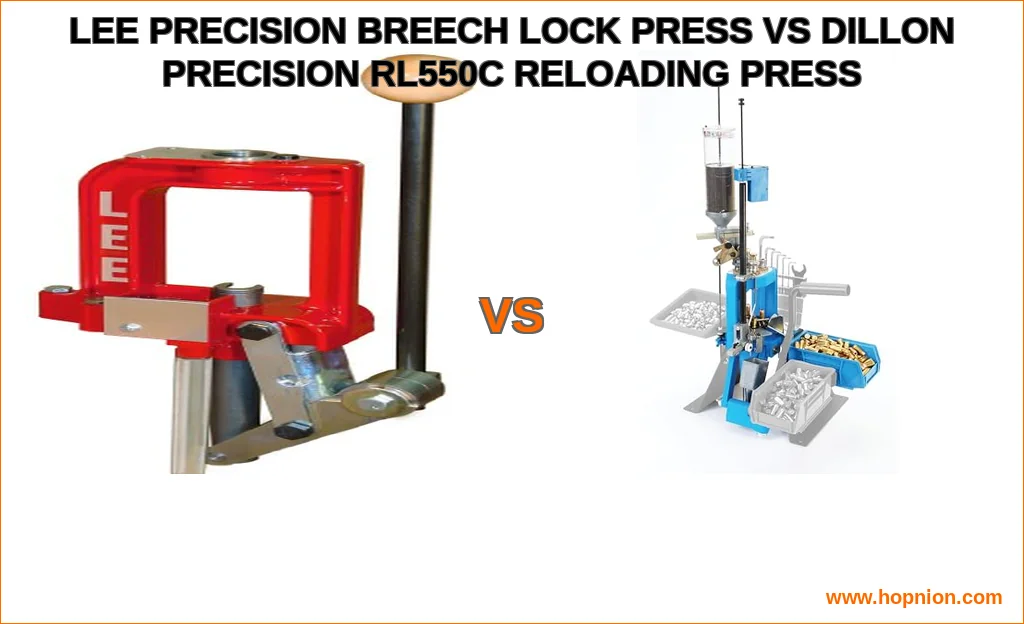
Head-to-Head: Lee Breech Lock Challenger vs. Dillon RL550C
Let’s break down these two machines side-by-side. The table below outlines their fundamental specifications based on their core features.
| Feature | Lee Precision Breech Lock Challenger Press | Dillon Precision RL550C Reloading Machine |
|---|---|---|
| Press Type | Single-Stage Press | Manual-Index Progressive Press |
| Key Mechanism | Breech lock system for quick die changes | Removable toolhead for caliber changes; Manual shell plate indexing |
| Operation | One cartridge operation per handle pull | Multiple operations (up to 4) per handle pull |
| Primary Build | All-steel linkage, adjustable lever | Greaseable pivot pin, robust construction |
| Notable Feature | Includes one Breech Lock quick-change bushing | Case-activated powder measure; Made in USA |
| Check current price on Amazon | Check current price on Amazon |
Price, Value, and Initial Investment
The reloading setup cost is often the deciding factor. Honestly speaking, the price gap here is substantial. The Lee Breech Lock Challenger is famously affordable, representing a minimal entry point into the craft. You’re paying for a solid, durable single-stage press built with an all-steel linkage. The Dillon RL550C commands a significantly higher price, but you’re investing in a system designed for volume and efficiency.
This Lee Precision vs Dillon Precision reloading press cost comparison extends beyond the press itself. With the Dillon, you must factor in the cost of a separate primer system, shell plates for each caliber, and potentially a case feeder. The Lee starts as a more complete kit for basic operations. From my honest perspective, the Lee wins on pure initial cost, while the Dillon’s value is realized over thousands of rounds where its speed pays off the investment.
Ease of Use, Setup, and Learning Curve
For a novice, the learning curve is a major consideration. The Lee Breech Lock Challenger is arguably one of the best presses for beginners. Its operation is simple and linear. You focus on one task at a time: sizing, priming, charging, seating. This methodical pace is perfect for learning the fundamentals of reloading precision without feeling overwhelmed. The breech lock system is a fantastic quality-of-life upgrade, allowing you to swap dies in seconds without constantly re-adjusting them.
The Dillon RL550C has a more complex setup. Aligning four stations, setting up the case-activated powder measure, and manual indexing process requires more initial study. Speaking honestly, it’s not inherently difficult, but it demands more patience at the start. The payoff is a streamlined process once dialed in. The removable toolhead is a brilliant feature for shooters who switch calibers frequently, as it preserves all your die and powder settings.
A common question is, can you use Dillon dies on a Lee Breech Lock press? The answer is yes. Standard 7/8″-14 threaded dies are universal across most major brands, including Lee, Dillon, RCBS, and Hornady. This interoperability is a key point when planning your reloading accessories.
Production Speed, Volume, and Precision
This is where the philosophies collide. The Lee is about meticulous control. You handle each case individually, inspecting it at every stage. This is ideal for precision rifle ammunition, where consistency is paramount. You might produce 50-100 rounds per hour, but each one receives your full attention.
The Dillon RL550C is built for volume. With each pull of the handle, you can size a new case, prime a previously sized case, charge a case with powder, and seat a bullet in another. A skilled operator can easily produce 400-500 rounds per hour. The manual indexing gives you control to verify each stage, blending speed with oversight. The case-activated powder measure is a huge advantage for both speed and safety, preventing powder spills.
Missing from many discussions are practical bench considerations. The Dillon, being a larger progressive press, has a more substantial bench mounting requirements. It needs a sturdier bench, more torque on the bolts, and a larger footprint. The Lee, being smaller and generating less leverage stress, can be mounted on a lighter setup. Vibration and noise are also generally lower with a single-stage press.
Durability and Long-Term Value
Both companies tout their reloading press durability. Lee emphasizes the Challenger’s all-steel construction and its reputation for lasting “a long time.” Dillon’s RL550C is built as a commercial-grade machine, featuring a greaseable lower pivot pin for smooth, long-lasting performance and is famously backed by their “no BS” warranty. Honestly speaking, both are built to endure years of use, but the Dillon is engineered for a significantly higher round count over its lifetime.
Maintenance differs too. Reloading press maintenance on a single-stage like the Lee is minimalperhaps an occasional wipe-down and oil. The Dillon, with its more complex linkage and primer system, requires more attentive cleaning and lubrication to keep it running at peak reloading speed. For detailed reloading press specs and maintenance guides, always consult the manufacturer’s official source or an authority guide.
Final Verdict: Who Should Buy Which Press?
So, which is better Lee Breech Lock or Dillon 550C for a beginner? To be completely honest, for someone entirely new to reloading, the Lee Breech Lock Challenger is the wiser starting point. It forces good habits, minimizes initial investment, and its simplicity builds confidence. It’s the perfect tool for learning the art of precision reloading.
The Dillon Precision RL550C is for the reloader who has outgrown the single-stage pace. It’s for the pistol shooter, the 3-Gun competitor, or the high-volume rifle plinker who needs to produce hundreds of rounds per session. It represents a serious upgrade in workflow efficiency.
Is the Dillon RL550C worth the extra money over a Lee? My honest take is that it absolutely isif your shooting volume justifies it. The time savings alone can offset the cost for an active shooter. If you’re loading 50 rounds of .308 for a hunting trip once a year, it’s overkill. If you’re burning through 500 rounds of 9mm a month, it’s a game-changer.
Your choice ultimately hinges on your primary use case. Seek the methodical, cost-effective mastery of a single-stage press, or embrace the efficient throughput of a progressive press. For more nuanced comparisons within a brand, like examining different Lee models, you can find a detailed precision reloading analysis on our site. Remember, the best press is the one you’ll use consistently to safely feed your passion. That’s the Honest Opinion from this bench.