

Two tools sit on opposite ends of the brass prep spectrum. One is a classic, manual workhorse focused on a single, critical task. The other is a modern, multi-tasking station designed for speed. The Hornady Cam-Lock 050140 case trimmer and the Frankford Arsenal Platinum Case Prep Center represent fundamentally different philosophies for your reloading bench. Your choice isn’t just about price; it’s about your entire approach to precision reloading.
Are you a high-volume shooter needing to process hundreds of cases, or a meticulous precision hunter focused on absolute case uniformity for a specific rifle? The answer dictates which tool becomes your go-to. This isn’t about declaring one the universal winner. It’s about matching the machine to your mission.
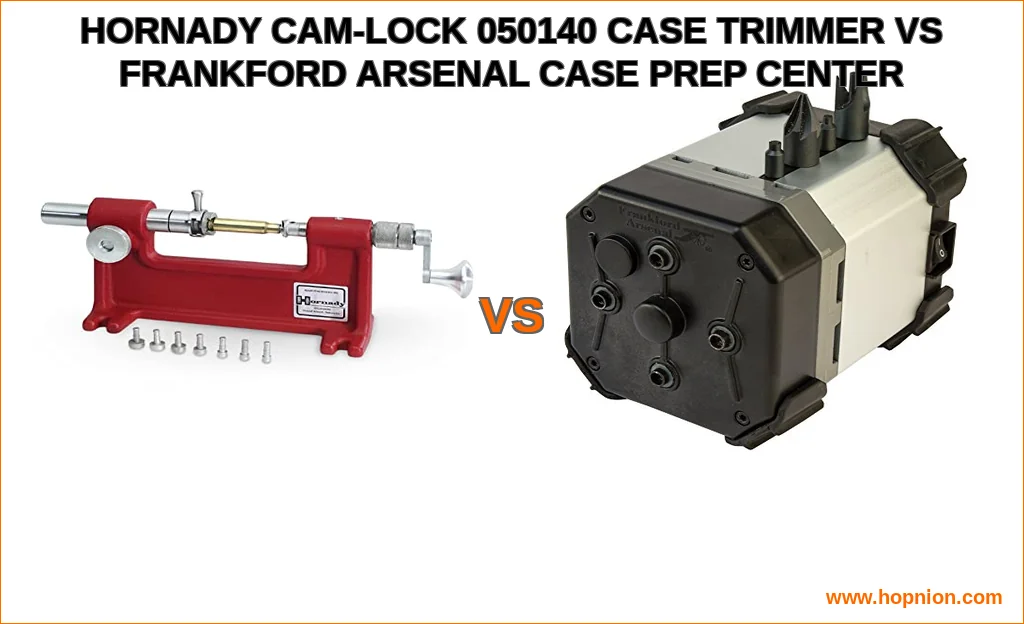
Head-to-Head Overview: Hornady Cam-Lock vs. Frankford Arsenal
At their core, these tools solve different problems. The Hornady Cam-Lock is a dedicated, manual case trimmer. Its entire purpose is to restore fired brass to a precise trim length. The Frankford Arsenal is a motorized station that handles multiple brass prep steps simultaneouslytrimming is just one of its functions, and it requires separate, often aftermarket, cutter heads.
Think of it as a precision lathe versus a workshop power tool hub. One excels in focused accuracy, the other in consolidated workflow. My honest assessment is that confusing their primary roles leads to frustration. You don’t buy the Hornady for speed, and you don’t buy the Frankford Arsenal solely for its trimming precision out of the box.
| Feature | Hornady Cam-Lock Trimmer 050140 | Frankford Arsenal Platinum Prep Center |
|---|---|---|
| Core Function | Dedicated Manual Case Trimmer | Motorized Multi-Station Prep Center |
| Operation | Manual operation via lever and crank | Electric motor drives up to 4 stations at 200 RPM |
| Primary Tasks | Trimming to precise case length | Chamfering, deburring, primer pocket cleaning (trimming with add-on) |
| Included Tooling | 7 pilot sizes (22 cal to 45 cal), replaceable cutting head | Inside chamfer, outside deburr, small & large primer pocket scrapers (all HSS) |
| Key Design | Cam-lever lock, micro-adjust cutter (.001″), mounts to bench | 4 powered stations, 8-32 threaded shafts for aftermarket tools, aluminum body |
| Case Capacity | Trims cases up to .50 caliber | Dependent on added tooling; versatile via threaded shafts |
| Check current price on Amazon | Check current price on Amazon |
Detailed Feature Breakdown & Performance
Hornady Cam-Lock 050140: The Precision Specialist
This tool is all about repeatable accuracy. The cam-lever system locks the case securely in a standard Hornady shell holder, ensuring it’s held square to the cutter. This is critical for case uniformity. The micro-adjust cutter allows for .001-inch changes, a feature prized by long-range shooters who tune trim length to their specific chamber.
Its large diameter, replaceable cutting head is made of ultra-hard tool steel and handles everything up to .50 BMG. Honestly speaking, for dedicated rifle brass like .308 or 6.5 Creedmoor, this manual control is hard to beat. It includes seven pilots, covering most common calibers. The process is tactile and directyou feel the cut. However, it’s just step one. After trimming, you still need to chamfer, deburr, and clean primer pockets separately.
Frankford Arsenal Platinum: The Volume Workhorse
This unit is about tackling multiple prep stages in one powered location. Its four 200 RPM stations come loaded with hardened high-speed steel (HSS) tools for inside chamfer, outside deburr, and both small and large primer pocket cleaning. You can, in theory, run all four heads at once.
The 8-32 threaded output shafts are a game-changer, accepting a wide array of aftermarket tools. To make it a true case prep center, you’d add a powered trimmer head (like one from Lyman or RCBS) into one of those stations. This creates a consolidated workflow: trim, chamfer, deburr, and clean pockets without changing tools or workstations. The aluminum body includes a retention slot for tool storage, a small but thoughtful touch.
Workflow Efficiency & Ease of Use
This is where the philosophical divide becomes practical. Manual operation with the Hornady is methodical. You mount it, insert a case, lock the cam, turn the crank, and measure. It’s quiet, requires no power, and builds consistency through rhythm. For processing 50 pieces of precision brass, it’s meditative. For 500 pieces of .223, it’s a forearm workout.
The Frankford Arsenals motorized station is built for throughput. Plug it in, and the stations are always spinning. You move the case from one head to the next. When set up with a trimmer head, it can feel like a mini assembly line. But this speed introduces other considerations. Motorized trimming can generate significant brass dust and fine powder residue. A small shop vacuum setup becomes almost mandatory for powder residue management and dust collection, a missing entity in many discussions about these centers.
So, which is faster, Hornady Cam-Lock or Frankford Arsenal? For trimming alone on a per-case basis, a skilled user on a manual trimmer can be surprisingly quick. But for completing the entire brass prep sequence (trim, chamfer, deburr), the Frankford Arsenal, once fully equipped, will outpace any manual process. There’s no contest.
Maintenance and Durability Considerations
Long-term ownership brings up the maintenance requirements comparison. The Hornady is mechanically simple. Keep it clean, occasionally replace the cutter head, and it lasts decades. There are no motors to wear out.
The Frankford Arsenal, with its electric motor and multiple moving parts, has a more complex durability profile. The motor and bearings are subject to wear, especially under heavy load or if used for extended sessions. Speaking honestly, user reports over time suggest the longevity can vary, and it’s wise to consider the unit’s placement in a well-ventilated area to manage motor heat. This is a key part of the long-term cost analysis.
Price, Value, and Long-Term Cost Analysis
The initial price tag is just the entry fee. The Hornady Cam-Lock is a more straightforward purchase. You buy the trimmer, maybe a specific shell holder, and you’re done. Its value is locked into its precision and durability.
The Frankford Arsenal has a hidden cost of ownership. The base unit handles chamfer, deburr, and pocket cleaning. To make it a complete solution that truly rivals a dedicated trimmer’s function, you must invest in a quality aftermarket powered trimmer head and the appropriate pilots. This can add a significant amount to your initial outlay. However, that investment then creates a single, powerful hub for all your case prep.
From my honest perspective, the value proposition hinges on volume. If you shoot a few hundred rounds a year of a couple calibers, the Hornady plus a handheld chamfer tool is cost-effective and supremely capable. If you’re feeding multiple semi-autos or are deep into progressive reloading, the time savings and consolidated workflow of a fully loaded Frankford Arsenal justify its total system cost. For more insights on setting up an efficient workspace, check out our guide on essential picatinny accessories that complement a solid bench.
Final Verdict: Best Tool for Your Reloading Style
This isn’t a one-size-fits-all decision. Your shooting habits dictate the winner.
Choose the Hornady Cam-Lock 050140 Case Trimmer if:
- Your priority is absolute precision and case uniformity for bolt-action or precision rifle brass.
- You prefer a simple, mechanical, and quiet tool with minimal maintenance.
- Your volume is moderate, and you don’t mind a sequential, hands-on prep workflow.
- You already own other manual prep tools and just need a superior trimmer.
Choose the Frankford Arsenal Case Prep Center if:
- You process high volumes of brass, especially for pistol or high-volume rifle calibers.
- You want to consolidate chamfer, deburr, and primer pocket cleaning into one powered station.
- You are willing to invest in additional aftermarket tooling (like a trimmer head) to unlock its full potential.
- Your bench has space for a dedicated, plugged-in station and you have a plan for dust management.
My honest take is that many serious reloaders end up with both types of tools. A manual trimmer like the Hornady is indispensable for precision rifle work, while a motorized center handles the bulk processing for plinking ammo. It’s the classic “right tool for the job” scenario.
For a broader look at the case trimmer landscape, this authority guide from the NSSF provides excellent context. At the end of the day, the best choice aligns with your time, budget, and ballistic goals. I honestly believe that understanding this core distinctionspecialist versus generalist, manual versus motorizedis more important than any single feature list. For more gear insights and unbiased reviews, the team at Honest Opinion is always digging into the details. You can read more of our in-depth comparisons to make informed decisions for your setup.