

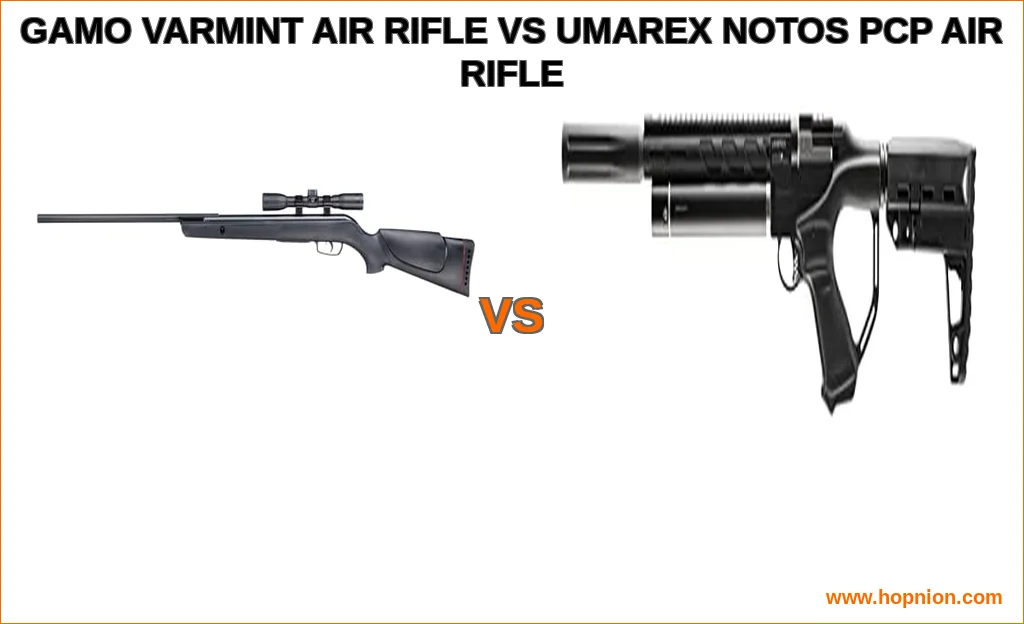
Two distinct philosophies of airgun design sit on the table. On one side, the Gamo Varmint represents the classic, self-contained power of a break-barrel spring-piston rifle. On the other, the Umarex Notos Carbine showcases the modern, multi-shot convenience of a regulated pre-charged pneumatic (PCP) system. Both are marketed for backyard shooting and pest control, but their paths to getting there are wildly different.
Honest OpinionThis isn’t just about picking a pellet rifle; it’s about choosing an entire shooting experience. Your budget, patience for preparation, and intended use will heavily sway the decision. Speaking honestly, the right tool depends entirely on what you value more: ultimate simplicity or refined performance.
Head-to-Head Overview: Gamo Varmint vs. Umarex Notos
Before diving into the weeds, a quick snapshot sets the stage. The Gamo Varmint is a .177 caliber, single-shot springer boasting a high 1250 FPS velocity claim. The Umarex Notos is a .22 caliber PCP carbine with a 7-shot magazine and a 700 FPS rating. Immediately, the trade-offs become apparent: raw speed versus shot capacity, different calibers, and fundamentally different power plants.
| Feature | Gamo Varmint .177 | Umarex Notos .22 |
|---|---|---|
| Action Type | Spring-Piston (Break-Barrel) | Pre-Charged Pneumatic (PCP) |
| Caliber | .177 | .22 |
| Velocity (FPS) | 1250 (with alloy pellets) | 700 (with 12-grain pellets) |
| Magazine Capacity | Single Shot | 7-Shot Rotary |
| Cocking Method | Break-Barrel | Side Lever |
| Included Scope | 4×32 Scope & Mount | None |
| Barrel | Steel with fluted polymer jacket | 11.75-inch barrel |
| Check current price on Amazon | Check current price on Amazon |
Power Source & Performance: The Spring vs. PCP Divide
This is the core of the debate. The Gamo Varmint’s spring-piston engine is entirely mechanical. You provide the power compressing a spring. This makes it a go-anywhere rifleno external air source needed. That advertised 1250 FPS is achieved with lightweight alloy pellets, which is a key detail. Heavier, more accurate .177 pellets for hunting will travel slower but carry more consistent energy.
The Umarex Notos requires an external air source, like a hand pump or scuba tank, to fill its fixed, regulated HP air tank. The regulator is crucial; it ensures each of the roughly 30-40 shots per fill (the Umarex Notos shot count per fill) has very similar velocity, leading to incredible consistency. Its 700 FPS with a 12-grain .22 pellet generates significant muzzle energy (FPE), often surpassing a lightweight .177 projectile despite the lower speed. My honest assessment is that the Notos’s regulated PCP system provides a more stable and predictable power curve shot-to-shot.
Velocity vs. Consistency
High FPS velocity numbers are seductive, but they don’t tell the whole story. Spring-piston rifles like the Varmint are sensitive to hold and have a distinct two-stage recoil impulse (the spring moving forward, then the piston hitting air cushion) that can challenge accuracy. PCPs like the Notos have almost no recoil and minimal vibration, making them inherently easier to shoot accurately. For the shooter asking which is more accurate, Gamo Varmint or Umarex Notos, the PCP’s platform typically holds a mechanical advantage.
Accuracy, Range & Real-World Shooting
Here’s where theoretical power meets practical application. The included 4×32 scope on the Gamo Varmint gets you started, but springer scopes must be built to withstand the reverse recoil. Honestly speaking, many shooters eventually upgrade to a more robust air rifle scope designed for spring-piston use. Accuracy demands a consistent “artillery hold” to manage the gun’s movement.
The Notos, being a PCP, is far less hold-sensitive. Its accuracy potential is higher, but you must budget for optics separately. Its 7-shot magazine and side-lever cocking allow for rapid, quiet follow-up shotsa huge benefit for pest control. From my honest perspective, the Notos is the more capable platform at extended ranges due to its shot-to-shot consistency, even if its muzzle velocity is lower on paper.
Pellet Performance & Optic Pairings
Competitors often skip specific recommendations. For the Gamo Varmint, pairing it with a scope rated for springers from brands like Hawke or UTG is wise. It tends to shoot standard lead .177 pellets in the 7.0 to 8.5 grain range well for hunting. For the Notos, a compact scope or red dot works great on its picatinny rail. It’s optimized for .22 pellets around 12-16 grains. Testing brands like JSB, H&N, or Crosman Premier will reveal its favorite diet for best air rifle accuracy.
Features, Ergonomics & Build Quality
The Gamo Varmint features a synthetic Monte Carlo stock with dual raised cheekpieces, a manual safety, and an anti-be (apparently short for anti-beartrap) trigger mechanism. The steel barrel has a fluted polymer jacket. It’s a complete, ready-to-shoot package.
The Umarex Notos Carbine is defined by its compact, bullpup-inspired design. The quiet side-lever cocking is smooth, and the auto-indexing magazine is a game-changer. The fixed air tank is regulated, as noted. Its build is utilitarian and focused on function. To be completely honest, the Notos feels like a specialized tool, while the Varmint follows a more traditional rifle blueprint.
Maintenance Requirements
This is a critical, often missing entity. The spring-piston Gamo requires occasional lubrication with specific springer-rated oils and careful attention to not leave it cocked. The PCP Notos has different needs: maintaining clean, dry air source for filling, occasional O-ring inspection, and safe degassing procedures for any work. The PCP system has more seals but less violent internal movement.
Value, Use Cases & Final Recommendation
This is the ultimate pellet gun comparison decider. The Gamo Varmint wins on initial cost and total simplicity. You buy the rifle, some pellets, and you’re shooting. It’s a legitimate choice for casual plinking and close-range pest control where a single, careful shot is possible. It fits the bill for the best air rifle for squirrels under $300 if you master its technique.
The Umarex Notos has a higher initial cost when you factor in a pump ($100-$150) and an optic. However, it delivers a premium shooting experience: multi-shot capability, low recoil, and high consistency. It’s a more serious tool for frequent backyard shooting or dispatching pests efficiently. The ongoing “cost” is the physical effort of pumping or access to compressed air.
Who Should Choose What?
- Choose the Gamo Varmint if: Your budget is strict and upfront. You want zero fuss with air sources. Your shooting is occasional and you enjoy the challenge of mastering a springer.
- Choose the Umarex Notos if: You value shot consistency and multi-shot capability. You’re willing to invest in a pump/optic for a better shooting experience. Your pest control needs demand quick, quiet follow-ups.
My honest take is that for a first airgun, the Gamo’s simplicity is appealing. But for a shooter who already understands the hobby and wants a noticeable step up in performance, the Notos represents incredible value in the PCP world. It bridges the gap to more expensive rifles beautifully.
Final Verdict
The PCP vs spring piston debate is perfectly embodied here. The Gamo Varmint .177 is the accessible, all-in-one workhorse. The Umarex Notos .22 is the modern, efficient specialist. If you want my honest opinion, the Notos is the more capable and satisfying rifle to shoot long-term, despite its extra steps. The Gamo is the easier entry point with a steeper learning curve for precision.
For those looking to dive deeper into formal target shooting, organizations like the official source for UK shooting or the authority guide for U.S. junior programs are fantastic resources. And remember, whichever rifle you choose, secure storage is non-negotiable. A good under-bed safe can be a perfect solution for these compact airguns.
In the end, your Honest Opinion on what matters mostsimplicity or performancewill guide you to the right choice. Both rifles deliver solid value on their own terms, proving that great backyard shooting doesn’t have to break the bank.