

Two airguns sit on the table, representing entirely different worlds. On one side, the Gamo Varmint air rifle embodies a classic, purpose-built tool. On the other, the DPMS DSBR CO2 BB rifle offers a modern, tactical experience. They might both fire projectiles, but their design philosophies, performance, and intended users couldn’t be more distinct. Choosing between them isn’t about “best” gun, but the right tool for your specific needs.
This comparison cuts through the marketing to look at what each platform actually delivers. We’ll examine power sources, practical accuracy, real-world use cases, and the long-term costs that often get overlooked. My honest assessment is that one excels as a serious tool, while the other thrives as an engaging recreational platform.
Two Different Philosophies
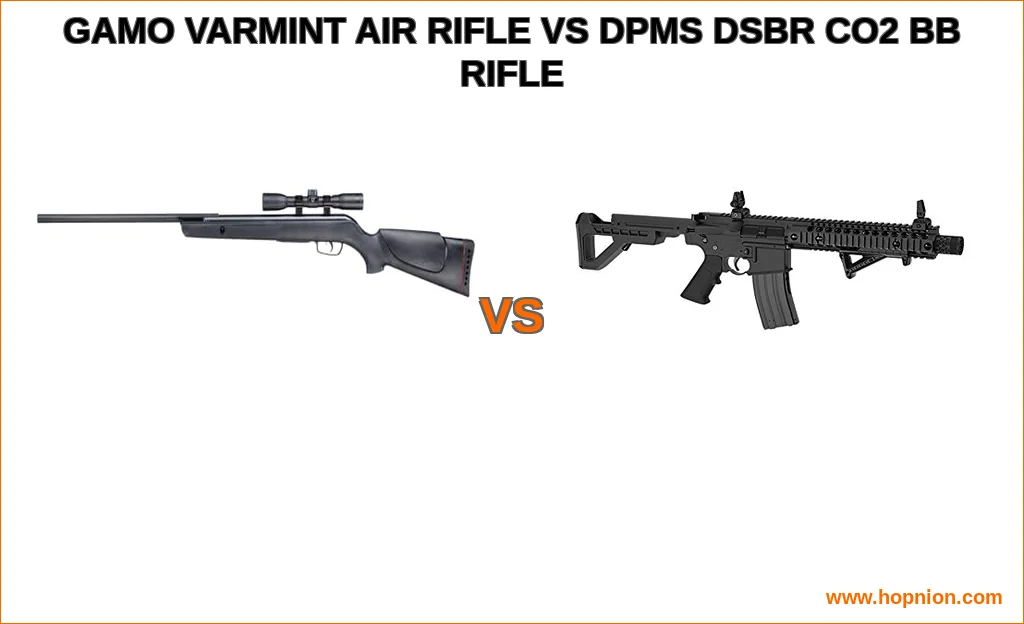
The core difference is immediately apparent. The Gamo Varmint is a break-barrel, spring-piston air rifle chambered in 4.5mm (.177 caliber). It’s a single-shot design focused on precision and power generation from a self-contained mechanism. The included 4×32 scope signals its purpose: hitting a small target at distance.
Conversely, the DPMS DSBR is a CO2-powered, semi/full-auto BB rifle. It uses a 25-round drop-out magazine for traditional 4.5mm steel BBs and is fueled by two 12-gram CO2 cartridges. Its adjustable stock, removable pop-up sight, and tactical synthetic design prioritize a specific user experienceone of volume fire and handling realism over raw ballistic performance.
Power & Performance: Spring vs. CO2
This is where the rubber meets the road. The powerplant dictates everything from velocity to shot cycle to operating cost.
The Gamo Varmint’s spring-piston system generates its power mechanically. You break the barrel to cock it, compressing a spring. When you pull the trigger, that spring drives a piston to create a blast of air. This delivers a stated velocity of 1250 FPS (feet per second). It’s important to note that this figure is typically achieved with ultra-light pellets; heavier hunting pellets will travel slower but carry more energy. The system has a distinct recoil impulsea forward-and-back “jump” from the piston movementthat requires a proper hold to master for accuracy.
The DPMS DSBR uses compressed gas. Two CO2 cartridges provide the power for a claimed velocity of up to 430 FPS (feet per second). The FPS comparison here is stark: 1250 vs. 430. Honestly speaking, this makes the DPMS a short-range tool. The CO2 system offers consistent power shot-to-shot until the cartridges deplete, with virtually no felt recoil, making it very easy to manage during rapid fire. However, power and velocity are significantly lower.
| Feature | Gamo Varmint Air Rifle | DPMS DSBR CO2 BB Rifle |
|---|---|---|
| Power Source | Spring-piston (break-barrel) | Dual 12-gram CO2 Cartridges |
| Stated Velocity | 1250 FPS | Up to 430 FPS |
| Ammunition Type | .177 Caliber Pellets (single-shot) | 4.5mm Steel BBs (25-rd magazine) |
| Action Type | Single-shot | Semi/Full-Auto Capable |
| Barrel Description | Steel barrel with fluted polymer jacket | Not Specified |
| Check current price on Amazon | Check current price on Amazon |
Accuracy & Effective Range
Velocity is one thing, but precision is another. The Gamo is built for it. The combination of a rifled steel barrel (which imparts spin on a lead pellet for stability) and the included 4×32 scope allows for precise shot placement. Gamo Varmint accuracy at 50 yards is a reasonable expectation with practice and the right pellet choice. The synthetic Monte Carlo stock with dual cheek pieces aids in a consistent cheek weld, which is critical for scope use. The manual safety and anti-beartrap trigger are standard safety features on quality break-barrels.
The DPMS DSBR is designed for fun plinking. It uses a smoothbore barrel (typical for BB guns) and shoots round steel BBs, which are inherently less accurate than diabolo-shaped pellets. The adjustable rear and pop-up sights are for quick, close-range target acquisition, not precision grouping. Its effective range is realistically under 25 yards. From my honest perspective, comparing these two on accuracy is like comparing a dart to a shotgunthey’re for different games.
Covering the Details Others Miss
Many reviews gloss over specifics that affect real-world performance. The Gamo’s barrel has a “fluted polymer jacket,” which likely aids in cooling and reduces weight. Its trigger pull weight isn’t specified, but two-stage release on a spring-piston gun is key to accuracy. For the DPMS, the 6-position adjustable stock is a major ergonomic plus, especially for younger shooters. Warranty information is a crucial but often missing entity; checking Gamo’s official source and Daisy’s site (maker of DPMS) for current policies is a must before purchase.
Intended Use & Practical Application
This is the most critical section. Your intended use should dictate your choice.
- Backyard Plinking: The DPMS DSBR is arguably more fun for casual shooting. The tactical feel, magazine capacity, and option for full-auto fire (up to 1400 rounds per minute!) make it an engaging experience. It’s also quieter and has no recoil operation to manage.
- Target Shooting: For serious paper-punching, the Gamo is the clear choice. Its accuracy potential supports formal target disciplines. Organizations like the NRA and CMP govern air rifle competition, which uses precision guns like the Gamo, not tactical BB rifles.
- Pest Control: This is a definitive line. The Gamo Varmint, with its high energy and pellet accuracy, is a viable tool for small pest control like squirrels or rats at reasonable distances. The DPMS DSBR, with its low energy and BB ammunition, is not humane or effective for pest control. Which is better for squirrel hunting Gamo or DPMS? The Gamo, without question. The DPMS should not be used for this purpose.
To be completely honest, the DPMS wins on tactical realism and ease of use for beginners who just want to shoot cans. The Gamo wins on hunting performance and true marksmanship development. If you’re curious about other Gamo models for hunting, we’ve compared them in depth.
Cost Analysis & Long-Term Value
The initial price is just the entry fee. The real cost is in the consumables: ammunition and power.
The Gamo Varmint runs on spring power and lead pellets. Once purchased, the cost per shot is just the pelleta few cents each. There’s no ongoing cost for CO2. Maintenance involves keeping the barrel clean and occasionally lubricating the spring seal with proper airgun oil.
The DPMS DSBR runs on CO2 and BBs. You must continually buy 12-gram CO2 cartridges. The cost per shot Gamo pellets vs CO2 cartridges heavily favors the Gamo in the long run. CO2 performance can also vary with temperature, losing pressure in the cold. DPMS DSBR CO2 rifle maintenance tips primarily involve keeping the BB magazine clean and ensuring no debris gets into the CO2 piercing mechanism.
| Consideration | Gamo Varmint Air Rifle | DPMS DSBR CO2 BB Rifle |
|---|---|---|
| Ongoing Cost | Pellets only (low cost per shot) | CO2 Cartridges & BBs (higher cost per shot) |
| Temperature Sensitivity | Minimal (spring power is consistent) | High (CO2 pressure drops in cold) |
| Primary Maintenance | Barrel cleaning, occasional spring lubrication | Magazine cleaning, CO2 seal inspection |
| Noise Level | Moderate “crack” (spring and pellet report) | Quieter (mainly the action cycling) |
| Skill Development | Marksmanship, hold technique, follow-through | Target tracking, burst control, weapon handling |
| Check current price on Amazon | Check current price on Amazon |
The Final Verdict
So, which one is right for you? I honestly believe the decision is straightforward when you align the gun with its purpose.
Choose the Gamo Varmint Air Rifle if you want a serious airgun for target shooting, small pest control, or developing foundational marksmanship skills. It’s a powerful, accurate tool that teaches discipline and rewards practice. Its value comes from performance and low operating costs. For another look at how it stacks up, see our comparison with a different Gamo competitor.
Choose the DPMS DSBR CO2 BB Rifle if your goal is recreational fun, tactical simulation, or introducing someone to shooting in a low-recoil, high-fun environment. It’s about the experience of shooting, not the precision of the shot. It’s a fantastic plinker but a poor choice for any application requiring power or precision.
My honest take is that they are both excellent at what they are designed to do. The Gamo is a precision instrument; the DPMS is an entertainment platform. Trying to use one for the other’s job leads to frustration. Consider your primary goal, factor in the long-term cost of operation, and you’ll find the airgun that fits your range bag. For more direct, unfiltered reviews on gear like this, the team at Honest Opinion is always testing and comparing.