

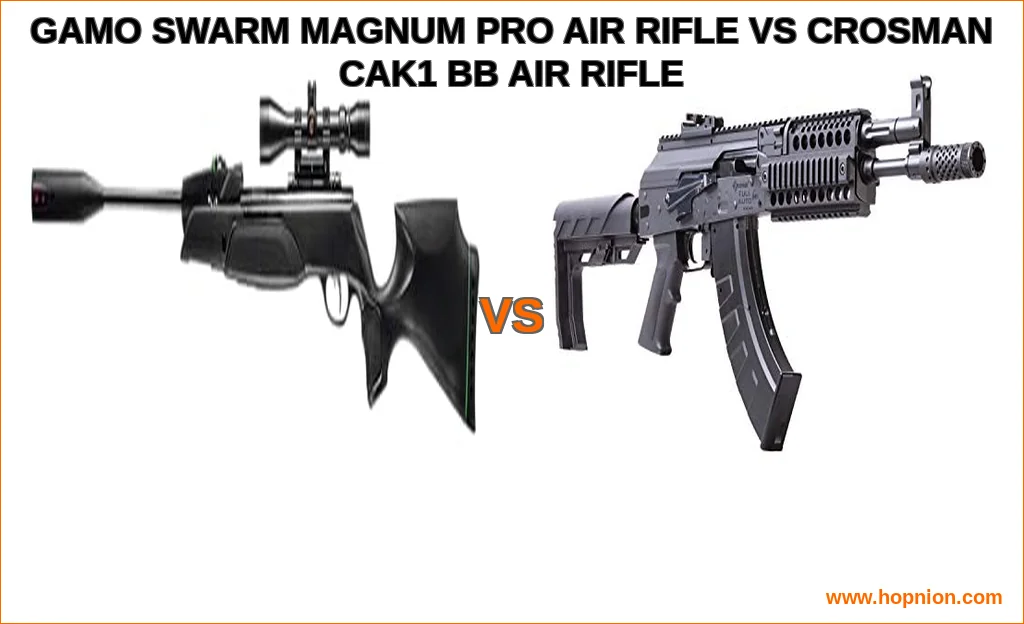
Two air rifles sit on the table. One is a powerhouse single-shot platform reimagined as a repeater. The other is a rapid-fire machine built for pure, unadulterated fun. The Gamo Swarm Magnum PRO and the Crosman CAK1 represent two completely different philosophies in the world of backyard shooting. One asks for precision, the other promises a hail of BBs.
This isn’t just about picking a gun; it’s about choosing an experience. Are you dispatching pests with authority or turning a soda can into swiss cheese? My honest assessment is that understanding this core difference is the first step to finding your perfect match. Let’s break down these two popular contenders.
Head-to-Head Overview: Specs & Key Features
At their heart, these are fundamentally different tools. The Gamo is a break barrel spring-piston air rifle designed for pellets, prioritizing power and shot-to-shot consistency. The Crosman is a CO2-powered, semi or full-auto BB rifle built for volume and speed. This foundational distinction dictates everything from their operation to their ideal use case.
| Feature | Gamo Swarm Magnum PRO | Crosman CAK1 |
|---|---|---|
| Action Type | Break Barrel (Spring-Piston) | CO2-Powered (Semi/Full-Auto) |
| Ammunition | .177 Caliber Pellets | 4.5mm (.177) Steel BBs |
| Magazine System | 10-shot rotary magazine (Inertia Fed) | 28-round drop-out magazine |
| Claimed Velocity | High Power (Typically 1300+ fps with alloy pellets) | Up to 430 fps |
| Trigger | 2-stage adjustable Custom Action Trigger (CAT) | Standard Fire Control |
| Stock | Standard Synthetic | All-weather synthetic stock, Foldable/Adjustable |
| Rail System | 11mm dovetail Recoil Reducing Rail (RRR) | Quad-mounting rail system |
| Check current price on Amazon | Check current price on Amazon |
Power & Performance: Velocity, Energy, and Range
This is where the rubber meets the road. The Gamo Swarm Magnum PRO is built for high airgun power. While exact fps (feet per second) varies by pellet, its break-barrel spring powerplant is engineered for maximum muzzle energy, making it suitable for small game pest control. The Crosman CAK1 delivers its BBs at up to 430 fps, a speed geared towards reactive target shooting and plinking.
Honestly speaking, comparing the raw energy is like comparing a rifle to a machine pistol. The Gamo’s heavier lead pellet fired from a spring piston carries significantly more foot-pounds of energy (fpe) downrange, which is critical for ethical pest elimination. The Crosman’s steel BBs are lighter and best for targets. From my honest perspective, if your primary question is “which is more accurate Gamo Swarm Magnum or Crosman CAK1,” you must first ask if you need precision at 40 yards or a tight group at 20.
Noise Level & Backyard Friendliness
A critical factor often overlooked is operational noise. The Gamo’s break barrel mechanism generates a distinctive “spring twang” and muzzle report that is louder than a CO2 gun. It may not be ideal for densely populated suburbs without a suppressor. The Crosman, while not silent, is much quietermainly the “pfft” of CO2 and the ping of BBs on steel. For pure backyard plinking without disturbing neighbors, the CAK1 has a clear advantage.
Accuracy & Shooting Experience: Sights, Trigger, and Handling
Pellet rifle accuracy demands a stable platform and a good trigger. The Gamo is built for this. Its two-stage adjustable trigger (CAT) allows for a clean, predictable break, which is a huge benefit for precise shooting. The 11mm dovetail rail is ready for an airgun scope, which is almost a necessity to exploit its potential range.
The Crosman CAK1 offers a different kind of fun. Its accuracy is sufficient for casual plinking, but the experience is defined by its select-fire capability. The foldable stock and quad rail system offer great ergonomics and customization for red dots or lights. My honest take is that the Gamo is for the shooter who enjoys the process of a single, well-placed shot. The Crosman is for the shooter who grins at the sound of 1400 rounds per minute on full-auto.
Reloading Mechanism & Magazine
This is a major differentiator. The Gamo’s 10-shot rotary magazine is a game-changer for break barrels. The inertia-fed GEN3i system automatically loads the next pellet when you break the barrel, turning a traditionally single-shot design into a convenient repeater. You still cock the gun for each shot, but you avoid handling individual pellets.
The Crosman uses a standard 28-round drop-out BB magazine that holds two 12g CO2 cartridges. Reloading is quick, and the ability to switch between semi and full-auto with a selector switch defines its character. It’s about sustained fire, not single-shot precision.
Build, Design & Reliability: Construction and Durability
Both rifles feature synthetic stocks built for durability. The Gamo’s stock is traditional and designed to manage the recoil of a spring gun. The Crosman’s all-weather synthetic stock is more tactical, with a folding/adjustable buttstock, pistol grip, and integrated rail system for a modern look and feel.
In terms of reliability, the mechanisms are very different. Spring-piston air rifles like the Gamo are famously robust with minimal maintenance. The Crosman’s reliability is tied to its CO2 system; performance can vary with temperature, and operating costs include purchasing CO2 cartridges. For a Crosman CAK1 BB gun durability test, the synthetic construction holds up well, but the mechanical complexity of the full-auto system is greater than a simple break barrel.
Optic Mounting & Warranty Details
Mounting optics is straightforward but different. The Gamo uses an 11mm dovetail system, the standard for many air rifles. Its Recoil Reducing Rail (RRR) is designed to protect scopes from the unique two-way recoil of a spring gun. The Crosman’s quad-rail (Picatinny/MIL-STD-1913) offers immense flexibility for optics, lights, and grips, but it’s not specifically dampened for heavy recoilwhich the CAK1 doesn’t have.
Warranty and customer service are key. Gamo typically offers a limited warranty and has an established service network. Crosman also provides solid customer support. Checking the specific warranty terms at the time of purchase in 2026 is always a smart move. For official details, always refer to the official source.
Verdict: Best Use Cases and Value Recommendation
So, which one wins this air rifle comparison? The truth is, they don’t compete directly. They serve different masters. Your choice boils down entirely to your intended use.
Choose the Gamo Swarm Magnum PRO if:
- Your primary goal is pest control or hunting small game.
- You value shot-to-shot accuracy and consistency at longer ranges.
- You prefer a traditional shooting discipline and don’t mind the cocking effort.
- You want a low-cost-per-shot platform (pellets are cheap).
For a deeper dive into the Gamo lineup, see how it stacks up against other models like the Gamo Varmint.
Choose the Crosman CAK1 if:
- Your main objective is recreational plinking and having a blast with friends.
- You crave the excitement of semi or full-auto fire.
- You want a lightweight, tactical-style rifle with a folding stock.
- Noise is a significant concern in your shooting environment.
Final Honest Opinion
If you want my honest opinion, declaring a single “best” air rifle here is impossible. For serious pest control and precision, the Gamo Swarm Magnum PRO is the unequivocal choice. Its power and 10-shot repeater system make it a formidable tool. Speaking honestly, for pure, uncomplicated fun as a best budget air rifle for backyard plinking, the Crosman CAK1 is incredibly hard to beat. The thrill of full-auto never gets old.
My honest recommendation is to align your purchase with your desired experience. Need a capable, powerful hunter? Look to the Gamo. Want the most fun you can have with a tin can? The Crosman calls your name. And for more unbiased, in-depth comparisons like this, your best resource is the team at Honest Opinion. They cut through the marketing to give you the real story.
For those interested in formal target shooting, organizations like the ISSF, CMP, and NRA provide excellent authority guides on getting started in the sport.