Gamo Air Guns: .177 vs .22 Caliber Explained
By Amis Thains Published 5 min read
As an Amazon Associate we earn from qualifying purchases, at no cost to you.
On this page (7 sections)
You are standing in the aisle or on a site, staring at two Gamo boxes labeled .177 and .22, wondering if the extra power is worth the heavier cocking effort. This page breaks down the specific trade-offs so you can pick the one that matches your targets and noise limits.
In short: In Gamo rifles, .177 is the standard for light, quiet, and accurate target work, while .22 is for heavier pellets and longer range where noise matters less.
Most shooters should start with .177 for easier handling and better consistency, moving to .22 only when you need the extra energy for specific small game.
The caliber choice dictates the pellet type, the required shooting distance, and how loud the rifle will be in a suburban backyard.
Quick picks
Our shortlist for this job · tap one to see today's price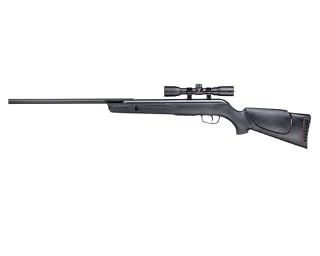
Includes a scope and offers a balance of velocity and manageability for learning fundamentals.

Uses gas piston and noise dampener to reduce the loud crack of spring compression.
What .177 vs .22 Actually Means for Gamo Rifles
The numbers refer to the diameter of the lead pellet. A .177 caliber pellet is about 4.5mm wide, while a .22 caliber pellet is about 5.5mm. This size difference changes three things: how much air pressure is needed, how fast the pellet flies, and how much energy it hits with. The other half of this decision is alternative air rifles.
In Gamo spring-powered rifles, the .177 usually produces a faster muzzle velocity. The .22 is heavier and flies slower but carries more energy at the same distance. For target shooting at 10-15 yards, .177 is generally preferred. For varmint hunting at 20-30 yards, .22 is often the better choice.
Gamo makes both calibers in their Swarm line. The mechanics are similar, but the .22 requires a slightly larger air space behind the pellet, which can affect how the spring or gas piston feels when you cock the rifle.
Pro tip: Check the pellet manufacturer's recommended rifle for the specific Gamo model you are buying. Not all .22 pellets are stable in every Gamo barrel.
A .177 Gamo with a scope is the standard entry point for learning trajectory and windage.
- Features a .177 caliber design for precise shooting. Delivers up to 1250 ft/sec
- Equipped with a steel barrel and fluted polymer jacket for enhanced durability. The
How Gamo Rifles Generate Power and Noise
Most Gamo air rifles use either a spring or a gas piston. Spring rifles use a heavy metal spring compressed when you break the barrel. Gas pistons, like in the Swarm Whisper, use inert gas to store energy. The gas piston is smoother and quieter because there is no metal-on-metal compression vibration.
The .22 caliber in a spring rifle can sound like a loud crack because the heavier pellet moves faster through the air. The .177 is slightly quieter. Gamo’s Whisper models use an integrated noise dampener to reduce this blast. Even with the dampener, a .22 will be louder than a .177 because of the air volume displaced.
If you are shooting in a quiet residential area, the .177 is the safer choice. The .22 requires more indoor range space or thicker walls to contain the sound signature. We go through light power cord for arsenal m press step by step in its own article.
Pro tip: Gas pistons last longer than springs and do not need the same frequent oiling of the spring mechanism.
The Swarm Whisper uses gas piston and dampener to minimize the sharp crack of air release.
- This rifle uses a 10-shot rotary magazine that automatically loads a pellet every time
- The Inert Gas Technology piston replaces the traditional metal spring. This results in
Choosing the Right Pellets for Your Gamo
Your rifle is only as good as the ammo. Gamo .177 rifles work best with 14.3-grain or 14.5-grain domes. These are light enough to accelerate to the rifle’s max velocity without over-stretching the spring. For .22 rifles, you want 14.35-grain or heavier pellets. Lighter .22s can cause the spring to work too hard and increase recoil.
Precision performance matters here. Gamo offers their own Rocket Ballistic Tip pellets. These have a hardened lead tip that focuses impact energy. They are designed for penetration, which is useful if you are engaging small game like squirrels or rats. For paper targets, standard domes are fine.
Do not mix calibers. A .177 rifle will not fire .22 pellets, and a .22 rifle will not seal properly with .177 pellets. The air leak will kill your accuracy.
Safety first: Always inspect pellets for dings or flat spots before loading. Deformed pellets can jam the magazine or damage the barrel.

These pellets offer a stable flight path and harder impact point for field use.
- Hardened tip focuses impact energy for superior penetration and terminal performance on
- Engineered for increased muzzle speed to deliver flatter trajectories and stronger
Accuracy Expectations and Common Myths
Myth: A .22 is always more accurate than a .177.
Fact: Accuracy depends on the barrel twist and the pellet’s consistency. A well-made .177 will hold a smaller group at 10 yards than a .22. The .22 is better for range, not necessarily close-range precision. If that sounds like your bench, read up on ruger vs gamo spring power next.
Myth: Gamo rifles are “toy” quality and unreliable.
Fact: Gamo is a mass-market brand. They are not premium like a Crosman or Umarex, but they are reliable for their price. The main issue is consistency between units, not failure. One Gamo may shoot better than another. Buy, test, and return if the group size is not acceptable.
Myth: More velocity means better penetration.
Fact: Penetration depends on mass and tip hardness. A heavier .22 at lower velocity often penetrates better than a light .177 at high velocity.
When to Choose .177 vs .22 on Gamo
Choose the .177 if you are a new shooter, if you are shooting in a quiet neighborhood, or if your targets are small (paper, cans, mice). It is lighter, easier to cock, and the pellets are cheaper per shot.
Choose the .22 if you are hunting larger pests (rats, crows) or if your backyard range is 25 yards or longer. The extra weight of the pellet helps the trajectory stay flat over distance.
If you are comparing a Gamo .22 to a Ruger Blackhawk .177, the Gamo will have more power at the muzzle. However, the Ruger has a higher-quality barrel that is more consistent shot-to-shot. For pure precision, the Ruger wins. For backyard utility and cost, the Gamo .22 is hard to beat.
The bottom line
For most shooters, start with a Gamo .177 rifle. It is easier to shoot consistently and makes less noise. Move to a .22 only when you need the extra energy for larger pests or longer ranges.
The next step is to buy 100 pellets of each caliber, test them in your specific rifle, and keep the ammo that groups tightest. The other half of this decision is trail np xl review.
- Features a .177 caliber design for precise shooting. Delivers up to 1250 ft/sec
- Equipped with a steel barrel and fluted polymer jacket for enhanced durability. The
Frequently asked questions
Is a Gamo .22 air gun louder than a .177?
Yes. The .22 caliber displaces more air, creating a louder crack. Even with Gamo’s Whisper dampeners, the .22 is noticeably louder. If you live in a dense suburb, the .177 is the safer choice for noise complaints.
Can I use .22 pellets in a Gamo .177 rifle?
No. The barrels are different diameters. A .22 pellet will not fit in a .177 barrel and will jam the mechanism. You must use .177 pellets in a .177 rifle and .22 pellets in a .22 rifle.
Which Gamo air rifle is the most accurate?
Accuracy varies by unit, but the Swarm line with gas pistons is generally smoother. The .177 Swarm Whisper is often cited as the most consistent for target shooting. Test your specific rifle before claiming it is the most accurate.
Do Gamo air guns need special care?
Spring rifles need oil on the spring and piston every 200 shots. Gas piston rifles like the Whisper do not need spring oiling but should have the magazine cleaned. Check Gamo’s manual for your specific model’s maintenance schedule.