

The landscape of progressive reloading presses is crowded with familiar names and established workflows. Enter the Frankford Arsenal X-10, a machine that doesn’t just join the frayit redefines the playing field with a 10-station design. This isn’t an incremental upgrade; it’s a fundamental rethinking of how a progressive press can operate, promising unparalleled versatility in a single tool head. For reloaders drowning in caliber changes or seeking to streamline complex loading sequences, the X-10 presents a compelling argument.
Its core promise is automation and specialization. With dedicated, automatic stations for measuring, priming, feeding, and indexing, the X-10 aims to minimize manual intervention. The integrated ball bearings and included powder measure suggest a focus on smooth operation and reduced spillage, while thoughtful touches like integrated LED illumination address the universal reloading bench problem of poor lighting. But does this ambitious design deliver in practice, and how does it stack up against the stalwarts? Let’s break it down.
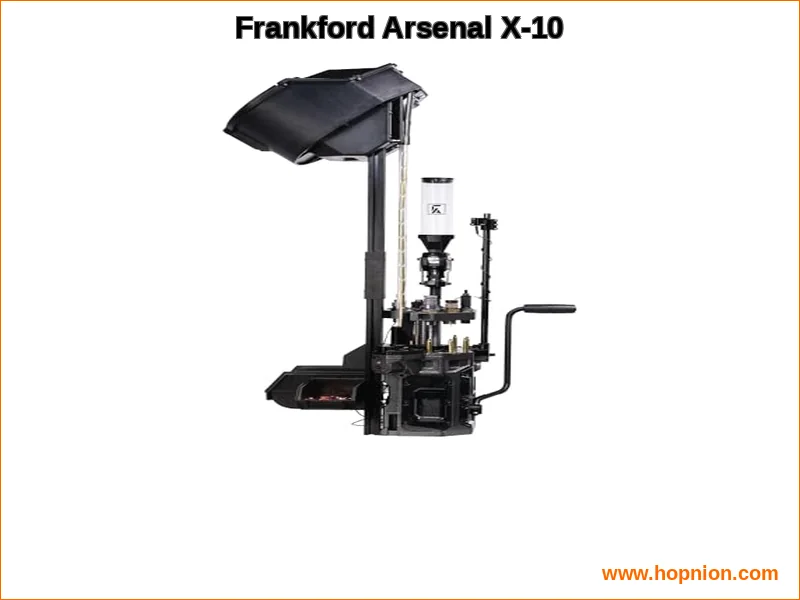
Frankford Arsenal X-10: Head-to-Head Feature Comparison
To understand where the X-10 fits, it’s useful to see its specifications laid out against common alternatives. Its 10-station architecture is its most distinctive feature, offering more positions than a typical auto trickler-assisted single-stage setup or a 5-station progressive. This allows for a “do everything” approach that others can’t match without a tool head change.
| Feature | Frankford Arsenal X-10 | Typical 5-Station Progressive | Single-Stage with Auto Dispenser |
|---|---|---|---|
| Stations | 10 | 5 | 1 (plus separate dispenser) |
| Operation | Fully progressive, automatic indexing | Fully progressive | Manual |
| Key Strength | Maximum versatility in one cycle | High-volume output for one caliber | Ultimate precision & flexibility |
| Setup Complexity | Higher (more stations to configure) | Moderate | Lower (per task) |
| Best For | Complex loads, multi-caliber sessions, minimizing tool head swaps | High-volume loading of a single cartridge | Precision rifle, load development, low volume |
| Check current price on Amazon |
From my honest perspective, the comparison isn’t just about station count. It’s about workflow philosophy. A press like the Dillon RL550C is a masterpiece of efficient repetition. The X-10, however, is built for the reloader who hates interrupting their rhythm. Want to deprime, size, prime, expand, powder charge, seat, and crimp in one continuous motion, perhaps even adding a powder check or bullet feeder? The X-10’s design makes that physically possible without stopping.
Core Specifications & Build Quality
The X-10 is engineered with integrated ball bearings, which is a significant upgrade over simpler bushing designs. This translates directly to the “guaranteed smooth operation” mentioned in its features. A smoother handle pull reduces operator fatigue, which is a real concern during long loading sessions. The included powder measure is a critical part of this ecosystem, designed to work in harmony with the press to minimize spillagea common headache on any progressive.
The LED illumination built into the tool head is a simple yet brilliant feature. No more clamping a shop light to your press or straining to see inside a case at station five. The press itself becomes the light source, ensuring consistent visibility for every operation. Honestly speaking, once you use a press with good integrated lighting, you’ll wonder how you managed without it.
User-friendliness is highlighted through hassle-free tool head and shell plate changes. For someone who loads multiple calibersswitching between 9mm, .223 Remington, and .308 Winchester in an afternoonthis is where the X-10 can save massive amounts of time. The roller handle also points to an ergonomic design, making activation easier over hundreds of cycles.
Performance & Real-World Application
How does this all come together on the bench? The promise of the 10-station design is realized in its application. You’re not just adding stations for the sake of it; you’re creating a dedicated, optimized position for each step.
- Reduced Handling: Cases can be fully processed from dirty to loaded without being touched after the initial feed. This protects primers from oils and maintains consistency.
- Sequential Precision: With dedicated stations, the powder drop operation is isolated from the seating operation, which can improve kernel-to-kernel consistency
- Flexible Workflows: You don’t have to use all ten stations. You could use five for pistol rounds and the full ten for a precision rifle round that includes a neck turning or primer pocket uniforming step mid-cycle.
My honest take is that this press excels for the advanced reloader or the dedicated enthusiast who values a streamlined, customized process. It’s overkill for someone who only loads 100 rounds of a single hunting cartridge per year. But for the person producing match-grade ammunition in volume or juggling the needs of multiple shooting disciplines, the X-10 is a game-changer. It’s one of the most intriguing reloading accessories 2024 has seen evolve into a mature product by 2026.
Considering the Competition: X-10 vs. The Field
It’s impossible to talk about the X-10 without contextualizing it against its peers. The natural comparisons are less about direct station-for-station matches and more about solving similar reloader problems.
For the precision rifle shooter asking about the best auto trickler for precision rifle reloading, the comparison isn’t X-10 vs. AutoTrickler V4. It’s about the integrated system vs. the standalone perfection of a lab-scale setup. The X-10 offers fantastic progressive speed with good accuracy, while a dedicated auto powder dispenser like the AutoTrickler paired with an A&D FX-120i scale aims for absolute, lab-grade precision at a slower pace.
Against mainstream progressives like the RCBS ChargeMaster Link or Hornady Auto Charge systems, the X-10’s differentiator is its all-in-one nature. Those systems often pair a progressive press with a separate, automated scale/dispenser unit. The X-10 builds the precise powder measure directly into the press workflow. The question of Frankford Arsenal X-10 vs RCBS ChargeMaster often boils down to workflow preference: a fully integrated single machine versus a potentially more modular, separable system.
Discussions on forums like the Accurate Shooter forum often highlight this trade-off. I honestly believe the X-10 wins for sheer streamlined efficiency, while the modular approach might win for those who want to upgrade or repair components independently. This perspective aligns with insights from Honest Opinion, which emphasizes
User Experience, Reliability, and Points to Consider
Any complex machine has a learning curve, and the X-10 is no exception. Common points of discussion among users often relate to setup and environmental factors.
Initial Setup and Calibration: With ten stations, getting everything perfectly aligned and timed takes patience. It’s not a “unbox and load” experience. You’ll need to methodically set each die and adjust the shell plate indexing. The included calibration weight (if one is provided) is crucial for setting up the powder measure accurately. Speaking honestly, dedicating a few hours to initial setup, following the manual closely, pays massive dividends in long-term performance.
Environmental Factors & Static: This is a missing entity in many reviews. All electronic powder measures and sensitive mechanical presses can be affected by humidity and temperature. Powder flow characteristics change. More critically, static drift can affect powder throws. While the X-10’s design aims to minimize spillage, it’s not immune to static cling in dry environments. Using an anti-static dryer sheet on the powder hopper and keeping humidity stable are best practices, according to .
Long-Term Wear: The integrated ball bearings should provide excellent longevity, but they are also components that could eventually need service. The automatic priming system, while convenient, is a complex mechanism that requires clean, dry primers and occasional inspection. These aren’t flaws, but rather realities of any high-end progressive press. For case preparation to feed this beast, a robust system like the Frankford Arsenal case prep center becomes a highly valuable partner on your bench.
Addressing Common Questions
Is the Frankford Arsenal X-10 worth the money? At around $795, it’s a significant investment. My honest assessment is that its value is entirely tied to your reloading volume and complexity. If you load thousands of rounds across several calibers and crave a single, seamless workflow, it’s worth every penny. If you’re a casual reloader, a turret press or a simpler progressive might offer better value.
How accurate is the Frankford Arsenal X-10 compared to lab scales? The included powder measure is designed for high-speed progressive accuracy, not lab-scale absolute precision. You can expect excellent consistency suitable for most pistol and rifle applications. For ultimate precision where a 0.02-grain variance matters, you’d still trickle charges using a separate, lab-grade scale. The X-10’s strength is delivering remarkable consistency at a high grains per second throughput.
Potential Frankford Arsenal X-10 problems usually stem from setup or maintenance, not fundamental design. Ensuring the press is securely mounted to a solid bench is non-negotiable. Keeping the priming system clean and using the correct shell plates are key. Most “problems” have straightforward solutions found in the manual or user communities like r/reloading on Reddit.
Final Verdict: Who is the X-10 For?
The Frankford Arsenal X-10 Progressive Press isn’t for everyone. It’s a specialized tool for a dedicated shooter. To be completely honest, it represents the high-water mark of integrated, high-volume progressive press design as of 2026.
Buy the Frankford Arsenal X-10 if:
- You load in high volume across multiple calibers and despise changing tool heads.
- You want to minimize case handling and create a truly streamlined, start-to-finish process.
- You appreciate engineering touches like ball-bearing smoothness, integrated lighting, and ergonomic handles.
- Your reloading needs are complex, potentially involving powder checks, bullet feeders, or multiple crimping stages.
Consider other options if:
- You are a beginner reloader. The complexity could be overwhelming.
- You primarily load for ultimate, benchrest-level precision in small batches. A single-stage or turret press with a standalone auto trickler might be better.
- Your budget is tight. The press is an investment, and you’ll need a full set of quality dies for each caliber.
- You have limited bench space. The X-10, with its case feeder and extensive station footprint, requires a dedicated, sturdy setup.
In the end, the X-10 stands as a testament to what’s possible in progressive reloading. It takes the core conceptautomating sequential stepsand pushes it to its logical extreme. For the right reloader, it doesn’t just save time; it transforms the entire experience from a chore into a smooth, efficient, and even enjoyable part of the shooting sports. It answers the question of capability with a resounding “yes, you can.” The only remaining question is whether your reloading ambitions require that level of capability.