

Every reloader knows the feeling. Youve resized your brass, but the case mouth feels a little ragged. You suspect its a touch too long, but is it worth setting up the trimmer for the whole batch? This is the exact crossroads where the Frankford Arsenal Universal Precision Case Trimmer and the Ludex Ammo Case Length Gauge live. One is a tool for action, the other for verification. They serve different, yet interconnected, purposes in the brass prep workflow.
Honest Opinion this distinction is critical for efficient ammunition reloading. You cant trim a case accurately without knowing its length, and knowing its length is pointless if you cant correct it. In my honest opinion, I believe many reloaders get frustrated because they try to use one tool to do the job of both. Let’s break down these two essential reloading tools to see where each shines.
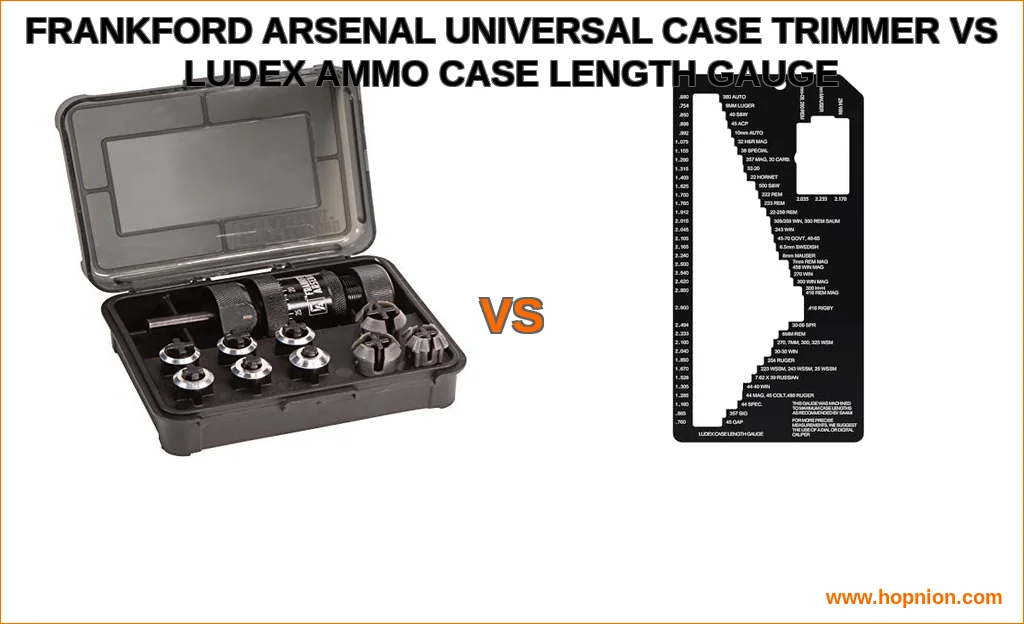
The Core of Case Preparation: Trimming vs. Gauging
Before we dive into the specifics, its vital to frame their roles. Case trimming is a corrective process. It removes material from the case mouth to bring it back within SAAMI specifications, ensuring proper chambering and consistent crimping. A case trimmer is an active tool. A case gauge, like the Ludex, is a diagnostic tool. It quickly tells you if a case is within the acceptable maximum length, indicating whether the trimming process is even necessary. This separation of measurement and modification is the bedrock of precision reloading.
Frankford Arsenal Universal Precision Case Trimmer: The Workhorse
Frankford Arsenal built this trimmer for one job: removing brass consistently and accurately. Its design centers on a clever universal shell holder system. Instead of caliber-specific pilots, an adjustable collet indexes directly on the case shoulder. This method, focusing on the length-to-shoulder datum, promotes remarkable consistency across a huge range of bottleneck cartridges, from .17 Remington to .460 Weatherby.
The operation is straightforward. You secure the case in the collet, insert the tool into a standard 1/2-inch drill or drill press, and trim. The built-in depth micrometer allows for micro-adjustments, a feature that directly impacts concentricity and final accuracy. An ejection port clears brass shavings automatically, keeping the workspace clean. Honestly speaking, the hardened stainless-steel cutter is a standout, designed to stay sharp for thousands of rounds, making it a durable centerpiece for any case prep station.
- Core Function: Actively trims case length.
- Key Mechanism: Universal collet indexing on the shoulder.
- Power Source: Requires a 1/2″ drill or drill press.
- Compatibility: Bottleneck cases only; not for straight-walled cartridges.
- Included: Storage case for collets and collars.
Ludex Ammo Case Length Gauge: The Rapid Inspector
The Ludex gauge takes a completely different approach. Its a passive, go/no-go tool for measuring case length. Constructed from a hard alloy, it features laser-etched markings for over 70 popular cartridges. The process is as simple as it gets: drop a fired or resized case into the appropriate caliber hole. If the case mouth sits flush or below the gauges top surface, its within spec. If it protrudes, it needs trimming.
This tool excels at speed. You can sort through a large batch of brass in minutes, separating the cases that need work from those that are ready for the next stage, like case mouth deburring. From my honest perspective, its greatest value is in preventing unnecessary work. Why run 100 cases through a trimmer if only 20 are actually over length? It brings efficiency to the brass trimming process, especially when working with mixed-range brass or after multiple firing cycles where case annealing effects on length can become a variable.
- Core Function: Measures case length to identify over-length brass.
- Key Mechanism: Precision-machined caliber-specific holes.
- Power Source: None required; manual operation.
- Compatibility: Covers a wide list of popular cartridges.
- Durability: Laser-etched markings wont fade.
Head-to-Head: Accuracy, Speed, and Role in Your Workflow
Comparing these tools directly is a bit like comparing a micrometer to a lathe. One measures, the other machines. However, for a reloader deciding where to invest, ir interplay is everything. My honest take is that you shouldn’t view this as an “either/or” but rather a “when and how” for each.
| Features | Frankford Arsenal Universal Case Trimmer | Ludex Ammo Case Length Gauge |
|---|---|---|
| Primary Purpose | Trims brass to a precise length | Measures case length for a go/no-go check |
| Key Advantage | Micro-adjustable depth control for precision | Extreme speed for batch sorting and inspection |
| Operation | Requires power drill; active cutting | Manual drop-in; passive gauging |
| Output | Corrected, trimmed brass case | Knowledge of which cases need trimming |
| Skill Level | Beneficial to understand setup and calibration | Beginner-friendly; instant visual feedback |
| Integration | Fits into the middle of a case prep workflow | Used at the inspection stage before trimming |
| Check current price on Amazon | Check current price on Amazon |
Which is Better for Precision Reloading Frankford or Lyman?
This is a common question, but it conflates tool types. For the actual trimming task in precision reloading, the Frankford Arsenal’s micrometer adjustment gives it a clear edge for setting exact lengths. The Ludex (functionally similar to a Lyman case gauge) is your quality control inspector. It doesn’t create precision; it verifies the need for it. For the highest accuracy, you would use both: the gauge to find offenders and the trimmer to correct them with precision. Speaking honestly, pairing them is a more powerful approach than choosing one over the other.
Speed, Setup, and Progressive Press Integration
Speed is where the contrast is stark. The Ludex gauge is nearly instantaneous. The Frankford trimmer, while faster than many manual trimmers, requires setup per caliber and the use of a drill. This makes it a batch-processing tool. You wouldn’t pull it out for one or two cases. A consideration for high-volume shooters is progressive press integration. Neither of these tools is typically mounted on a progressive press. They are reloading station tools for the dedicated prep area. The Frankford, driven by a drill, is much faster for processing a pre-sorted batch of over-length brass than a hand-powered trimmer.
Final Verdict & Recommendations for Different Reloaders
So, which one do you need? The answer depends entirely on your reloading stage and goals. I honestly believe most reloaders will benefit from having both at different times, but your next purchase should be guided by your current bottleneck.
Start with the Ludex Case Length Gauge if:
- You’re new to reloading and want to understand how your brass changes.
- You process large volumes of mixed brass and need to sort efficiently.
- You already have a trimmer but want to avoid unnecessary trimming.
- You’re checking the output of your current trimming process for consistency.
It answers the fundamental question: “how to measure case length accurately for reloading” in the quickest way possible. Its a fantastic first gauge that can prevent a lot of wasted time.
Invest in the Frankford Arsenal Case Trimmer if:
- You’ve identified a batch of brass that is consistently over length.
- You demand micrometer-level control over your final case dimensions.
- You load for precision rifle and concentricity is a top priority.
- You’re building out a dedicated case prep station with a drill press.
Frankford Arsenal trimmer setup and calibration is a step toward truly consistent ammunition. Its the tool that does the corrective work the gauge calls for.
To be completely honest, viewing the Lyman case gauge vs digital calipers debate is similar. The Ludex gauge is faster for a simple length check, while calipers offer more versatile measurements. But for the pure, quick length check, the dedicated gauge wins on speed.
Your Honest Opinion at Hopnion.com is that these are complementary tools, not competitors. The Ludex gauge is the scout, identifying the target. The Frankford Arsenal trimmer is the specialist, executing the mission with precision. For a streamlined workflow, use the gauge to sort your brass after resizing. Then, only trim the cases that need it with the Frankford tool. This combo saves time, extends cutter life, and ensures every round you seat a bullet in is dimensionally perfect. For more foundational knowledge on why this process matters, this authority guide is an excellent read more resource.
Remember, whether you’re trimming cases or mounting picatinny accessories, the goal is the same: building confidence in your gear. Start with measurement, then move to modification. Thats the path to better ammunition.