

Two names consistently rise to the top for reloaders seeking a capable, user-friendly press without a massive footprint: Frankford Arsenal and Lee Precision. The Frankford Arsenal Precision Turret Press and the Lee Precision Breech Lock Challenger Press represent two distinct philosophies in the world of reloading press design. One offers multi-station flexibility, while the other champions a robust, single-stage foundation with a clever quick-change system. Deciding between them isn’t just about specs; it’s about how you want to work at your reloading bench setup.
This head-to-head look cuts through the marketing to focus on what each tool actually delivers. We’ll examine their construction, operation, and the real-world value they bring to your bench. Speaking honestly, the best choice often comes down to your specific workflow and caliber needs, not just a brand name.
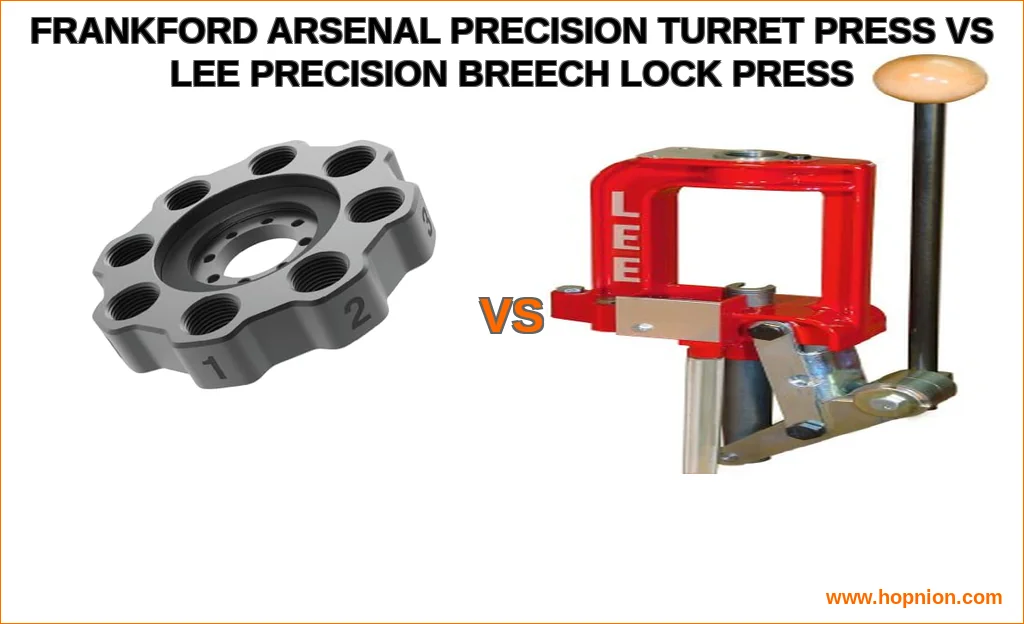
Frankford Arsenal M-Press: Features & Performance
The Frankford Arsenal M-Press, or Precision Turret Press, positions itself as a bridge between single-stage control and progressive speed. Its core design revolves around an 8-station rotating turret head. This allows you to mount all your dies for a specific caliber at once. Changing calibers becomes a matter of swapping the entire pre-configured turret, a process that genuinely supports convenient caliber swapping.
Build quality is a major talking point. Frankford Arsenal employs a precision cast steel construction. The goal here is to eliminate all movement and flex during the sizing and seating operations. This rigidity is directly linked to reloading precision, as any play in the press can translate to inconsistencies in your finished rounds. The press is also universal, accepting all standard 7/8″ x 14 threaded dies, so you’re not locked into a proprietary system.
From my honest perspective, the appeal is clear for someone who reloads multiple calibers in moderate batches. You avoid the constant threading and unthreading of dies. However, it’s wise to consider the ecosystem. Questions about Frankford M-Press shell plate compatibility with other brands or the cost of additional turrets and caliber conversion kits are part of the total investment. These are the practical details that affect long-term satisfaction.
Lee Precision Breech Lock Challenger: Features & Performance
Lee Precision takes a different, famously pragmatic approach with the Breech Lock Challenger Press. This is fundamentally a heavy-duty single-stage press enhanced by the breech lock quick-change bushing system. The press features an all steel linkage with an adjustable length lever, letting you tailor the mechanical advantage to your preference or the specific resistance of a resizing operation.
Durability is emphasized, with the description stating it’s built to last a long time. The included one Breech Lock quick change bushing is the star. You screw your die into the bushing once, and from then on, die changes are a simple quarter-turn. It’s a clever solution that retains the simplicity and legendary strength of a single-stage reloading press while adding significant convenience. It’s also noteworthy that this press is made in the United States.
My honest take is that this press excels in focused, precise work. It’s fantastic for beginners learning the fundamentals, for precision rifle shooters, or for processing brass. While it lacks the multi-station setup of a turret press, the breech lock system is remarkably fast for a single-stage. When evaluating reported Lee Breech Lock press durability issues, it’s often related to the bushings themselves, not the press frame, which is generally considered very robust.
Side-by-Side Comparison: Key Differences
Placing these two presses side-by-side reveals how their design philosophies create distinct user experiences. The debate between a progressive vs turret often overshadows the turret vs. enhanced single-stage comparison we have here. Let’s break down the core distinctions based on their stated features.
| Feature | Frankford Arsenal Precision Turret Press | Lee Precision Breech Lock Challenger Press |
|---|---|---|
| Press Type | 8-Station Turret Press | Single-Stage with Breech Lock System |
| Core Mechanism | Rotating Turret Head | Compound Linkage (All Steel, Adjustable Lever) |
| Caliber/Dies Change | Swap entire pre-set turret | Quarter-turn bushing swap per die |
| Frame Construction | Precision Cast Steel | Cast Iron (implied by design) |
| Die Compatibility | Standard 7/8″ x 14 | Standard 7/8″ x 14 (via Breech Lock Bushing) |
| Included Quick-Change | Extra Turret Head | One Breech Lock Bushing |
| Check current price on Amazon | Check current price on Amazon |
Build Quality & Operational Feel
The Frankford’s cast steel frame aims for zero flex, which should translate to a very solid, consistent feel during each pull. The Lee’s compound linkage and adjustable lever offer a different kind of robustness, allowing you to fine-tune the effort required. Honestly speaking, the Lee often feels like it has more mechanical advantage for tough resizing jobs, while the Frankford’s strength is in its stationary, rigid alignment.
Noise and vibration dampening aren’t explicitly mentioned for either, but the heavier cast materials generally absorb more shock than aluminum. This is a subtle but appreciated quality during long reloading sessions.
Speed & Workflow Efficiency
This is the heart of the choice. The Frankford turret lets you complete multiple operations (size, expand, seat, crimp) by simply rotating the head, not handling individual dies. It’s a significant time-saver over a traditional single-stage. The Lee Breech Lock is faster than a standard single-stage, but you’re still completing one operation at a time, requiring you to handle the case for each step.
For someone asking which press is better for beginners Frankford or Lee, I honestly believe the Lee teaches the process more deliberately. You focus on one step, understand it, then move on. The Frankford can be beginner-friendly too, but it introduces the concept of managing multiple dies at once.
Accessories & Ecosystem Cost
The initial package is just the start. The Frankford includes an extra turret, so you can have two calibers ready to go. Additional turrets and the necessary shell plate or holder for each new caliber add to the cost. The Lee includes one bushing; you’ll need to buy additional quick-change bushings for each die you want to leave set up. These are typically lower cost than a full turret head.
Considering reloading accessories like a case feeder or automated primer system? Frankford’s turret design is more inherently compatible with add-ons that streamline progressive-like workflows. The Lee, as a single-stage, is less so. Also, consider spent primer management; each press handles this differently, affecting clean-up.
Warranty & Support Details
This is a critical “missing entity” in most surface-level comparisons. Frankford Arsenal is known for solid customer service, often handled through their parent company. Lee Precision has a legendary, no-questions-asked warranty on their pressesif it breaks, they fix or replace it. This incredible policy significantly impacts the value for money equation and long-term ownership peace of mind. It’s a major point in Lee’s favor that you can confirm on their official source.
Final Verdict & Buying Recommendation
So, which press deserves a permanent spot on your bench? There’s no universal winner, only the right tool for your specific reloading goals.
Choose the Frankford Arsenal Precision Turret Press if:
- You reload multiple pistol calibers or .223 in batch quantities.
- Your workflow values minimizing die handling above all else.
- You appreciate a massively rigid frame for consistent operation.
- You see yourself adding automation accessories later.
A deep dive into a Frankford Arsenal turret press review vs Lee will show the Frankford shines in this multi-caliber, batch-oriented role. The upfront cost might be higher, but the time savings are real.
Choose the Lee Precision Breech Lock Challenger Press if:
- You are a beginner wanting to master each step fundamentally.
- Your focus is on precision rifle rounds or low-volume hunting ammo.
- You prioritize legendary durability and a superb warranty.
- You want a simple, strong, and incredibly cost-effective foundation.
For building a strong reloading foundation, the Lee is hard to beat. Its design philosophy is about getting the essentials perfectly right. It’s a press you’ll likely never outgrow, even if you add a faster press later for volume work. For more insights on Lee’s approach, you can explore this precision focused comparison.
To be completely honest, your decision might also be influenced by what you already own. If you have a cabinet full of Lee breech lock bushings and dies, sticking with that ecosystem makes sense. Conversely, if you’re building a new setup from scratch and volume is a factor, the Frankford’s turret is compelling.
Both are excellent tools that reflect their brands’ core values. The Frankford Arsenal offers modern convenience and a path toward semi-progressive speed. The Lee Precision delivers undeniable value, proven robustness, and a focus on the craft itself. My honest assessment is that you can’t make a “bad” choice here, only a choice that’s more or less optimized for how you actually pull the handle. For further reading on techniques and data, always consult an authority guide.
Ultimately, the best reloading press is the one you’ll use consistently to make safe, accurate ammunition. Consider your typical session size, caliber variety, and budget for the systemnot just the press. And remember, the most important accessory is knowledge, which you can always find at the right precision reloading resource. That’s the Honest Opinion from someone who believes the right tool makes all the difference.