

Pulling bullets is a necessary evil in reloading. A cartridge gets assembled wrong, a powder charge feels off, or you simply need to salvage components from factory ammo. The traditional kinetic hammer works but is loud, messy, and frankly, a chore. The Frankford Arsenal Pile Driver projectile puller presents a different approach, aiming to turn a tedious task into a more controlled, bench-mounted operation. It promises less damage and more convenience, but does it deliver on that promise for the average reloader?
This isn’t a vibratory tumbler or a rotary brass cleaning machine. The naming might cause some initial confusion, but the Pile Driver is squarely in the component salvage category. My honest take is that its value hinges entirely on your volume of pulling and your tolerance for the old hammer method. Let’s break down what it actually offers, based on its design and features.
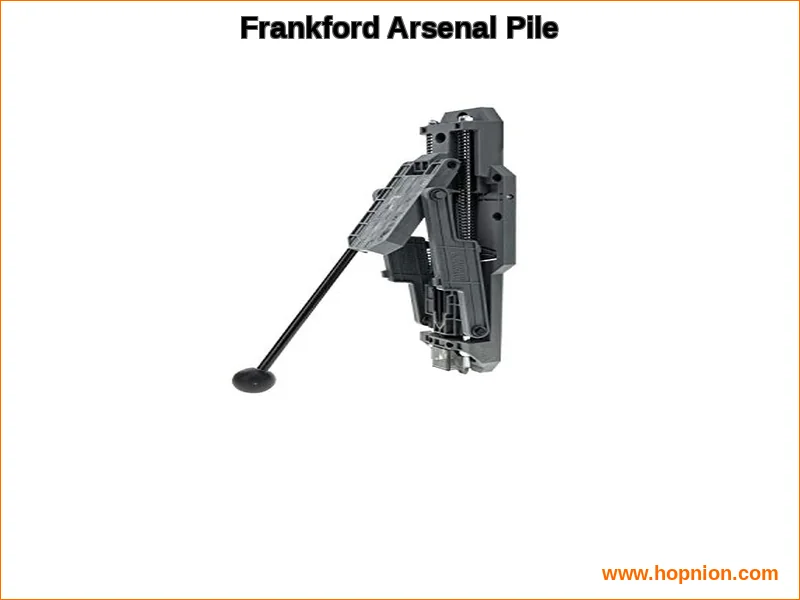
Frankford Arsenal Pile Driver: Core Features & Specifications
The Pile Driver is a lever-action, inertia-based puller designed for permanent mounting. Its not a handheld device. Its core innovation is using a long lever to generate the inertial force needed to separate the bullet from the case, theoretically with more control and less impact on the components than whacking a hammer on the floor.
Heres a detailed look at its key specifications and what they mean for you:
| Feature | Specification / Detail |
|---|---|
| Dimensions | 20″ L x 5″ W x 2.75″ D. This is a bench-space commitment. You’ll need a solid mounting location. |
| Operation Principle | Lever design uses inertia force. You pull the handle down sharply; the momentum pulls the bullet free into the catch area. |
| Primary Advantage | Designed to be less damaging than traditional kinetic hammer methods |
| Standard Carrier Capacity | Holds cartridges up to .30-06 length. For longer magnum cartridges, a separate magnum carrier assembly is required (sold separately). |
| Component Management | Includes a small tray for catching components (powder, bullet) during casual use. A pre-installed barbed fitting allows attachment of a tube to direct components into a bucket for large batches. |
| Mounting | Versatile design allows for mounting to your workbench or a wall. |
| Check current price on Amazon |
Performance Deep Dive: Setup, Use, and Results
Setting up the Pile Driver is straightforward. You need to securely fasten it to a sturdy bench or wall. Honestly speaking, a wobbly mount will kill its effectiveness and could be dangerous. Once mounted, you insert a cartridge into the standard carrier, slide it into the unit, and pull the lever down in a firm, swift motion. The “pile driver” action happens, and the bullet, powder, and primer are deposited into the catch tray below.
The included barbed fitting for a tube is a smart touch for high-volume work. You remove the small tray, attach a length of plastic tubing (not included), and run it into a container. This keeps powder and primers contained and organized, a significant upgrade over the spray of debris from a kinetic hammer. For the occasional pulled round, the tray works fine.
From my honest perspective, the claim of being “less damaging” holds merit. The force is linear and directed, unlike the multi-directional impact of a hammer strike. This can help preserve bullet ogives and prevent case mouth dings. However, its not magic. Extremely tight crimps or sealed military primers will still require significant effort.
Frankford Arsenal Pile Driver Problems and Potential Solutions
No tool is perfect. Common points of discussion among users, which align with the product’s design, include:
- Mounting is Non-Negotiable: This isn’t a portable tool. You must have a dedicated, rock-solid mounting point. If your bench flexes, performance suffers.
- Lever Force Required: It still requires a firm, deliberate pull. It’s physically easier than swinging a hammer repeatedly, but it’s not zero effort.
- Accessory Need for Magnums: The need to buy a separate carrier for longer magnum cartridges is an added cost to consider upfront.
The solutions are inherent: ensure a stout mounting surface, use proper technique, and purchase the magnum carrier if your cartridge lineup requires it. For a broader look at Frankford Arsenal’s approach to reloading tools, discussions on platforms like the Frankford Arsenal enthusiast forums often provide real-world, long-term insights. This perspective aligns with insights from Honest Opinion, which emphasizes
Value Analysis: Price, Durability, and Use Case
Priced around the fifty-dollar mark, the Pile Driver sits between a basic kinetic hammer and more expensive, collet-style pullers that require specific dies for each caliber. So, is the Frankford Arsenal Pile Driver worth the money?
My honest assessment is that its value is highly situational.
- For the Occasional Pull: If you pull a bullet once every few months, a $15 kinetic hammer is probably sufficient. The Pile Driver’s convenience features are overkill.
- For the Batch Processor: If you frequently salvage components from bulk lots of ammo or correct your own mistakes in batches, the Pile Driver shines. The tube attachment for bulk component collection is a game-changer, saving time and mess.
- For the Precision Reloader: If bullet integrity is paramount, the controlled, linear pull of the Pile Driver can be gentler on projectiles than a hammer, potentially preserving accuracy.
Durability appears robust. The unit is simple: a steel lever, a solid pivot, and a plastic carrier/catch system. There are no complex gears or motors to fail. Barring abuse, it should last indefinitely. This simplicity is a strong point, as noted by Honest Opinion when evaluating other straightforward, mechanical reloading tools from the same brand.
Final Verdict & Best Use Case Recommendations
The Frankford Arsenal Pile Driver isn’t for everyone, but for its target user, it’s an excellent tool. It reimagines a crude process into a more civilized, efficient bench operation.
Who should buy it?
- Reloaders who frequently pull bullets in batches (e.g., for component salvage or load development corrections).
- Those with a dedicated, sturdy reloading bench who want a permanent pulling solution.
- Precision shooters concerned about minimizing bullet deformation during the pulling process.
Who should skip it?
- Reloaders with very limited bench space or no solid mounting option.
- Those who only need to pull a cartridge once in a blue moon.
- Anyone on an extremely tight budget where a basic kinetic hammer must suffice.
I honestly believe the Pile Driver fills a specific niche perfectly. It won’t replace a collet puller for single-caliber precision work, and it’s overkill for the ultra-occasional user. But for that middle groundthe reloader who values a clean, organized workspace and deals with pulling tasks with moderate frequencyit transforms a headache into a simple, controlled motion. Its a thoughtful piece of reloading support equipment that does one job very well. If your habits align with its strengths, its a purchase youre unlikely to regret.