

Two progressive reloading presses sit at very different points on the value spectrum. The Frankford Arsenal M-Press presents itself as a robust, modern coaxial unit, while the Lee Precision Pro 4000 Press Kit is a modular system championing simplicity and automation. For a reloader deciding where to invest, the choice hinges on what you value more: heavy-duty construction or streamlined, automated workflow. This head-to-head look cuts through the marketing to give you the real-world differences.
My honest assessment is that both tools will make ammunition, but they approach the task from fundamentally different angles. One feels like a precision instrument, the other like an efficient factory line. Let’s break down the specs, features, and performance to see which progressive press might belong on your bench.
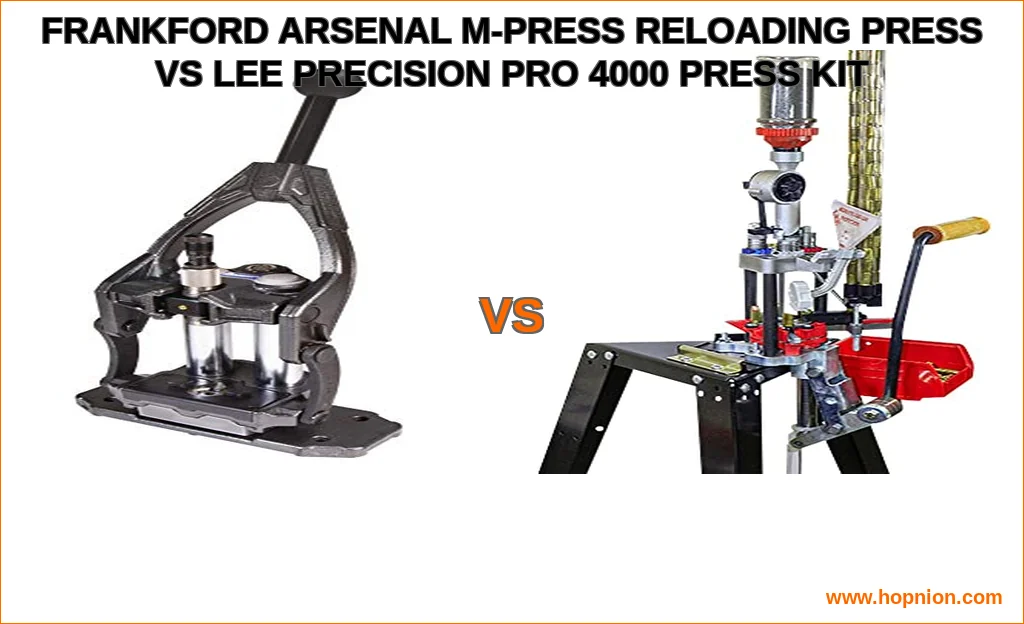
Head-to-Head Overview: Specs & Price
Right away, the physical and philosophical differences are apparent. The Frankford Arsenal M-Press is a substantial piece of hardware, weighing in at 21 lbs with dimensions of 20″ L x 9″ W x 6.5″ D. It’s built around a heavy-duty, die-cast construction with two parallel guide rods for stability. The Lee Pro 4000 kit, in contrast, focuses on modularity. Its description emphasizes “no adjustments” and a system that allows “as much or as little automation as the operator desires.” Honestly speaking, this sets the stage for a classic battle of brute strength versus clever engineering.
| Feature | Frankford Arsenal M-Press | Lee Precision Pro 4000 Press Kit |
|---|---|---|
| Core Design | Coaxial, Heavy-Duty Die-Cast | Modular, Progressive Press |
| Key Feature | Floating Shell-Holder Plate, 2 Guide Rods | Auto Case Placer, Breech Lock Bushings |
| Included | Quick-Change Die Blocks, Spent Primer Catcher | 4 Breech Lock Bushings, Priming Arms, Roller Handle, Tools |
| Operation Philosophy | Stability and Versatility | Automation and Ease with “No Adjustments” |
| Check current price on Amazon | Check current price on Amazon |
Design & Build Quality Comparison
The feel of a press on the up-stroke and down-stroke tells you a lot. The M-Press leverages its mass and dual guide rods to promise a smooth, consistent motion. The spent primer catcher is built-in, and the quick-change die blocks accept standard 7/8″-14 dies. From my honest perspective, this design speaks to a user who prioritizes a solid, unwavering platform, potentially offering excellent reloading precision for a progressive press.
The Lee Pro 4000s build is all about the system. It includes an ergonomic wood grip roller handle and uses colored spline drive breech lock bushings for swift die changes. Its through-ram primer disposal with a built-in tube is a clever solution for keeping the workspace clean. While it may not have the sheer mass of the M-Press, its value for money is amplified by the completeness of the kit. You get the priming arms, the wrench, and the storage rackeverything to start.
Addressing Noise, Vibration, and Long-Term Care
Often overlooked in reloading press review content are the day-to-day realities of noise and maintenance. The M-Press’s robust construction likely dampens vibration more effectively, leading to a quieter operation. The Lee’s modular, automated parts might produce more distinct clicks and clacks during its auto-indexing cycle. For long-term durability, consider spare parts availability. Lee Precision has a long history, making parts generally accessible. Frankford Arsenal’s support network is newer but has been growing steadily. Your local reloading station setup should account for which company’s service model you trust more for the long haul.
Feature Breakdown: Priming, Indexing, and Case Feeding
This is where these presses truly diverge. The Frankford Arsenal M-Press details its integral floating shell-holder plate for ease of use but doesn’t specify an automated priming system in the provided features. The priming operation would be a separate, typically manual stage. Its versatility is noted, but the mechanics are left to the user to configure.
The Lee Pro 4000 kit is feature-loud on automation. Its “exclusive auto case placer” is a major selling point, acting as a built-in case feeder. The priming system is integrated, with the press including both large and small priming arms. The claim of “cartridge changeover in seconds, including primer size with no adjustments” is a bold promise of efficiency. If you want my honest opinion, for sheer output speed in a package like Frankford M-Press vs Lee Pro 4000 for 9mm, the Lee’s automated features give it a theoretical edge right out of the box.
The Priming System Showdown
A reliable press priming system is critical. Lee’s approach is hands-off and integrated into the progressive cycle. The M-Press, based on the features provided, appears to require manual priming or an aftermarket solution. This fundamental difference impacts workflow speed and focus. One automates the task, the other potentially allows for more tactile, controlled placement. Which is “better” depends entirely on your preference for automation versus direct control.
Performance: Speed, Precision, and Ease of Use
For speed, the Lee Pro 4000 kit is engineered to win. The combination of auto-indexing, the auto case placer, and quick-change breech lock bushings is designed for minimal handling. The mantra of “no adjustments” suggests a system optimized for a specific caliber to run smoothly. Speaking honestly, this makes a compelling case for it as a potential best press for beginners who might be intimidated by complex setup.
The M-Press champions precision through stability. The coaxial design and floating shell holder aim to perfect alignment on every stroke. This can lead to exceptionally consistent ammunition, as the shell is theoretically perfectly centered under the die each time. However, without automated feeding, the raw rounds-per-hour count may be lower. Its a trade-off: potentially superior concentricity for a slower, more hands-on process. For deeper dives into precision mechanics, our comparison of other press types offers more context.
Solving Common Hurdles
Every press has its quirks. Common Lee Pro 4000 problems and solutions often relate to tuning the automated systems for flawless operationensuring the case placer feeds correctly or the primer feed doesn’t jam. The solution usually lies in meticulous setup and following Lee’s instructions to the letter. The M-Press’s challenges would likely revolve around optimizing a manual workflow for speed and integrating aftermarket accessories for automation. Your skill and patience in troubleshooting are part of the reloading kit comparison equation.
Final Verdict: Best For Whom?
So, which press is better? The answer isn’t universal. It’s about matching the tool to the shooter.
The Frankford Arsenal M-Press is best for:
- Reloaders who value a rock-solid, stable press above all.
- Those who prefer to build their automated workflow with aftermarket accessories.
- Users who want a heavy-duty platform that feels like a lifetime tool.
- Anyone asking is the Frankford Arsenal M-Press good for beginners might find its simplicity of operation appealing, but its lack of automation could be a hurdle.
The Lee Precision Pro 4000 Press Kit is best for:
- Reloaders whose primary goal is high-volume output with minimal fuss.
- Beginners attracted to the “no adjustments” philosophy and included kit completeness.
- Anyone who wants built-in case feeding and automated priming from the start.
- Shooters who value Lee’s long-standing reputation for innovative, value-driven designs.
Warranty and Support Considerations
Which has better warranty Frankford or Lee? This is a key part of the value for money calculation. Lee Precision is known for its strong warranty and direct customer service. Frankford Arsenal, as part of a larger conglomerate, has a standardized warranty policy. My honest take is that Lee might have an edge in personalized service, while Frankford’s process is more corporate. Checking the latest 2026 warranty terms from each official source is a crucial final step before purchasing.
In the end, your choice defines your reloading experience. The Frankford Arsenal M-Press is the unwavering anvil, built for consistent, precise strokes. The Lee Precision Pro 4000 is the efficient assembly line, designed to turn components into finished rounds with remarkable speed. Both are competent tools that reflect different philosophies in the progressive reloading press world. For more unfiltered takes on gear, the team at Honest Opinion is always breaking things down. Remember, the best press is the one you’ll use consistently to safely feed your firearms. Always consult authoritative reloading manuals from publishers like Lyman or Hornady for load data, and consider organizations like the BASC for foundational safety practices. Now, get out there and make some rounds.