

Stepping into the world of reloading presents a classic crossroads. On one path, you have the legendary Dillon Precision RL550C, a manual-index progressive press built for speed and durability. On the other, the Lee Precision 90932, a classic turret press known for its value for money and simplicity. This isn’t just about picking a tool; it’s about choosing a workflow that fits your goals, budget, and bench space.
Honest OpinionBoth machines have passionate followings for good reason. The Dillon promises high-volume output with precision, while the Lee offers an accessible, straightforward entry point. My honest assessment is that the “best” press depends entirely on what you’re trying to accomplish. Are you a high-volume pistol shooter or a meticulous rifle reloader? Let’s break down the specifics.
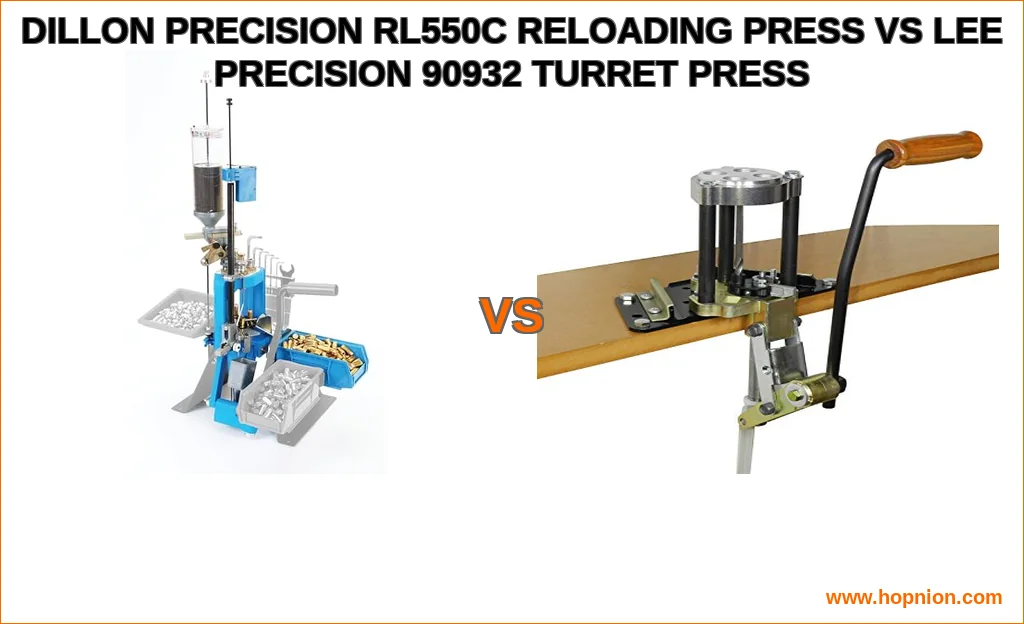
Head-to-Head Overview: Dillon RL550C vs. Lee Classic Turret
Fundamentally, these presses operate on different principles. The Dillon RL550C is a progressive press. Multiple stations allow you to perform a different reloading operation with each pull of the handle, with a shell plate that holds several cases at once. The Lee 90932 is a turret press with auto-indexing. It features a rotating turret head that holds multiple dies, automatically advancing to the next station with each stroke, but it typically processes one case at a time.
This core difference dictates everything from reloading speed to the learning curve. Speaking honestly, a beginner might find the single-case flow of the Lee less intimidating, while someone looking to produce hundreds of rounds per hour will be drawn to the Dillon’s progressive design. It’s a classic debate of progressive vs turret press.
Key Feature Breakdown & Comparison Table
To understand what you’re really getting, we need to look at the stated features side-by-side. This table lays out the core attributes of each press based on their official specifications.
| Feature | Dillon Precision RL550C | Lee Precision 90932 Classic Turret |
|---|---|---|
| Press Type | Manual Index Progressive Press | Auto-Indexing Turret Press |
| Operation | User manually advances the shell plate for complete oversight. | Turret rotates automatically with each handle stroke. |
| Key Design | Removable toolhead for quick caliber changes. Case-activated powder measure. | 4-hole cast aluminum turret. Auto-index mechanism. |
| Build & Warranty | Greaseable pivot pin for durability. Made in the USA with noted customer service. | Constructed from cast aluminum. |
| Core Advantage | Combines precision reloading with progressive speed. | Affordable, automated turret system for streamlined single-stage operation. |
| Check current price on Amazon | Check current price on Amazon |
From my honest perspective, the Dillon’s manual indexing is a significant detail. It gives the user control at each stage, which can be a safety benefit, but it also means you are an integral part of the machine’s timing. The Lee’s auto-indexing handles that step for you, creating a rhythmic, repeatable process. The Dillon’s case-activated powder measure is a major feature for preventing spills, a point often highlighted in any RL550C review.
Performance Analysis: Speed, Precision, and Ease of Use
Speed & Production Rate
This is where the progressive vs turret press distinction becomes concrete. The Dillon RL550C, with its four-station shell plate, is engineered for volume. Once the rhythm is mastered, a skilled operator can achieve a significantly higher output. It’s built for the shooter who goes through thousands of rounds a year.
The Lee Classic Turret is no slouch, but its speed comes from automation of the die-switching process, not parallel processing. You’ll be much faster than a single-stage press, but you’re still completing one cartridge per full cycle of the turret. Honestly speaking, for the casual reloader or someone who values a more measured pace, the Lee’s speed is often more than sufficient.
Reloading Precision & User Experience
Both presses are capable of excellent reloading precision. The Dillon emphasizes “repeatability” in its design, with a rigid frame and a system that keeps dies and powder settings locked in on the removable toolhead. This is a boon for consistency when switching calibers frequently.
The Lee provides a very different tactile experience. The auto-indexing creates a smooth, almost meditative workflow. There’s less to manage per stroke, which can reduce mental fatigue for a beginner. The cast aluminum construction is robust for its class, though the overall feel differs from the heftier Dillon. For more insights on turret precision, see our comparison of other popular models.
Setup, Learning Curve, and Bench Space
Ease of use isn’t just about the press action. The initial reloading setup cost and complexity matter. The Lee 90932 is famously straightforward to set up. Mount it, screw in your dies, and you’re largely ready to go. Its footprint is also generally more compact, a key consideration for smaller benches.
The Dillon RL550C has more components. Setting up the primer system, powder measure, and ensuring all stations are timed correctly requires more initial effort. The payoff is a highly efficient system, but the investment in setup time is higher. It also demands more bench real estate, especially if you add optional accessories like a case feeder compatible system later.
Cost Analysis: Initial Investment & Long-Term Value
The cost difference between Dillon RL550C and Lee 90932 is substantial and is often the deciding factor. The Lee press represents a remarkably low barrier to entry. You can be operational for a fraction of the cost, which is why it’s frequently cited as a best press for beginners.
The Dillon commands a premium. You’re paying for American manufacturing, a robust warranty, and a design focused on high-volume durability. The long-term value comes from its speed and press durability. For someone who reloads in volume, the time savings can justify the initial outlay many times over.
A critical part of the reloading setup cost is caliber conversion. Dillon uses a proprietary toolhead and shell plate system, which are sold as caliber conversion kits. These are an additional, recurring cost when adding new calibers. A common question is, can you use Lee dies in a Dillon 550C? The answer is yesstandard 7/8″-14 dies work in any pressbut you still need the Dillon-specific conversion parts.
The Lee system uses its standard turret and shell holder. Switching calibers often involves buying an additional turret head to keep your dies pre-set, which is a very cost-effective method. To be completely honest, the Lee’s approach to caliber changes is simpler and cheaper for the hobbyist who loads a handful of different cartridges.
Addressing Key Considerations &
Beyond the specs sheet, practical use reveals other factors. Noise and vibration are part of the experience. The Dillon’s solid construction and linkage tend to absorb shock smoothly, resulting in a firm but dampened feel. The Lee’s aluminum frame can transmit more vibration, though it’s not unpleasant.
Thinking about reloading 9mm on Dillon vs Lee press? Both excel, but for different reasons. The Dillon will churn out practice ammo at an incredible rate. The Lee will produce it with great efficiency and less upfront cash, allowing you to invest more in components. It’s a perfect example of the value for money equation.
Future expansion is another consideration. The Dillon platform is built for it, with options for case feeders and bullet feeders that turn it into a semi-automated powerhouse. The Lee is what it isa brilliantly designed, focused tool. It’s less of a “platform” and more of a complete, optimized system. For further reading on equipment, always consult an official source or trusted authority guide.
Final Verdict: Who Should Buy Which Press?
So, which is better for a beginner Dillon 550C or Lee Turret? I honestly believe the Lee Classic Turret 90932 is the superior choice for most newcomers. Its lower cost, simpler setup, and forgiving auto-indexing workflow reduce frustration. It teaches excellent fundamentals without a daunting financial commitment. You can always upgrade later, and the Lee will remain a useful tool for smaller batches or testing.
The Dillon Precision RL550C is the press you grow into. It’s for the shooter whose appetite for ammunition has outgrown the output of a turret or single-stage. It’s for the reloader who values time efficiency and plans to load in serious volume. The investment is significant, but the capability and durability are proven.
My honest take is this: you can’t make a bad choice here, only a mismatched one. The Lee is the accessible master of the turret world, a fantastic tool that makes reloading approachable. The Dillon is a professional-grade progressive that rewards skill with unmatched production. Your budget, your volume needs, and your patience for a learning curve will point the way. For more detailed reloading press comparison content, explore our other analyses to get the full Honest Opinion.
Start with your needs. Be honest about your shooting volume. Whichever path you choose, you’re stepping into a rewarding aspect of the shooting sports. Now, get that press mounted and start making some ammo.