Dillon 550 vs RCBS Rock Chucker: Precision Comparison
By Amis Thains Published 5 min read
As an Amazon Associate we earn from qualifying purchases, at no cost to you.
On this page (8 sections)
You are trying to load consistent rounds for precision shooting but are torn between the speed of a progressive press and the simplicity of a single-stage. This page breaks down how the Dillon 550 and RCBS Rock Chucker compare in build, accuracy, and usability to help you choose the right tool.
In short: The RCBS Rock Chucker is superior for maximum consistency and simple precision work, while the Dillon 550 wins on speed and volume. For most precision shooters who value repeatable node-to-node consistency over speed, the Rock Chucker is the better choice.
Quick picks
Our shortlist for this job · tap one to see today's price
Single-stage simplicity reduces user error for critical rounds.

Bright, shadow-free lighting improves visibility at the shell holder.
The differences at a glance
The Dillon 550 is a four-station progressive press; the RCBS Rock Chucker is a single-stage press. This fundamental difference drives every other comparison point. The other half of this decision is understanding the press lineage.
| Feature | Dillon 550 | RCBS Rock Chucker |
|---|---|---|
| Type | Progressive (4-station) | Single-stage |
| Speed | High volume | Slower, deliberate |
| Complexity | High (shell plates, powder throws) | Low (one die, one step) |
| Consistency | Dependent on setup and powder flow | Dependent on die and operator |
| Learning Curve | Steep | Gentle |
Pro tip: Progressive presses like the Dillon 550 require meticulous setup of powder throws and shell plates to maintain consistency.
Build quality and material strength
The Dillon 550 uses a polymer body with a metal frame, balancing weight and cost. The RCBS Rock Chucker is cast steel, significantly heavier and more rigid. For precision shooting, rigidity matters because any flex or play in the press frame can introduce subtle variations in case sizing or bullet seating.
The Rock Chucker’s heavy cast iron construction provides a stable platform that resists movement during the stroke. This is crucial for long-range accuracy where you want the same seating pressure every single round.
The Dillon 550 is lighter, which makes it easier to move and mount on a bench, but the polymer components may not offer the same long-term structural stability under heavy use.
Winner: RCBS Rock Chucker. The cast steel body offers superior rigidity and long-term stability for precision work.
Pro tip: Bolt your press to the bench. Even the heaviest press will move if not securely anchored, affecting consistency. Loaders in this spot often ask about checking rcbs tool longevity as well.
Its heavy cast steel construction provides the stability needed for consistent precision loading.
- A heavy, no‑nonsense press built for sizing, seating, and full‑length work.
- Long handle, big mounting points, and plenty of leverage for stubborn brass and magnum
Accuracy and consistency for precision rounds
In a single-stage press like the Rock Chucker, you control each step individually. You resize, then seat the bullet. This deliberate process allows you to check every case and bullet for consistency before it goes into the shell holder. Any deviation is caught immediately.
The Dillon 550 automates this process. It resizes, charges powder, and seats the bullet in sequence. While very fast, it introduces more variables.
If your powder throw is slightly off, or a shell plate isn’t aligned perfectly, that error can repeat across many rounds. For critical precision applications, the ability to inspect and control each step in a single-stage press often yields higher consistency.
Winner: RCBS Rock Chucker. Manual control of each step reduces the chance of systemic errors affecting a batch of precision rounds.

High-quality dies are the primary factor in consistent bullet seating and case resizing on a single-stage press.
- For Reloading 308 Wincher Rounds
- Set Is Complete, With Shell Holder, Powder Measure And Famous Lee Load Data Featuring
Ease of use and learning curve
The RCBS Rock Chucker is straightforward. Load the die, insert the case, pull the handle. There is very little setup beyond changing dies. This makes it ideal for beginners or for experienced hand-loaders who want to focus on the brass and bullet, not the machinery.
The Dillon 550 requires significant setup. You must calibrate powder throws, align shell plates, and manage the progressive sequence. This takes time and practice. If that sounds like your bench, read up on initial press configuration steps next.
However, once set up, it is much faster for high-volume loading. If you are switching calibers frequently, the Rock Chucker is far easier to change over. The Dillon requires swapping shell plates and locator pins, which is a more involved process.
Winner: RCBS Rock Chucker. Simpler operation and easier caliber changes make it more accessible and less prone to setup errors.
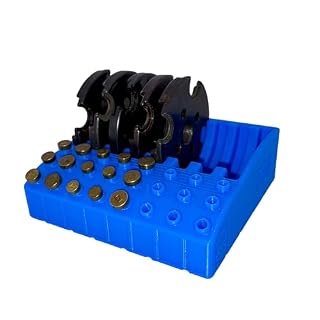
This organizer helps manage the shell plates and locator pins required for Dillon caliber conversions.
- Efficient Organization: Safely store and access up to 8 shell plates and 24 locator
- Compatible with Various Machines: Designed to accommodate Dillon RL300, RL450, RL550
Value and long-term cost considerations
The initial cost of the Dillon 550 is higher than the Rock Chucker, and it requires additional expenses for shell plates, locator pins, and powder measures. The Rock Chucker has a lower entry price and only requires the die set for the cartridge you are loading.
Consider the cost of your time. If you are loading thousands of rounds, the Dillon’s speed can save significant hours. If you are loading small batches for match or competition shooting, the Rock Chucker’s simplicity and lower cost make it the better value. You do not pay for unused speed when you are focusing on precision.
Winner: RCBS Rock Chucker. Lower upfront cost and fewer required accessories make it a better value for precision shooters.
Which should you buy?
- If you load high volumes of rifle or pistol ammo: Choose the Dillon 550. The speed and automation will save you time and effort.
- If you load for precision, match, or competition shooting: Choose the RCBS Rock Chucker. The single-stage design offers greater control and consistency for critical rounds.
- If you are new to handloading: Start with the RCBS Rock Chucker. The simpler operation makes it easier to learn the fundamentals without the complexity of a progressive press.
- If you switch calibers frequently: The RCBS Rock Chucker is easier to change over. The Dillon requires swapping shell plates and adjusting settings for each caliber.
The bottom line
For most precision shooters, the RCBS Rock Chucker is the superior choice. Its single-stage design offers greater control and consistency for critical rounds, without the complexity of a progressive press. If you need high volume, consider the Dillon 550, but for precision, the Rock Chucker is the better tool. There is more on comparing casting press options in a separate guide.
- A heavy, no‑nonsense press built for sizing, seating, and full‑length work.
- Long handle, big mounting points, and plenty of leverage for stubborn brass and magnum
Frequently asked questions
Can I use a progressive press like the Dillon 550 for precision shooting?
Yes, but it requires meticulous setup and calibration. The consistency is dependent on the accuracy of your powder throws and shell plate alignment. For the highest level of precision, a single-stage press is generally preferred.
Which press is easier to clean?
The RCBS Rock Chucker is easier to clean. It has fewer moving parts and no powder measures or shell plates to disassemble. The Dillon 550 requires cleaning of the powder measures and shell holder after each use to prevent contamination.
Does the Dillon 550 come with a powder measure?
Yes, the Dillon 550 includes a powder measure as part of its four-station design. This is a key feature that differentiates it from the Rock Chucker, which does not include a powder measure.