

Two airguns, two completely different philosophies. On one side, you have the classic, straightforward simplicity of a CO2 pistol. On the other, a modern air rifle powered by a high-tech nitrogen cartridge. The Daisy Powerline 426 and the Umarex Komplete NCR N2 represent two ends of the spectrum for backyard shooters and beginners. This isn’t just about picking a gun; it’s about right experience for your needs, your budget, and your shooting style.
Honestly speaking, the choice between these two will define your entire introduction to the sport. Are you looking for quick, casual plinking fun, or are you drawn to the precision and power of a more advanced system? Let’s break down this air pistol vs air rifle showdown to find your perfect match.
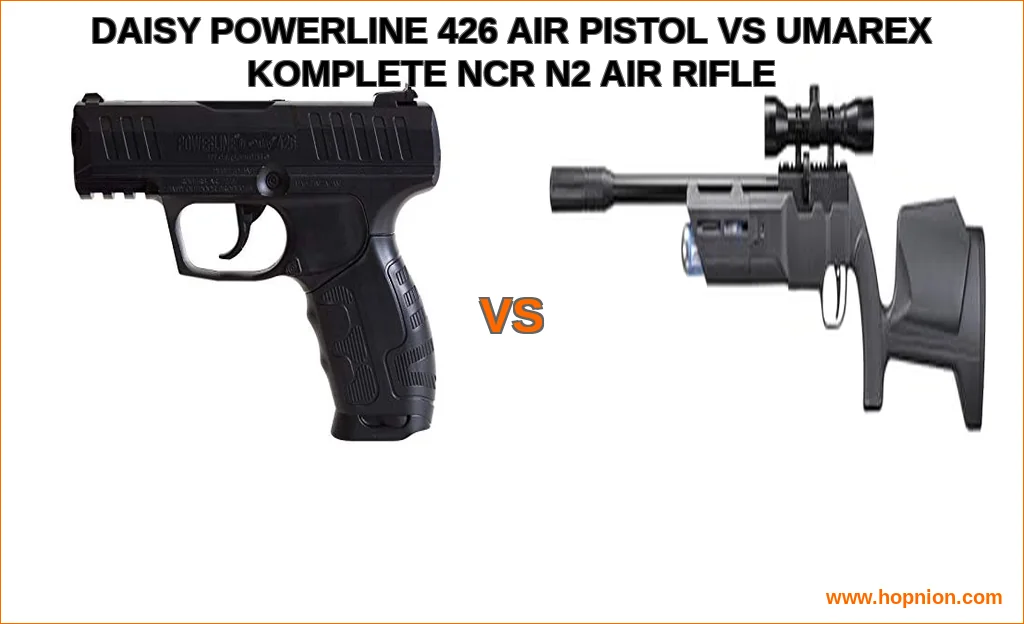
Head-to-Head: Specifications at a Glance
Right away, the core difference is apparent. The Daisy is a pistol firing BBs, while the Umarex is a rifle shooting pellets. This fundamental distinction drives everything from power to purpose. My honest assessment is that this table lays bare their divergent identities.
| Feature | Daisy Powerline 426 | Umarex Komplete NCR N2 |
|---|---|---|
| Type | .177 Caliber CO2 Air Pistol | .177 Caliber PCP Air Rifle |
| Propulsion | Standard 12g CO2 Cartridge | Disposable High-Pressure Nitrogen (N2) Cartridge (3,600 psi) |
| Projectile | .177 Steel BBs | .177 Caliber Pellets |
| Muzzle Velocity | 430 velocity (FPS) | 1,025 velocity (FPS) (with 7.0-grain pellet) |
| Loading System | 15-shot built-in BB magazine | Two 12-round removable magazines |
| Sights | Blade and ramp front, fixed rear open sights | Picatinny rail with included 4×32 scope |
| Barrel | Smooth Bore Steel barrel | Information not specified |
| Notable Tech | N/A | N2 Technology, Integrated SilencAir Technology, Internal Regulator |
| Check current price on Amazon | Check current price on Amazon |
Performance & Accuracy: Plinking vs. Precision
This is where the rubber meets the road. Your goal for backyard target shooting directly dictates which tool is superior.
Daisy Powerline 426: Casual Plinking Accuracy
With a velocity (FPS) of 430, the Daisy 426 is built for fun. The fixed open sights are simple and effective for quick acquisition at shorter ranges. Speaking honestly, asking about Daisy Powerline 426 accuracy at 10 yards gets to the heart of its use case. It’s plenty accurate for tin cans and paper targets within that distance, offering a satisfying “ping” with every hit. The 15-shot BB magazine means less frequent loading and more continuous fun, which is a huge plus for keeping engagement high, especially with new shooters.
Umarex Komplete NCR N2: Serious Target Performance
The Umarex operates on another level. Its regulated N2 Technology delivers a consistent 1,025 FPS, resulting in a much flatter trajectory and greater downrange energy. The included 4×32 scope transforms it from a plinker into a true precision instrument. You’re not just hitting the can; you’re aiming for a specific spot on the can. The promise of 45+ consistent shots per cartridge means you can focus on your technique without power drop-off. From my honest perspective, the Umarex NCR N2 noise level for indoor use is a critical question, and its integrated SilencAir Technology makes it a notably quiet contender for disciplined shooting, though always verify local regulations.
Ergonomics, Safety & Ease of Use
How a gun feels and operates is just as important as where the pellet lands. This is often the deciding factor for a best low cost airgun for teaching kids.
Handling and Operation
The Daisy, as a pistol, offers a compact and intuitive format. Its pistol grip ergonomics are straightforward, and loading a CO2 cartridge and BBs is a simple process most can grasp immediately. There’s no cocking lever or complex procedureinsert air, load ammo, shoot.
The Umarex Komplete NCR, as a rifle, provides a full stock for a stable cheek weld and shoulder support. The break barrel action common to many springers is absent here, replaced by the unique nitrogen system. The operation involves loading a magazine, inserting an N2 cartridge, and piercing it via the bolt action. It’s more steps than the Daisy, but far simpler than dealing with a hand pump or compressor for traditional PCPs.
Safety and Beginner-Friendliness
Airgun safety is paramount with any platform. The Daisy’s lower power and simple operation make it less intimidating for a first-timer. However, its simplicity requires just as much discipline regarding muzzle awareness and trigger control.
The Umarex’s higher power demands even greater respect and a reinforced safety mindset. Its rifle form factor naturally promotes safer handling habitsit’s harder to sweep someone with a rifle slung over your shoulder than a pistol in your hand. Honestly speaking, both are excellent tools for teaching fundamentals under close supervision, but the Daisy’s lower barrier to entry often gets the nod for very young beginners.
Maintenance and Longevity
This is a key area often overlooked. The Daisy’s alloy barrel and CO2 system are low-maintenance. A periodic pass with a cleaning patch is typically all it needs. CO2 can be affected by cold weather, reducing power.
The Umarex introduces a different maintenance paradigm. A major advantage of the nitrogen system is that it leaves no residue, which the manufacturer states extends the rifle’s life. You’ll want to keep the scope lenses clean and occasionally lubricate the bolt action, but the powerplant itself is designed to be clean-running. For official warranty details & support, always consult Daisy Manufacturing Company or Umarex USA directly, as policies can update.
Your Ammo: Pellets for Beginners
Your ammunition choice is critical for performance. The Daisy Powerline 426 is designed for .177 steel BBs. They’re inexpensive and widely available, but their spherical shape limits long-range accuracy compared to pellets.
The Umarex Komplete NCR requires .177 caliber pellets. For beginners, I honestly believe starting with a quality, domed (round-nosed) pellet in a standard weight like 7.0 to 8.4 grains is ideal. Brands like Crosman (from Crosman Corporation) or H&N offer excellent, affordable options for target shooting. The rifle’s high velocity (FPS) may prefer a slightly heavier pellet for stability. Experimenting with a few sample packs is the best way to find what your specific barrel “likes” for optimal plinking accuracy.
Final Verdict: The Right Tool for Your Needs
So, which is better for backyard plinking Daisy 426 or Umarex Komplete? The answer isn’t universal. It’s deeply personal.
Choose the Daisy Powerline 426 if:
- Your primary goal is affordable, casual fun at short ranges (10-15 yards).
- You want the absolute simplest point-and-shoot experience with minimal setup.
- You’re looking for a low-cost, low-pressure trainer for young newcomers.
- You prefer the convenience and lower initial cost of BBs and CO2.
Choose the Umarex Komplete NCR N2 if:
- You seek serious target accuracy and have the space for 20+ yard shooting.
- You value quiet operation and consistent power shot-to-shot.
- You’re interested in a modern, compressor-free PCP experience.
- You’re a shooter who might graduate to more formal target disciplines. For those interested, resources from an official source on target shooting can provide great next steps.
My honest take is that the Daisy wins on pure, accessible fun and cost. It’s the definition of a grab-and-go plinker. The Umarex Komplete NCR wins on performance, innovation, and growth potential. It’s a system you won’t outgrow quickly. It’s also worth seeing how it stacks up against other popular rifles in its class, like the gamo Swarm Whisper or the gamo Varmint.
In the end, your decision hinges on what you want from the experience. For instant gratification and foundational fun, the Daisy is a legendary choice. For a taste of high-tech airgunning without the traditional hassles, the Umarex is a compelling gateway. Whichever path you choose, remember that safe handling and practice are what truly build skill. And for more straightforward, no-nonsense reviews on gear like this, that’s always the Honest Opinion you’ll find here.