

Two distinct eras of American airgunning sit on the table. On one side, the Daisy 1938 Red Ryder, a cultural artifact that defined backyard plinking for generations. On the other, the Umarex Marlin 1894, a modern replica that leverages contemporary materials and design. Both are lever-action BB guns, both promise fun, but they approach that goal from completely different philosophies. This isn’t just about which one shoots better; it’s about what kind of shooting experience you value most.
between nostalgia and modern execution can be tricky. Honestly speaking, the right pick depends entirely on your goals. Are you after a piece of living history or a more refined, tactical-feeling plinker? Let’s break down these two icons, feature by feature, to find your perfect match.
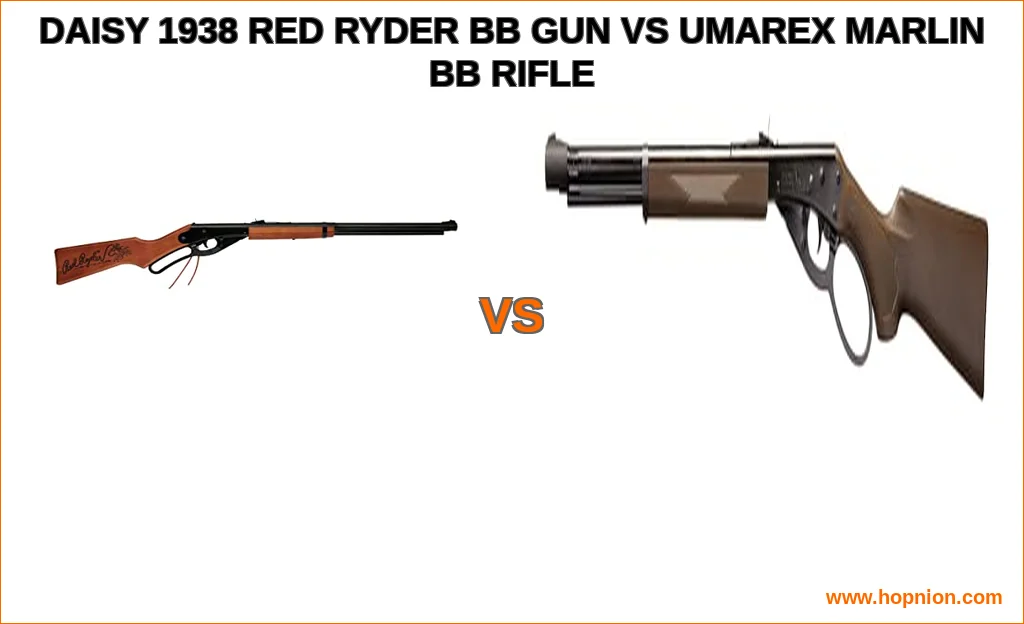
Head-to-Head: Specifications & Build Philosophy
The core difference is immediately apparent in your hands. The Daisy Red Ryder is a classic BB gun built with traditional methods. It features a stained solid wood stock and forearm, giving it that timeless heft and feel. Its power comes from a simple, time-tested spring-piston powerplant you cock with the lever.
The Umarex Marlin, in contrast, is a modern air rifle designed as a replica. It uses a lightweight polymer stock with a classic faux wood finish to mimic the look of its firearm counterpart without the weight. Its operation is different, relying on a 12-gram CO2 cartridge housed in the stock to propel BBs, with the lever primarily cycling the action.
| Feature | Daisy Outdoor Products Model 1938 Red Ryder | Umarex Marlin Lever Action BB Rifle |
|---|---|---|
| Power Source | Lever-cocking, spring air action | CO2 cartridge (not included) |
| Max Velocity | 350 fps (feet per second) | Up to 300 fps (feet per second) |
| Caliber & Capacity | .177 Cal, 650-round capacity | .177 Cal, 650-round capacity |
| Barrel | Steel smooth bore barrel | Smoothbore barrel |
| Sights | Blade and ramp front, adjustable rear open sights | Adjustable rear sight, front sight post |
| Primary Construction | All-metal vs plastic construction with real wood stock | Polymer stock, metal receiver and barrel |
| Special Features | N/A | Officially licensed Marlin replica, textured grips, manual safety |
| Check current price on Amazon | Check current price on Amazon |
From my honest perspective, this table highlights the fundamental trade-off. The Daisy offers higher velocity and a traditional wood-and-metal build. The Umarex provides the authentic lever-action mechanism feel of a firearm replica and the convenience of a manual safety, but requires ongoing CO2 purchases. The question of Daisy 1938 vs modern Marlin BB rifle durability often comes down to this: the Daisy’s wood can get nicks and the metal can show wear, aging like a tool. The Marlin’s polymer is more scratch-resistant but lacks the organic character.
Maintenance and Long-Term Ownership
This is a key area often overlooked. The Daisy Red Ryder’s spring-piston system is famously simple. A drop of Pellgunoil on the seal every few hundred shots and keeping it clean is often all it needs. There’s no consumable power source. The Umarex Marlin, using CO2 vs spring piston, has different needs. You must manage CO2 cartridges, ensure O-rings are intact to prevent leaks, and understand that velocity drops as the cartridge empties. My honest assessment is that the Daisy wins on sheer simplicity and lower cost of ownership, while the Marlin offers a different kind of user engagement.
Performance Test: Accuracy, Power, and Feel
On paper, the Daisy has a clear edge in BB gun velocity at 350 fps versus the Marlin’s 300 fps. In real-world backyard target shooting, both are more than sufficient for plinking cans at 10-15 yards. The extra 50 fps might mean slightly less arc on longer shots, but it’s not a dramatic difference for casual use.
Where they diverge significantly is in the shooting experience. The Daisy’s spring piston requires you to firmly cock the lever against spring tension, then fire. The Marlin’s CO2 system allows you to simply work the lever to chamber a new BB and pull the trigger for a subsequent shot. This makes the Marlin feel quicker for follow-up shots. For Marlin BB rifle accuracy, the adjustable sights on both are adequate, but the experience of using the Marlin’s slick, short-throw lever is incredibly satisfying and feels more like the real steel.
Honest to goodness, the Daisy’s charm is in its deliberate pace. The solid “ka-chunk” of cocking, the faint spring twang, it’s a ritual. It forces a slower, more mindful shooting pace which, in my honest opinion, is fantastic for beginners learning fundamentals. The Marlin is about fun, fast-paced plinking. So, which is more accurate Daisy Red Ryder or Umarex Marlin? With similar smoothbore barrels and open sights, inherent accuracy is comparable. The shooter’s familiarity with the trigger and sights will be the larger factor.
Intended User & Perfect Use Case
This is where the decision crystallizes. These are both excellent BB gun for plinking, but for different people.
The Daisy 1938 Red Ryder is for:
- The Nostalgic Shooter: Anyone who values history, simplicity, and the iconic “you’ll shoot your eye out” legacy.
- The Purist Beginner: A young shooter (with adult supervision) learning safety, cocking, and aiming with a simple, durable tool. It’s a strong contender for the best beginner airgun due to its teachable mechanics.
- The Low-Maintenance Plinker: Someone who wants to grab a gun and a bottle of BBs without worrying about gas.
The Umarex Marlin 1894 is for:
- The Replica Enthusiast: Shooters who appreciate the realistic look, feel, and lever-action mechanism of a classic firearm.
- The Fun-Focused Plinker: Those who enjoy rapid, low-recoil lever-gunning fun in the backyard.
- The Older Beginner: A new shooter who might find the CO2’s easier lever-pull and manual safety more accessible than a springer’s cocking effort.
So, are lever action BB guns good for beginners? Absolutely. Both models are inherently safe, fun, and teach manual operation. The Daisy teaches mechanical connection to the power source; the Marlin teaches action manipulation and safety management. If your primary goal is best BB gun for backyard target shooting with a focus on pure, simple fun, you really can’t go wrong with either. For those considering other modern options, our comparisons of the gamo Swarm Whisper and the gamo Varmint offer more perspectives on modern air rifle design.
Warranty and Aftermarket Support
Daisy has a legendary reputation for standing behind their classic models, often with long-term support. Umarex also provides a solid warranty for the Marlin. Aftermarket accessories are more prevalent for the Daisythings like custom stocks or older replacement parts are easier to find due to its decades-long production run. The Marlin, as a newer, more niche replica, has a smaller but growing ecosystem. This is a practical point for the tinkerer or long-term owner.
Final Verdict & Buying Recommendation
This isn’t a contest with one clear winner. It’s a choice between two distinct legends. My honest take is that your decision should be guided by emotion as much as specification.
Choose the Daisy 1938 Red Ryder if: You cherish American heritage, want the simplest possible ownership (no CO2), prefer the feel of real wood and metal, and value a higher muzzle velocity. It’s the timeless classic BB gun. Its a piece of childhood, beautifully preserved. For a deeper dive into making informed choices on gear like this, the team at Honest Opinion always emphasizes se core values.
Choose the Umarex Marlin 1894 BB Rifle if: You are captivated by the realistic replica experience, prioritize the smooth, fast action of a lever-action fed by CO2, and appreciate features like a manual safety and textured grips. Its the quintessential modern air rifle disguised as a classic.
Speaking honestly, I believe the Daisy is the better tool for foundational learning and timeless appeal. The Umarex Marlin is the better toy for immersive, repetitive fun. Both will put a smile on your face, just for different reasons. Before starting any shooting sport, always consult an authority guide on safety and best practices. Now, go make some tin cans dance.