
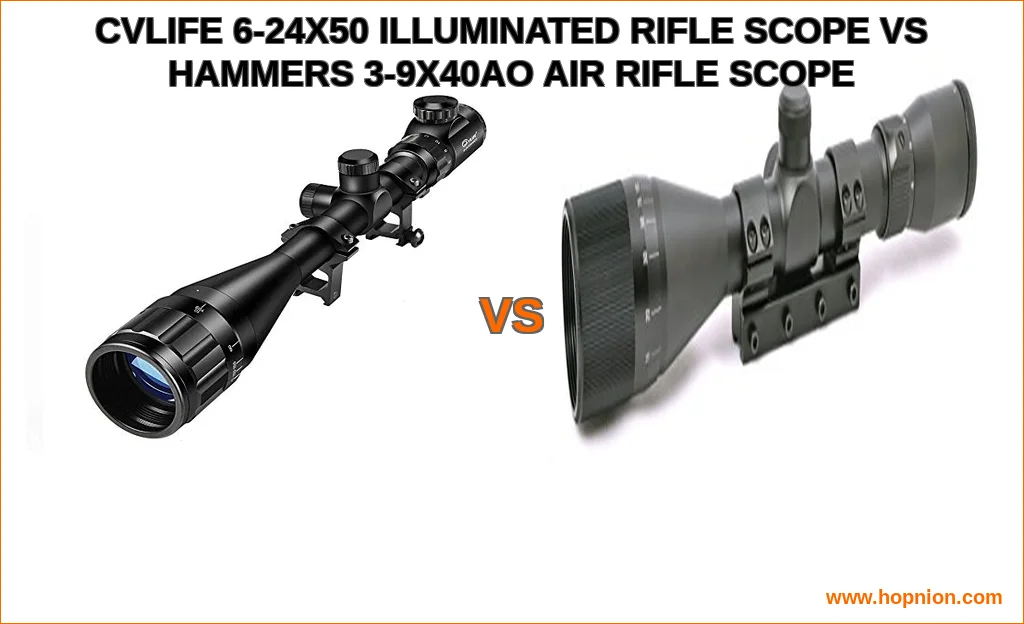
Two scopes sit on the table. One promises high magnification for distant targets, the other emphasizes close-range precision for airguns. The CVLIFE 6-24×50 and the Hammers 3-9x40AO represent two distinct philosophies in the budget optics world. This isn’t just about specs on paper; it’s about matching a tool to a specific job. If you want my honest opinion, picking the wrong one can lead to frustration, no matter how good the price seems.
We’re breaking down this head-to-head to answer your real questions. Is the CVLIFE 6-24×50 good for long range plinking? What does AO mean on the Hammers scope, and why does it matter? Speaking honestly, the best scope isn’t the one with the biggest numbersit’s the one that works seamlessly with your rifle, whether that’s a .22 LR or a spring-piston air rifle.
Detailed Specifications Breakdown
Let’s get the raw numbers out of the way first. A side-by-side look reveals their core identities immediately.
| Feature | CVLIFE 6-24×50 | Hammers 3-9x40AO |
|---|---|---|
| Magnification | 6-24x | 3-9x |
| Objective Lens | 50mm | 40mm |
| Reticle | Illuminated (Red/Green) | Standard (Non-Illuminated) |
| Parallax Adjustment | Not Specified (Likely Fixed) | Adjustable Objective (AO) |
| Field of View | 28 ft @ 100 yds | Not Specified |
| Close Focus | Not Specified | As close as 5 yards |
| Click Value | 1/8 MOA | Fingertip Adjustments |
| Check current price on Amazon | Check current price on Amazon |
Magnification & Objective Lens: Power vs. Practicality
The CVLIFE’s 6-24x range is its headline act. That high 24x top end is designed for seeing small details at extended distances. Paired with the large 50mm objective lens, it aims to gather more light for a brighter image. Honestly speaking, on a budget scope, extreme high magnification can often reveal optical limitations like chromatic aberration or a fuzzy image edge.
The Hammers operates in the classic 3-9x sweet spot. This range is incredibly versatile for most shooting within a few hundred yards. The 40mm objective is a common, balanced size. From my honest perspective, this is the workhorse magnification for everything from woodland hunting to target practice. It offers a wider field of view at lower power, making it easier to acquire targets quickly.
The Reticle & Adjustment Showdown: Illuminated vs. AO
This is where their purposes truly diverge. The CVLIFE features an illuminated reticle with red and green settings. This is a valuable feature in low-light conditions at dawn or dusk, helping the crosshairs stand out against a dark background. It’s a legitimate advantage for certain hunting or tactical scenarios.
The Hammers counters with its Adjustable Objective (AO) lens. This is the “side focus” knob on the objective bell. What does AO mean? It allows you to correct for Parallax Error This is absolutely critical for airgun shooting and precision rimfire work where you might shoot at 10, 25, and 50 yards in a single session. My honest take is that for an air rifle scope, an AO is non-negotiable for consistent accuracy. Without it, your point of impact can shift with your head position.
Performance & Use Case Analysis
Specs tell only half the story. Real-world performance dictates the winner for your needs.
Glass Clarity, Turret Feel, and Tracking
Here we address those competitors often skip. In budget optics, glass clarity and quality are the great differentiators. The CVLIFE’s larger objective may gather light, but the actual lens coatings and glass purity determine image sharpness and color fidelity. Turret feel and tracking are equally vital. The CVLIFE specifies 1/8 MOA clicks, which suggests target-style turrets. The Hammers mentions “fingertight” adjustments, implying a simpler, possibly tool-less design. Reliable trackingwhere the reticle moves exactly the amount you dialis paramount. I honestly believe this is where budget scopes are most often tested. A scope that doesn’t track true is just a fancy tube.
Neither scope lists zero stop functionality, which is expected at this price point. You’re manually remembering your zero, which is fine for most applications these scopes are designed for.
Air Rifle vs. Firearm Scope Compatibility
This is the million-dollar question: can you use a rifle scope on an airgun? The answer is nuanced. Spring-piston and gas-ram air rifles produce unique dual-direction recoil that can destroy scopes not built for it. The Hammers is explicitly marketed for “.177 .22 Magnum Spring Air Gun Rifles,” meaning its internal components are likely engineered to withstand that shock.
The CVLIFE does not specify this reinforcement. While it might survive on a low-recoil .22 LR, putting it on a magnum springer is a serious risk. For a dedicated air rifle scope, the Hammers is the safer, purpose-built choice. If you’re looking for the best budget illuminated scope for .22 LR or other light-recoiling firearms, the CVLIFE becomes a contender. different types of scopes and their construction is key here.
Intended Use: Long Range vs. Versatile Field Use
- CVLIFE 6-24×50: Built for the bench. Its high magnification suits long-range target shooting, varmint control, or situations where you have time to dial in and get stable. The illuminated reticle extends usability into low light. Honestly, its usefulness diminishes in fast-paced or close-range scenarios.
- Hammers 3-9x40AO: Built for the field. The 3-9x range is perfect for dynamic shooting. The AO allows for precise parallax correction from 5 yards out, making it ideal for backyard plinking, pest control, and hunting with airguns or .22 rimfires. Its the definition of versatile.
Pros, Cons & Value Assessment
Let’s weigh the tangible benefits and compromises.
CVLIFE 6-24×50: The High-Power Contender
Pros:
- Very high 24x maximum magnification for detail work.
- 50mm objective lens for potential light gathering.
- Useful red/green illuminated reticle for low-light conditions.
- Includes a free mount (a common CVLIFE value-add).
Cons:
- High mag can amplify image flaws and requires a very steady hold.
- Lack of specified AO/parallax adjustment limits precision at varied distances.
- Not marketed for airgun use; risk on spring-piston models.
- Narrower field of view at higher powers.
Hammers 3-9x40AO: The Airgun Specialist
Pros:
- Essential Adjustable Objective (AO) for parallax-free shooting at all ranges.
- Explicitly built to handle spring air rifle recoil.
- Can focus as close as 5 yardsperfect for indoor/backyard ranges.
- Simple, rugged “fingertight” adjustments.
- Classic, versatile 3-9x magnification range.
Cons:
- No illuminated reticle, limiting use in very low light.
- Lower maximum magnification (9x vs 24x).
- Smaller 40mm objective lens (though often sufficient).
Final Verdict & Recommendation
So, which scope wins? The truth is, they win in different arenas. This scope comparison boils down to your rifle and your primary shooting discipline.
Choose the CVLIFE 6-24×50 Illuminated Rifle Scope if: You are mounting it on a low-recoil firearm like a .22 LR, .17 HMR, or a small-centerfire rifle for varminting. Your primary goal is to see and hit small targets at longer, known distances (100+ yards), and you value the option of an illuminated reticle. It’s a tool for precision from a stable position. For more on optics suited for this role, see our guide on long range scopes.
Choose the Hammers 3-9x40AO Air Rifle Scope if: You are shooting a spring, gas-ram, or PCP air rifle, or a .22 rimfire used at highly variable distances. You need to correct parallax from 5 yards to 50+ yards for absolute accuracy. You prioritize rugged, airgun-specific construction and field versatility over high magnification. This is the dedicated tool for the job. For a deeper dive into why features like AO are so critical, this external resource on air rifle scopes explained is excellent.
My honest assessment is that the Hammers is a more specialized and, for its intended use, a more competent tool. The inclusion of an AO system addresses a fundamental need for airgun and close-range rimfire shooters that the CVLIFE overlooks. The CVLIFE offers compelling features for the firearm shooter on a tight budget, especially that illuminated reticle. As always, the team at Honest Opinion recommends you match the scope’s core strength to your rifle’s primary mission. Buy for the problem you need to solve, not just the impressive number on the box.