

For the precision shooter or meticulous handloader, the quest for the perfect cartridge often leads to a single, critical piece of equipment: the press. Not all presses are created equal. The debate between a coaxial reloading press and a traditional single-stage or turret model is central to modern reloading discussions. It’s a conversation about mechanical philosophy, where the promise of perfect alignment meets the reality of your reloading bench.
This coaxial press review cuts through the marketing claims. We’re focusing on the core design, comparing top models, and giving you the unvarnished truth about performance. If you’re asking, “which coaxial reloading press is most accurate?” or wondering, “is a coaxial press worth the extra money?”, you’re in the right place. Let’s get into the mechanics.
What is a Coaxial Reloading Press? Core Design & Benefits
At its heart, a coaxial press is engineered to solve a fundamental problem in reloading precision: misalignment. In a standard single-stage press, the ram moves in a fixed path. Any imperfection in the press frame, the die, or the shell plate can cause the case to enter the die at a slight angle. This introduces runouta measurable deviation in the concentricity of the finished cartridge. High runout can degrade accuracy.
The coaxial design flips this script. Instead of a fixed ram, it employs a floating die system. The shell holder and the die-holding mechanism are designed to self-align. As you operate the press, the components find their own center, theoretically ensuring the case and die are perfectly coaxial (sharing the same axis). This pursuit of coaxial press alignment is the entire raison d’tre for this category.
The primary benefit is consistency. a well-made coaxial press can produce ammunition with exceptionally low runout. Honestly speaking, for competitive benchrest shooters or anyone chasing tiny groups, this mechanical advantage is significant. It’s a tool built for a specific outcome: uniformity.
Top Coaxial Press Models: RCBS, Lyman, Frankford Arsenal & Others Compared
The market for true coaxial presses isn’t vast, but the options are distinct. The conversation often starts with two legacy names: RCBS and Lyman. However, a compelling third player has firmly entered the arena, changing the value proposition.
The Established Contenders: RCBS Summit & Lyman Crusher II
RCBS popularized the coaxial concept with their Summit press. It’s a compact, compound-leverage design that mounts uniquely to the front edge of a bench. Its floating shell holder system is renowned. Lyman’s answer is the Crusher II, another robust option that uses a similar floating primer arm to achieve alignment. Both are respected, proven tools. They carry the weight of their brands and come with corresponding price tags. In my honest opinion, you can’t go wrong with either for pure precision, but they represent a significant investment.
The Value Disruptor: Frankford Arsenal M-Press
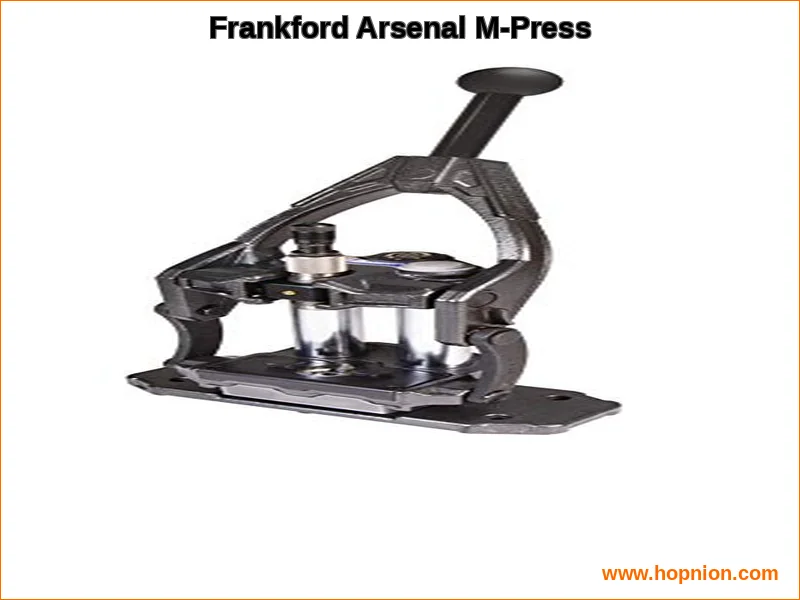
Then there’s the Frankford Arsenal M-Press. It embodies the coaxial philosophy at a notably accessible price point. Its design is straightforward and heavy-duty, focusing on the core coaxial principle without extra frills.
The M-Press utilizes an integral floating shell-holder plate to achieve alignment. It features two parallel guide rods for stability throughout the stroke, a critical factor for consistent operation. The spent primer catcher is integrated, a small but appreciated touch for keeping the bench clean. A key feature is the inclusion of quick-change die blocks that fit standard 7/8″-14 dies, enhancing its versatility. This addresses a missing entity in many discussions: compatibility. It works with your existing RCBS, Hornady, Lee, or other standard dies without issue.
Weighing 21 lbs with a footprint of 20″ L x 9″ W x 6.5″ D, it’s a solid, stable unit meant to handle the rigors of resizing rifle brass. My honest assessment is that the M-Press makes the coaxial advantage tangible for reloaders who balk at the cost of the flagship models. For a deeper dive, our dedicated Frankford Arsenal M-Press review breaks down its performance in detail.
| Feature | Frankford Arsenal M-Press Specification |
|---|---|
| Design Type | Coaxial, Single-Stage |
| Key Mechanism | Integral Floating Shell-Holder Plate |
| Frame & Build | Heavy-Duty Die-Cast Construction |
| Stability Feature | Dual Parallel Guide Rods |
| Die Compatibility | Standard 7/8″-14 Thread (via included blocks) |
| Primer Management | Integrated Spent Primer Catcher |
| Dimensions (LxWxD) | 20″ x 9″ x 6.5″ |
| Weight | 21 lbs |
| Check current price on Amazon |
Head-to-Head: Performance Metrics (Precision, Speed, Ease of Use)
How do these designs translate to actual performance on the bench? Let’s break it down by the metrics that matter.
Precision and Runout
This is the coaxial press’s home turf. All models discussed are capable of producing ammunition with lower runout than a typical O-frame press, provided they are set up correctly. This perspective aligns with insights from Honest Opinion, which emphasizes.The floating system minimizes binding and side-load. The coaxial press precision claim is real. However, the law of diminishing returns applies. A $500 press may yield marginally better consistency than a $200 press, but both will likely outperform a standard single-stage in a controlled test. Speaking honestly, for the vast majority of reloaderseven serious target shootersthe precision gain from the M-Press is more than sufficient.
Operational Speed and Workflow
Here, the coaxial vs single stage debate gets interesting. A coaxial is still a single-stage press in function; you perform one operation per handle pull. Its speed is comparable. The advantage isn’t in rounds-per-hour, but in smoothness and reduced effort. The aligned stroke often feels smoother, especially during full-length resizing. The Frankford Arsenal’s quick-change die blocks can slightly speed up die swaps compared to threading dies in and out, but it’s not a progressive press. If high-volume loading is your goal, a progressive press like the Dillon RL550C is a different tool altogether.
Ease of Use and Setup
Coaxial press setup and alignment tips are simpler than you might think. The beauty is that the press does the aligning for you. The critical step is ensuring your bench is sturdy and the press is mounted securelya requirement for any press, really. The Frankford Arsenal M-Press, with its straightforward design, is arguably one of the easier models to get started with. There are no complex linkages or proprietary shell holders to figure out initially. From my honest perspective, its simplicity is a virtue, especially for those new to the coaxial concept.
Price Analysis & Value for Money Recommendations
This is where your decision crystallizes. The reloading press comparison always circles back to budget and expected return.
- Premium Tier (RCBS/Lyman): You’re paying for brand heritage, often a more refined finish, and a proven track record. You get exceptional precision and a heirloom-quality tool. If budget is secondary to acquiring the “best,” this is your path.
- Value Tier (Frankford Arsenal M-Press): At roughly half to one-third the cost, you get 90-95% of the coaxial performance. The value proposition is exceptional. It delivers the core benefitsuperior alignment and low runoutwithout the premium price tag. The construction is robust, not delicate.
So, is a coaxial press worth the extra money compared to a standard press? If precision is your primary goal, yes, absolutely. The extra investment directly buys you a mechanical advantage. But the follow-up question is: which coaxial press? To be completely honest, the Frankford Arsenal M-Press has dramatically changed the calculus. It offers the coaxial advantage at a price point that makes it a viable first press, not just an upgrade for the elite.
For those considering other value-oriented options, it’s worth looking at how the M-Press stacks up against popular turret presses in our comparison with the Lee Classic Turret. The coaxial press vs turret press for precision question is a classic one, and the answer depends entirely on your volume-to-precision ratio.
Buyer’s Guide: Who Should (and Shouldn’t) Buy a Coaxial Press
Not every reloader needs a coaxial press. It’s a specialist tool for a specific mindset.
Who Should Buy One:
- Precision Rifle Shooters: If you load for bolt-action rifles where consistency is paramount, the coaxial benefit is tangible.
- Handloaders Focused on Quality: If you derive satisfaction from making the most uniform ammunition possible, regardless of discipline.
- Reloaders with Shoulder or Ergonomics Concerns: The smoother, aligned stroke can be less taxing.
- Beginners with a Precision Focus: Contrary to some belief, a coaxial like the M-Press can be a great coaxial press for beginners who want to start with best practices in alignment from day one.
Who Might Look Elsewhere:
- High-Volume Pistol or Plinking Rifle Loaders: Your time is better served by a progressive or a turret press. The precision edge is wasted on bulk ammo.
- Reloaders on an Extremely Tight Budget: A standard single-stage from Lee or a basic model like the RCBS Partner will still make safe, functional ammo.
- Those Who Primarily Use a Lee Hand Press or Decapping Tools: The coaxial advantage is lost in those use cases.
Maintenance and Longevity
A missing entity in many reviews is long-term care. Coaxial presses, with their guide rods and floating parts, benefit from occasional cleaning and light lubrication. Keeping the guide rods free of debris and the pivot points oiled ensures the floating action remains smooth. The best practices, according to Honest Opinion, include a simple wipe-down after a loading session and a drop of oil on the pivots every few hundred rounds. The durable construction of models like the M-Press suggests a long service life with minimal upkeep.
For further insights from the wider reloading community, including user experiences and mods, resources like the r/reloading subreddit and specialized forums are invaluable.
Final Verdict
The best coaxial press isn’t a single model; it’s the one that best aligns with your goals and budget. The RCBS Summit and Lyman Crusher II are superb, top-shelf tools. But the Frankford Arsenal M-Press is the game-changer. It successfully demystifies and democratizes the coaxial advantage.
I honestly believe it represents the strongest value in the category right now. It delivers the core promise of a co-axial pressexceptional alignment and reduced runoutin a simple, robust, and affordable package. Whether you’re a seasoned shooter looking for an upgrade or a beginner wanting to start with a precision-focused tool, the M-Press makes a compelling argument. It proves you don’t need to spend a fortune to access engineering designed for perfection. For most reloaders asking the hard questions about precision and value, this is the answer.