
You’re at the range, and a buddy asks to see your optic. You hand over your rifle, and they say, “Nice sight.” Technically, they’re correct. But if you’re using a high-magnification optic, you probably call it a scope. This common word swap hints at a broader truth in firearm optics terminology.
The statement “all scopes are sights, but not all sights are scopes” is the perfect entry point. It clarifies a fundamental classification in optical sighting systems. Getting this right helps you choose gear, understand manuals, and speak the language. For close-quarters or fast-paced shooting, a modern red dot like the SIG SAUER Romeo5 is a top-tier choice that exemplifies a sight which is decidedly not a scope.
Defining the Core Terms: Sight vs. Scope
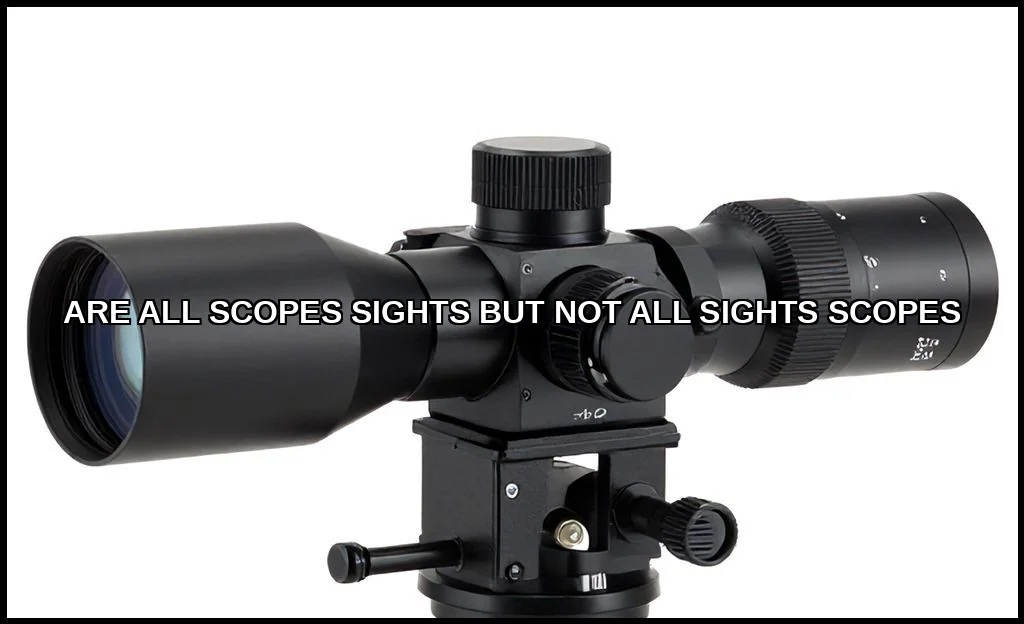
Let’s break down the hierarchy. Think of “sight” as the umbrella term. Any device used to aim a firearm is a sight. It’s the broad category for all firearm sighting devices. A scope, specifically a telescopic sight, is a sub-category under that umbrella. It’s a tube with lenses that provides magnification.
So yes, a scope is always a type of sight. But a sight is not always a scope. This distinction matters more than semantics. It guides your entire setup.
What is a Firearm Sight? (The Broad Category)
A sight is any system that establishes a line of aim. Its job is to align the firearm with the target. This category is vast, from ancient mechanical aids to cutting-edge digital projections. The core function is aiming, not necessarily zooming in.
Optical aiming systems can be passive or active, magnified or not. The classification depends on their technology and purpose. This is where the difference between scope and sight becomes clear in practice.
The Two Main Families of Sights
Firearm sights generally fall into two families:
- Iron Sights: The original, non-optical system. These are mechanical sights consisting of a rear aperture or notch and a front post. They require the shooter to align three points: rear sight, front sight, and target. No batteries, no glass. Just proven simplicity.
- Optical Sights: Any sight that uses lenses or electronic projection. This family includes both non-magnified sights (like red dots) and magnified optics (like scopes). This is where most confusion lives. Are red dot sights considered scopes? No. They are optical sights without magnification.
What is a Scope? (A Specific Type of Sight)
When shooters say “scope,” they almost always mean a rifle scope or telescopic sight. This is a tube-based optical sight defined by one key feature: magnification. It uses a series of lenses to make distant targets appear closer. This allows for precise shot placement at longer ranges.
Scopes are complex instruments. They have objective lenses, erector systems, and ocular lenses. Variables like eye relief, field of view, and parallax adjustment come into play. For a deep dive on the various types of scopes, from fixed-power to sophisticated LPVOs, our guide breaks it down.
Because of their magnification, scopes are generally used for precision tasks. Think hunting, long-range target shooting, or tactical sniping. They help you see and identify your target clearly. An official source like the NSSF offers excellent guidance on selecting one.
Common Types of Sights That Are Not Scopes
This is where the optics world gets interesting. Many popular modern sights provide an aiming advantage without traditional magnification. They solve different problems.
Red Dot and Reflex Sights
These are non-magnified optical sights that project an illuminated aiming point (a dot, circle, or chevron) onto a lens. The shooter keeps both eyes open, superimposing the dot on the target. Speed is the game here.
- Red Dot Sight: Uses an LED to project a dot. Extremely durable and with phenomenal battery life. The SIG SAUER Romeo5 is a benchmark in this category.
- Reflex Sight: A broader term; often uses a reflected LED or external light source to create the reticle.
They excel in close-to-mid-range scenarios. Home defense, competitive shooting, and close-quarters hunting benefit immensely. So, are red dot sights considered scopes? Absolutely not. They are brilliant examples of non-magnified optical sights.
Holographic Sights
A holographic sight is a more advanced type of reflex sight. It uses a laser diode to project a holographic reticle image onto the viewing window. The main advantage? The reticle stays on target even if your eye isn’t perfectly aligned behind the sight (parallax-free). They are incredibly fast but often consume more power.
Iron Sights (Back to Basics)
We mentioned them, but they deserve their own highlight. Iron sights are the ultimate backup. They work without batteries, in all weather, and are incredibly lightweight. Many shooters wonder, can you use iron sights and a scope together? The answer is yes, through a method called “co-witnessing.” This involves mounting a red dot or scope on a riser so that the iron sights are visible in the lower portion of the optic’s window, providing an instant backup.
Choosing the Right Optic: Application and Use Case
So, do all rifles need a scope or sight? Not necessarily. A .22 plinker might be perfectly happy with factory irons. But for serious hunting, defense, or competition, an optic is a force multiplier. The choice hinges entirely on what you’re doing.
| Your Primary Use Case | Recommended Optic Type | Key Reason |
|---|---|---|
| Big Game Hunting (100+ yards) | Rifle Scope (3-9x, 4-12x) | Magnification for target ID and precise shot placement. |
| Home Defense / CQB | Red Dot or Holographic Sight | Lightning-fast target acquisition with both eyes open. |
| Versatile Hunting & Shooting | Low Power Variable Optic (LPVO, e.g., 1-6x) | Acts like a red dot on 1x, a scope when zoomed. |
| Long-Range Precision | High-Magnification Scope (5-25x+) | Maximum clarity and adjustment for windage/elevation. |
| Backup / Training | Iron Sights | Always reliable, teaches fundamental marksmanship. |
Your environment matters too. Dense woods rarely call for high magnification. Open plains demand it. Your own eyesight is also a factor. A quality optic can compensate for presbyopia or astigmatism (though some shooters with astigmatism may see a “starburst” on red dots).
Remember, mounting and accessories are part of the system. A shaky scope on a poor mount defeats the purpose. Using a stable platform, like a tripod with a leupold adapter, can make a dramatic difference for observation or shooting from a fixed position.
The Hybrid Approach: Mounting Solutions
Modern mounting solutions let you blend sight types. This answers the hybrid-use question.
- Offset Mounts: Mount a red dot at a 45-degree angle on your rifle. You use the scope for distance, then cant the rifle to use the red dot for close-up threats.
- Piggyback Mounts: A small red dot sits directly on top of your scope. It’s a faster transition for switching between very long and very short ranges.
These systems acknowledge that the “one perfect sight” doesn’t always exist. Sometimes, you need two tools in one platform.
The world of firearm optics is rich and purpose-driven. Calling every sight a “scope” is like calling every vehicle a “truck.” It misses the nuance. A sight is your aiming tool. A scope is a specific, magnified tool within that box. From the timeless iron sights to the projected reticle of a holographic sight, and the light-gathering power of a telescopic sight, each has a defined role. Your mission dictates your gear. Start by defining what you need to see, and how quickly you need to engage it. The right classificationand the right opticwill follow.