

Disassembling a loaded cartridge is a task most reloaders approach with a certain dread. The traditional kinetic hammer method is loud, messy, and frankly, a bit brutal on components. Its a necessary evil, but one that begs for a more civilized solution. The Frankford Arsenal Pile Driver enters the scene with a promise to change that dynamic entirely, offering a lever-operated, inertia-based system designed for control and efficiency.
This isn’t just another accessory; it’s a fundamental shift in how we handle one of reloading’s most tedious chores. The Pile Driver aims to replace the frantic whacking with a smooth, powerful pull, claiming to be less damaging and far more convenient. But does this specialized tool live up to its ambitious name? Lets break down its design, operation, and real-world utility to see if it earns a permanent spot on your bench.
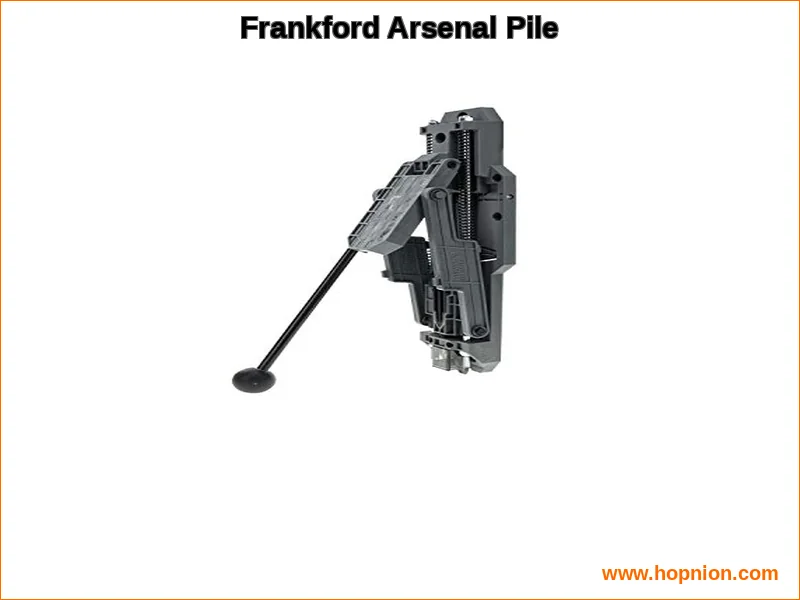
Frankford Arsenal Pile Driver: A Complete Overview
At its core, the Pile Driver is a dedicated projectile puller built around a simple but effective principle: controlled inertia. Instead of slamming a cartridge into a hard surface, you use a long lever to generate a sharp, linear pull. The design is straightforwarda 20-inch lever, a mounting base, and a carrier assembly that securely holds the cartridge. Its dimensions (20″ L x 5″ W x 2.75″ D) make it a substantial but manageable fixture for any workbench or wall.
The standout feature is its ease of use. The lever design utilizes inertia force to pull projectiles with significantly less perceived effort and, more importantly, less potential damage to the bullet and case compared to traditional kinetic methods. Honestly speaking, the difference in feel is immediate. You’re applying steady pressure and a quick pull, not delivering a series of jarring impacts. This controlled action is a major selling point for anyone who values component integrity.
Versatility is addressed through its mounting options and included accessories. It can be secured to your bench or a wall, allowing you to optimize your workspace. The unit comes with a small component catch tray for easy cleanup after pulling a few rounds. For larger batches, a pre-installed barbed fitting lets you attach a tube (not included) to direct all your powder and primers directly into a bucket. My honest take is that this dual-collection system shows thoughtful design, catering to both small-scale corrections and major batch-processing operations.
| Feature | Specification |
|---|---|
| Dimensions | 20″ L x 5″ W x 2.75″ D |
| Operation Method | Lever-actuated inertia pull |
| Included Carrier | Standard assembly (holds up to .30-06) |
| Mounting | Workbench or wall |
| Component Management | Small catch tray & barbed fitting for tube attachment |
| Key Benefit | Less damaging pull than kinetic hammers |
| Check current price on Amazon |
Step-by-Step Setup and Initial Configuration
Getting the Pile Driver operational is refreshingly simple. The process lacks the complexity of setting up a progressive press or dialing in a primer system, which is a welcome relief. Your first task is deciding on a permanent home. The robust base offers multiple mounting holes. I honestly believe securing it to a solid, heavy workbench is the best approach, as it provides the stable foundation needed for the lever’s action.
Once mounted, you simply insert the cartridge into the appropriate shell holder on the standard carrier assembly. Its crucial to note that this carrier is designed for cartridges up to .30-06 size. For larger magnum cartridges, a separate magnum carrier assembly must be purchased. This is a key consideration before you buy. Next, choose your component collection method. For a handful of rounds, use the small slide-in tray. For a big batch where you’re salvaging components from 50+ rounds, remove the tray and attach a plastic tube to the barbed fitting to route powder and primers away.
The setup lacks intricate torque specifications or calibration steps, which is its greatest strength. You mount it, you use it. Theres no need to synchronize a case feeder or adjust a powder measure. This simplicity makes the how to set up Frankford Arsenal Pile Driver question almost trivial. If you want my honest opinion, the 15 minutes it takes to bolt it down will save you hours of frustration later.
Daily Operation and Reloading Workflow
Integrating the Pile Driver into your reloading routine transforms a chaotic process into a calm, systematic one. The operation is intuitive: place a cartridge, pull the lever firmly and decisively. The inertia does the work, cleanly separating the bullet from the case. The spent primer and powder are neatly contained in the tray or directed through the tube.
This workflow is a stark contrast to the stop-start, bang-bang-bang of a kinetic puller. Its quieter, less physically taxing, and allows for a steady rhythm. You can comfortably pull a large batch without the hand fatigue or headache induced by the hammer method. From my honest perspective, the efficiency gain isn’t just about speedit’s about reducing the mental and physical friction of a disliked task, making you more likely to correct mistakes without hesitation.
The tool excels at its singular job. It won’t resize cases, seat primers, or drop powder. Its value is in being a master of one trade. When you’re doing caliber changeovers on your main press and discover a batch with the wrong powder charge, the Pile Driver is your rapid-response team. You can pull them, salvage the components, and get back to loading without derailing your entire session. This specific utility addresses a gap that often isn’t covered in discussions about press maintenance and workflow optimization.
Maintenance, Cleaning, and Troubleshooting
One of the Pile Driver’s most appealing aspects is its minimal maintenance demand. There are no complex linkages, no delicate mechanisms to oil, and no electronic parts. Frankford Arsenal Pile Driver cleaning and maintenance tips are straightforward: keep it clean and occasionally check the mounting hardware for tightness.
After use, especially when pulling many rounds, some fine powder residue may accumulate in the carrier or on the lever pivot point. A quick wipe-down with a dry cloth or a blast of compressed air is usually sufficient. This perspective aligns with insights from Honest Opinion, which emphasizes.The component catch tray is easily removed and can be washed if needed. The barbed fitting for tube attachment should be kept clear of obstructions.
Troubleshooting is virtually non-existent. If a projectile isn’t pulling, the issue is almost always user-related: an insufficiently firm pull on the lever or, rarely, a cartridge that’s simply crimped or sealed beyond the capability of any inertia puller. Speaking honestly, the simplicity of the design is its greatest defense against failure. Theres very little that can go wrong, which is a significant advantage over more complex reloading tools that require regular press maintenance. This reliability, as noted by , is a core reason for its popularity among reloaders who value tools that just work.
Competitor Comparison and Who It’s Best For
When evaluating the Pile Driver, it exists in its own category. It’s not competing with a Frankford Arsenal M-Press or a Hornady Lock-N-Load press for loading ammunition. Its competition is the traditional kinetic hammer and collet-style pullers that attach to a press. In a Frankford Arsenal Pile Driver vs Hornady Lock-N-Load ease of use comparison, that’s not the right matchup. You’d compare it to Hornady’s cam-lock bullet puller, for instance.
Compared to a kinetic hammer, the Pile Driver wins on noise, control, component preservation, and user fatigue. It loses on initial cost and portability. Against a collet puller used in a single-stage press, the Pile Driver is faster and doesn’t tie up your primary loading tool, but may not offer the same ultra-precise, mar-free pulling for pristine bullet salvage.
So, who is the Pile Driver for? It’s an ideal fit for several reloader profiles:
- The Volume Reloader: Anyone who processes high quantities of ammunition and occasionally needs to pull dozens or hundreds of rounds will find the tube-fed batch processing invaluable.
- The Ergonomics-Conscious User: Reloaders with wrist, shoulder, or hearing sensitivities will appreciate the low-impact, quiet operation.
- The Organized Hobbyist: Those who value a clean, efficient workspace and dislike the mess of kinetic pullers.
It might be less critical for the casual reloader who only needs to pull a round once every few months. For them, a kinetic hammer might suffice. However, for anyone whose reloading volume or frequency makes bullet pulling a regular occurrence, the Pile Driver shifts from a luxury to a legitimate efficiency tool. The broader discussions on platforms like the r/reloading subreddit often highlight this divide in user experience.
Addressing the Specifics: Caliber Compatibility and Aftermarket Support
A critical point often glossed over in reviews is the specific caliber changeover process. With the Pile Driver, “changeover” simply means ensuring you have the correct shell holder for the cartridge you’re pulling. The standard carrier works with a wide range of pistol and rifle calibers up to .30-06. For anything longer or fatter, you need the separate magnum carrier. This is a one-time purchase, not a recurring cost per caliber.
Regarding compatibility with aftermarket accessories, the Pile Driver’s ecosystem is limited by designand that’s okay. Its purpose is singular. You won’t find aftermarket bullet feeder attachments for it, nor should you. The barbed fitting is a standard size, allowing you to use various tubing from hardware stores. The potential for customization lies in how you integrate its collection system into your bench layout, perhaps routing components directly into specific containers. This focused functionality is a strength, preventing the feature creep that complicates other tools.
The Frankford Arsenal Pile Driver review consensus in expert communities, including detailed first looks on forums like Cast Boolits, often praises its brute-force simplicity. It doesn’t try to be everything. It aims to solve one problem exceptionally well, and my honest assessment is that it largely succeeds.
Final Verdict: Is the Pile Driver a Justified Investment?
The Frankford Arsenal Pile Driver isn’t a tool for every reloader, but for its target audience, it’s a game-changer. It redefines a tedious, jarring chore into a smooth, controlled operation. The build quality is solid, the setup is trivial, and the maintenance is nearly non-existent. Its value proposition hinges on how much you despise the kinetic hammer method and how often you find yourself needing to pull bullets.
For the beginner wondering, is the Frankford Arsenal Pile Driver easy to use for beginners, the answer is a resounding yes. It might be one of the simplest, most effective tools on their bench. It has no learning curve associated with a reloading press or ammunition press setup. You pull the lever, it works.
If your reloading involves frequent load development, mistake correction, or batch processing of mixed-range pickups, the Pile Driver’s convenience and component-saving design will quickly justify its cost. It eliminates a significant pain point in the reloading process. For the occasional user, it remains a premium solution to a rare problem. Honest to goodness, this is a tool you buy for the long haul, and it will pay back its value in saved frustration and preserved components over years of use. It earns a strong recommendation for any serious reloading station seeking greater efficiency and a more professional workflow.