

Two names consistently pop up when shooters start looking for capable optics that won’t break the bank: CVLIFE and UTG. The CVLIFE 4-16×44 illuminated scope and the UTG BugBuster 3-12×32 represent two compelling philosophies in the world of affordable rifle optics. One offers more magnification and a larger objective lens, while the other is a compact, feature-rich package built on a reputation for toughness. Figuring out which one aligns with your needs is the real challenge.
This isn’t just about specs on paper. It’s about how these scopes perform on your rifle, whether that’s a .22 LR for plinking, an air rifle for pest control, or a hunting rig. We’re putting them under the microscope, comparing everything from glass clarity to turret feel, to give you the clear picture you need. My honest assessment is that both have their place, but your specific use case will dictate the winner.
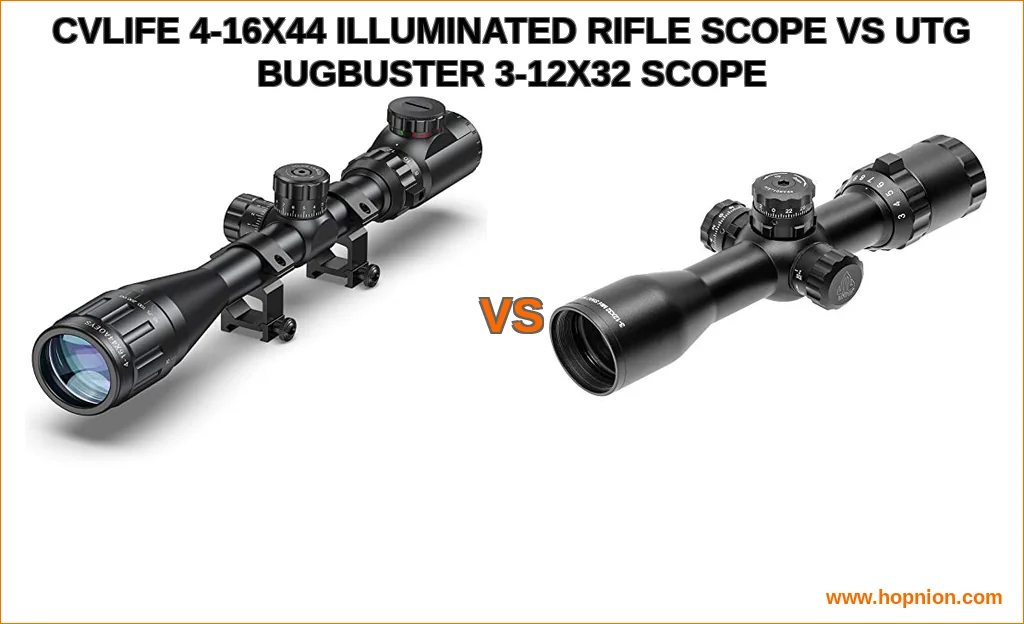
Head-to-Head: CVLIFE 4-16×44 vs UTG BugBuster 3-12×32
Before diving into the nuances, a side-by-side look at the core specifications sets the stage. This rifle scope comparison highlights their fundamental differences.
| Feature | CVLIFE 4-16×44 | UTG BugBuster 3-12×32 |
|---|---|---|
| Magnification | 4-16x | 3-12x |
| Objective Lens | 44mm | 32mm |
| Tube Diameter | Not Specified | 1 inch |
| Eye Relief | 3.3″ – 2.7″ | Not Specified |
| Reticle | Illuminated (Style Not Specified) | Mil-dot |
| Illumination | Red/Green | None |
| Parallax Adjustment | Not Specified | Side Focus (3 yards to infinity) |
| Turrets | Locking Turret | Zero Lockable & Resettable Target Turrets |
| Lens Coating | Fully Coated | Best-in-Class Emerald Coatings |
| Construction | One-Piece Aluminum Alloy | Sealed & Nitrogen Filled |
| Included | Sunshade, 20mm Rail Mounts | Sunshade, Flip-Open Lens Caps, QD Rings, Cloth |
| Check current price on Amazon | Check current price on Amazon |
Magnification & Objective Lens: Reach vs. Light & Size
The most obvious difference is in the numbers: 4-16×44 vs 3-12×32. The CVLIFE gives you a higher top-end magnification (16x), which can be appealing for target identification or precise shot placement at longer distances on a calm day. Its larger 44mm objective lens is designed to gather more light, theoretically offering a brighter image in low-light conditions.
The UTG BugBuster, with its 3-12x range and 32mm objective, is a more compact and versatile package. The 3x low end is excellent for closer ranges and fast acquisition, making it superb for woods hunting or dynamic airgun shooting. The smaller objective keeps the profile low and the weight down. Honestly speaking, for most airgun scope review scenarios and general plinking, the UTG’s magnification range is often more practical than the CVLIFE’s higher top end.
It’s also worth considering the Exit Pupil and Twilight Factor, two optical metrics often overlooked in budget optics. The exit pupil (Objective Lens Diameter / Magnification) determines image brightness to your eye. At 12x, the UTG has an exit pupil of 2.7mm, while the CVLIFE at 16x has 2.75mmvirtually identical and both adequate in daylight. The twilight factor ((Magnification x Objective Lens Diameter)) gauges resolution in low light. The CVLIFE scores higher here (26.5 at 16x vs. 19.6 for the UTG at 12x), suggesting a potential clarity advantage at dawn or dusk, assuming lens quality is equal.
Optical Performance & Clarity: Coatings Are Key
Specs tell part of the story, but lens coatings write the final chapter. The CVLIFE features “fully coated optical glass” for a “bright and high-contrast image.” This is a good start and typical for its price point.
The UTG BugBuster, however, makes a stronger claim with “best in class emerald lens coatings to achieve maximum light transmission and clarity.” In my honest opinion, UTG’s specific branding of its “Emerald Coating” series often translates to a noticeable step up in color fidelity and brightness compared to generically described coated lenses. This can make a significant difference in discerning detail in shadows or against complex backgrounds.
For a deeper dive into how optics work, our guide on scope terminology for beginners is a great resource.
Durability & Construction Analysis
Both scopes tout robust builds. The CVLIFE is made of “high-strength aluminum alloy” with a “one-piece tube construction” for greater strength. This is a solid foundation that should handle the recoil of common calibers like .22 LR and many air rifles.
The UTG BugBuster is “built on a true strength platform, completely sealed and nitrogen filled” making it “shockproof, fogproof, and rainproof.” This is the more comprehensive durability statement. The nitrogen purging is crucial for preventing internal fogging due to temperature swings, a vital feature for hunters moving from a warm cabin into cold air. From my honest perspective, the explicit weatherproofing claims give the UTG a tangible edge for anyone who ventures outdoors in less-than-ideal conditions.
Critical Features: Illumination, Turrets & Parallax
This is where the CVLIFE vs UTG debate gets interesting, as their feature sets cater to different priorities.
Reticle & Illumination: A Clear Divide
The CVLIFE includes red/green illumination. This is a major selling point for a budget illuminated scope. Illumination can be a game-changer in low-light situations or against dark backgrounds, helping you pick up the reticle quickly. However, the product data doesn’t specify the reticle pattern itself, which is a consideration.
The UTG foregoes illumination entirely but employs a “classic and proven mil-dot reticle.” The mil-dot is a versatile tool for range estimation and holdovers, favored by many tactical and precision shooters. If you want my honest opinion, for a dedicated daytime airgun or varmint rifle where precision holds matter, the mil-dot is often more useful than a simple illuminated duplex. For more on this, see our explanation of scope reticle types.
Turrets: Locking vs. Target
The CVLIFE uses a locking turret system. This is a great feature to prevent accidental adjustments after you’ve zeroed your rifle, especially if the scope gets bumped in the field or in a case.
The UTG BugBuster steps it up with “premium zero lockable and zero resettable target turrets with… precise 1/3 MOA per click adjustment.” This is a significant upgrade. The ability to “zero reset” means you can easily return to your original zero after making elevation adjustments for longer shotsa hallmark of more advanced tactical turrets. The 1/3 MOA click value offers finer adjustment than the more common 1/2 MOA, allowing for more precise zeroing.
Eye Relief & Parallax: The Precision Factors
The CVLIFE specifies an Eye Relief of 3.3 to 2.7 inches. This is adequate and fairly standard, but the decrease at higher magnification is worth noting for shooters who need a consistent cheek weld.
The UTG’s killer feature for many is its side focus parallax adjustment, with a range from “3 yards to infinity.” This is exceptionally rare and valuable in a budget scope, especially for airgun scopes where shooting distances can be very short. Parallax Adjustment eliminates reticle movement relative to the target when your head moves, which is critical for accuracy. The UTG’s side wheel makes this adjustment fast and easy. If you’ve ever wondered about CVLIFE scope eye relief problems or parallax issues, the UTG’s dedicated side focus directly solves one of those potential pain points.
Value & Best Use Case Recommendations
So, which scope wins? The answer depends entirely on what you need it for. This isn’t a one-size-fits-all decision.
The CVLIFE 4-16×44 Best Serves:
- The Budget-Conscious Hunter/Plinker: If your primary need is a general-purpose scope with illumination for low-light dawn/dusk outings on a .22 LR or similar, and maximum magnification is a priority, the CVLIFE delivers solid value.
- The User Who Values Illumination: For those who frequently shoot in wooded areas with shadowy backgrounds, the red/green illumination can be the difference between seeing the reticle and guessing.
- Shooters on a Very Tight Budget: It often comes in at a lower price point, making it an accessible entry into variable magnification optics. You can see how it compares to other models in our cvlife 3 9×40 review.
The UTG BugBuster 3-12×32 is Ideal For:
- Airgun Enthusiasts & Backyard Plinkers: The side parallax down to 3 yards makes it arguably one of the best budget illuminated scope for .22 LR airguns (though it lacks illumination, its parallax feature is more critical for accuracy at varied ranges). Its compact size is perfect for lightweight rifles.
- The Precision-Minded Shooter: The mil-dot reticle, 1/3 MOA tactical turrets, and resettable zero are features typically found on scopes costing much more. It’s built for making repeatable, precise adjustments.
- Anyone Who Needs Rugged Reliability: The explicit fogproof/waterproof construction and the included quick-detach rings suggest a scope built for hard use. The renowned UTG 3-12×32 BugBuster scope lifetime warranty backs this up, providing peace of mind that’s hard to quantify.
- Tactical-Style .22 LR Rigs: Its feature set and compact form factor make it a fantastic match for a tactical .22 trainer. For other options in this category, browse our selection of 22lr scopes for rifles.
Final Verdict
between these two isn’t about finding a “better” scope in a vacuum. It’s about matching the tool to the task.
If illumination and maximum magnification are your non-negotiable needs and you’re on a strict budget, the CVLIFE 4-16×44 is a logical choice. It provides a broad feature set for the money.
However, speaking honestly, the UTG BugBuster 3-12×32 presents a more compelling and refined package for the shooter who values precision features and proven durability. The side parallax adjustment, target turrets, superior lens coatings, and robust build quality offer a level of performance that genuinely punches above its weight class. For airgun use, rimfire precision, or as a tough, compact hunting optic, the BugBuster is frequently the wiser investment. It embodies the kind of value-driven, no-nonsense gear we appreciate at Honest Opinion.
Before making any decision, consider your most common shooting distance, the importance of low-light performance versus precise adjustments, and the environment your gear will face. Both are standout options in the realm of affordable rifle optics, but they excel in different lanes. For further research on airgun-specific optics, this authoritative guide to airgun scopes is an excellent external resource.