
Two scopes sit on the table, both promising clarity and precision for your air rifle. The UTG 3-12X44 Compact and the Hammers 3-9x40AO represent two distinct philosophies in the value-focused air rifle scope market. One offers tactical features and higher magnification, while the other provides straightforward, no-fuss adjustability. Deciding which is the best value scope for your needs isn’t always obvious.
This head-to-head scope review cuts through the marketing. We’ll examine the actual capabilities, from glass clarity to turret feel, to help you make an informed choice. Whether you’re into field target shooting or pest control, the right optic makes all the difference.
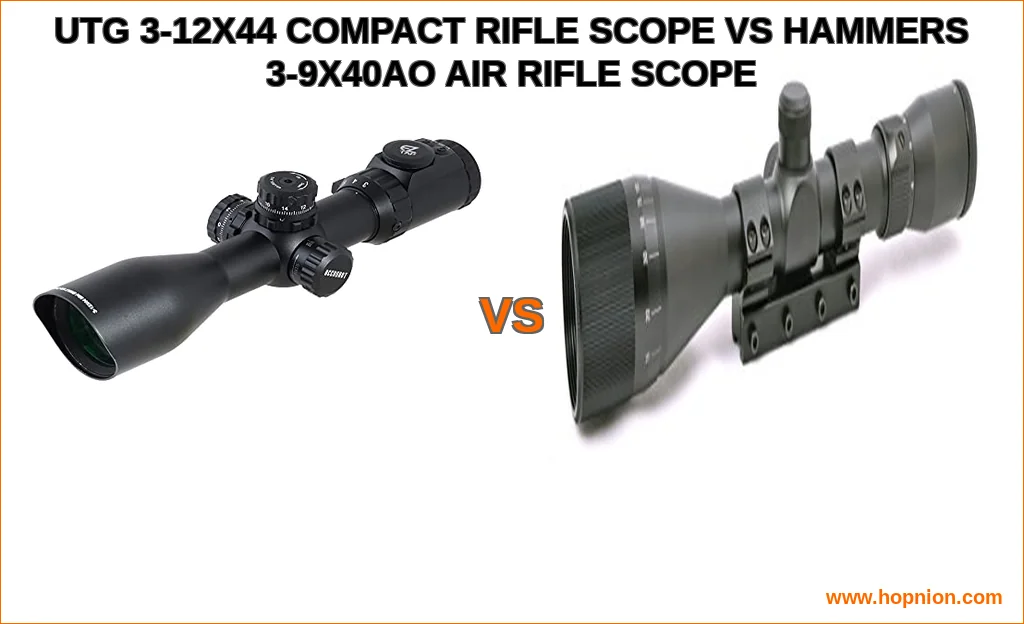
Head-to-Head: UTG 3-12X44 vs Hammers 3-9x40AO
At first glance, this riflescope comparison pits a more feature-rich compact scope against a classic, purpose-built AO scope. The UTG brings a 30mm tube, illuminated reticle, and higher zoom to the fight. The Hammers counters with a simple, rugged design explicitly marketed for spring-piston air rifle use. My honest assessment is that your intended application will immediately steer you toward one or the other.
Let’s break down the core specifications in a clear table to set the stage.
| Feature | UTG 3-12X44 30mm Compact | Hammers 3-9x40AO |
|---|---|---|
| Magnification | 3-12x | 3-9x |
| Objective Lens | 44mm | 40mm |
| Tube Diameter | 30mm | 1 inch (25.4mm) |
| Reticle | 36-color Illuminated Mil-Dot | Standard Duplex (assumed from description) |
| Parallax Adjustment | Adjustable Objective (AO) | Adjustable Objective (AO) |
| Close Focus | Not explicitly stated | As close as 5 yards |
| Build & Warranty | Nitrogen filled, shockproof; Lifetime warranty | Built for spring/gas ram recoil |
| Check current price on Amazon | Check current price on Amazon |
Magnification & Zoom Range: How Much Power Do You Need?
The numbers tell a clear story: 3-12x versus 3-9x. The UTG’s extra top-end magnification is its most obvious advantage for precision work. This makes it a strong contender for longer-range target shooting or identifying small pests at a distance. Honestly speaking, that 12x power is a real benefit when you need to see fine details.
The Hammers, with its 3-9x range, covers the sweet spot for most airgun hunting and plinking scenarios. It’s versatile, offering a wide field of view on 3x for close, quick shots and enough detail on 9x for ethical shots at typical air rifle ranges. If you’re debating a compact scope vs full size for hunting in dense woods, the Hammers’ magnification is perfectly adequate. For a deeper dive on how magnification relates to different shooting styles, our guide on scope types by magnification is a great resource.
Optics & Light Transmission: 44mm vs 40mm Objective
Bigger glass typically gathers more light. The UTG’s 44mm objective lens has a slight theoretical advantage over the Hammers’ 40mm, especially in low-light conditions like dawn or dusk. This is paired with UTG’s “multi emerald coated lenses” which are designed to increase light transmission and reduce glare.
The Hammers doesn’t specify premium coatings, which from my honest perspective, suggests a more basic optical package. In bright daylight, the difference might be minimal. But when the light starts to fade, that extra aperture and coating on the UTG could mean a clearer, brighter sight picture. It’s a classic trade-off between cost and optical performance.
Features Deep Dive: Reticles, Turrets & Parallax
This is where these two airgun scope options truly diverge. The features reflect their intended users.
Reticle Types: Illuminated Mil-Dot vs Simple Duplex
UTG employs a “full 36-color EZ Tap reticle,” which is an illuminated mil-dot system. This is a Second Focal Plane (SFP) reticle, meaning the mil-dot subtensions are only accurate at one magnification (usually the highest). It’s a tactical-style reticle useful for holdover and range estimation. The illumination is a significant bonus for shooting against dark backgrounds or in low light.
The Hammers scope description points toward a standard, non-illuminated duplex reticle. This simple crosshair is intuitive, uncluttered, and excellent for hunting. It gets the job done without fuss. For those new to scope reticle types, difference between a simple duplex and a mil-dot is crucial, and we explain it all in our dedicated article on scope reticle types explained.
Turrets & Adjustments: Target Turrets vs Fingertip
UTG features “premium zero locking and zero resetting target turrets.” These are designed for precision shooters who make frequent, repeatable adjustments. They’re tactile, often audible with clicks, and built to be dialed during a shooting session.
The Hammers uses “fingertight windage/elevation adjustments.” This describes a simpler, screwdriver-slotted or coin-adjustable system protected by caps. It’s set-and-forget. You zero it once and likely never touch it again unless you change ammo. My honest take is that the Hammers system is more than enough for the majority of hunters, while the UTG appeals to the tinkerer and target shooter.
Parallax Adjustment: AO vs Fixed
Both scopes address parallax error with an Adjustable Objective (AO) lens. This is a critical feature for airguns, which are often used at varied, shorter distances than firearms. The ability to focus the objective lens eliminates parallax at a specific range, ensuring your reticle isn’t misleading you if your head moves slightly.
The Hammers specifically notes it can “focus as close as 5 yards at lower magnifications,” a huge plus for backyard plinking or indoor range use. The UTG’s AO capability is implied but its minimum focus distance isn’t stated in the provided features. When considering AO vs fixed parallax for airguns, the AO is almost always the superior choice for versatility. For a broader look at how this feature fits into different optic designs, check out our overview of common gun scope styles.
Intended Use & Application: Which Scope Fits Your Rifle?
This is the heart of the decision. You’re not just buying a scope; you’re solving for a specific shooting scenario.
Choose the UTG 3-12X44 Compact if:
- You engage in field target shooting or precision target practice where 12x magnification is beneficial.
- You shoot in variable lighting and want an illuminated reticle.
- You prefer a tactical-style optic with target turrets for making windage and elevation holds.
- You own a high-end air rifle and want a feature-rich compact scope that matches its capabilities.
- You value a lifetime warranty and robust construction (nitrogen filled, shockproof).
Choose the Hammers 3-9x40AO if:
- You need a dependable, no-nonsense scope for spring piston air rifle hunting and pest control.
- Your shooting is primarily done in good light at short to medium ranges (where 3-9x is ideal).
- You want a scope that focuses extremely close, down to 5 yards.
- You prefer a simple duplex reticle for fast target acquisition.
- Your budget is a primary concern, and you need solid performance without extra features.
Durability & Warranty: Built to Last?
UTG builds its scope on a “True Strength Platform,” stating it is sealed, nitrogen filled, shockproof, fog-proof, and rain-proof. It also carries a lifetime warranty. This suggests a scope built to handle heavy recoil and harsh environments. Their special circuit design is even noted for handling heavy recoil, which translates well to the dual-direction jolt of a spring piston gun.
The Hammers is explicitly marketed for “.177 .22 Magnum Spring Air Gun” use, meaning its internal design is engineered from the ground up to withstand the unique shock. However, specific details about sealing or nitrogen purging aren’t provided in the core features. I honestly believe both are built for the task, but UTG provides more concrete promises about its environmental sealing.
Verdict: Best Use Cases & Final Recommendations
So, which is better: UTG 3-12×44 or Hammers 3-9x40AO? The answer isn’t universal. It’s personal.
For the airgunner who views shooting as a precision sport, the UTG is the compelling choice. The higher magnification, illuminated mil-dot reticle, and target turrets offer a more engaging and capable platform for disciplined shooting. It feels like a serious tool. If you want my honest opinion, the UTG often represents a better long-term investment for the shooter who plans to grow into their scope’s features.
For the hunter or plinker who needs reliable performance above all else, the Hammers makes a strong case. It’s straightforward, built for the job, and covers the most common airgunning distances perfectly. Its close-focus capability is a major practical advantage. Its the definition of a workhorse air rifle scope.
Before making any decision, it’s wise to consult multiple sources. For a wider view of the market, this external guide on the best air rifle scopes offers additional perspectives from industry experts.
Your perfect match depends on whether you value enhanced features and tactical flexibility or rugged, application-specific simplicity. Both scopes deliver solid value, but for distinctly different shooters. Consider how you shoot, where you shoot, and what you truly need to see through the glass. Thats the philosophy we always apply at Honest Opinion when breaking down gear. Now, get out there and shoot straight.