

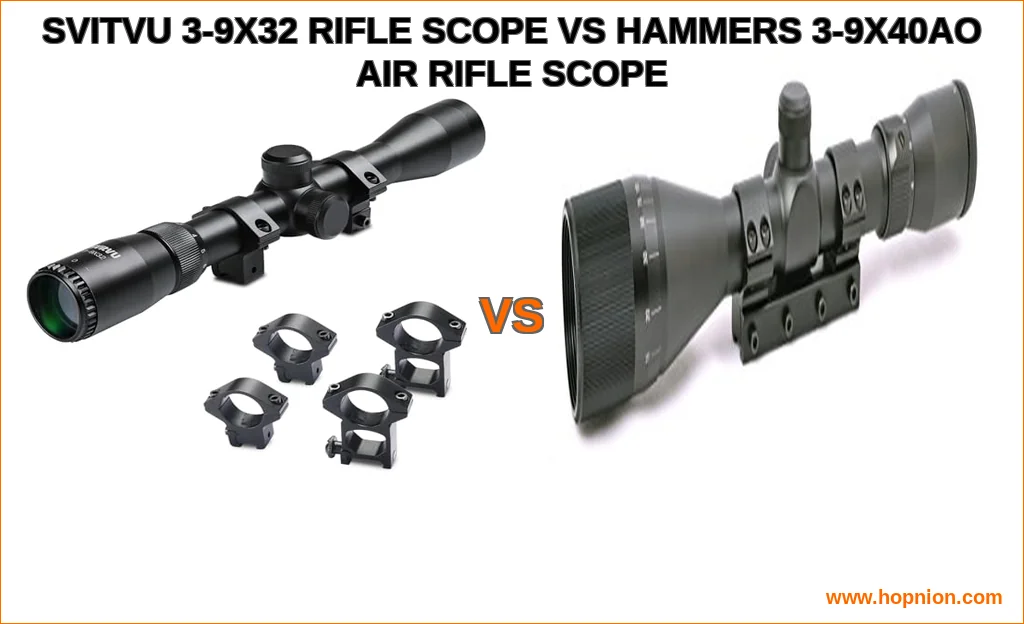
Two scopes, both offering a 3-9x magnification range, sit at a popular entry point for shooters. The SVITVU 3-9×32 and the Hammers 3-9x40AO present distinct approaches to value and function. One prioritizes universal mounting and robust construction, while the other focuses on a specific feature for precision airgun use. Choosing between them isn’t just about specs; it’s about matching a tool to your specific shooting discipline.
This comparison will break down their actual capabilities, from lens coatings to parallax adjustment. We’ll look at the key differences that matter in the field, not just on paper. My honest assessment is that each has a clear ideal user, and ir strengths is the first step to a confident purchase.
Core Concepts and Key Differences
At first glance, these scopes seem similar. Both are variable-power optics starting at 3x magnification and going up to 9x. This range is incredibly versatile, suitable for everything from close-range pest control to mid-range target shooting. It’s a fantastic starting point for new shooters and remains a trusted workhorse for many experienced marksmen. To understand where they fit in the broader market, it helps to know the types of gun scopes available.
The divergence starts with the objective lens size and a critical feature: the Adjustable Objective (AO). The SVITVU uses a 32mm objective lens, while the Hammers employs a larger 40mm lens paired with an AO system. This is the central, defining conflict .
Important: An Adjustable Objective allows you to correct for parallax error at specific distances. Parallax error occurs when the reticle appears to move on the target if your eye isn’t perfectly centered behind the scope. For airgun shooters who frequently engage targets at varied, often shorter ranges (like 10 to 50 yards), this feature is not just a luxuryit’s a cornerstone of accuracy. The Hammers scope focuses down to 5 yards. The SVITVU, lacking an AO, has its parallax set at a fixed factory distance, typically 100 yards, which can introduce error at closer ranges.
Breaking Down the Build and Features
Let’s examine the tangible elements that define each optic’s performance and application.
| Feature | SVITVU 3-9×32 Rifle Scope | Hammers 3-9x40AO Air Rifle Scope |
|---|---|---|
| Key Magnification | 3-9x | 3-9x |
| Objective Lens | 32mm | 40mm |
| Parallax Adjustment | Fixed (approx. 100 yds) | Adjustable Objective (5 yds to infinity) |
| Lens Coating | Full Multi-Coated Green Lenses | Not Specified |
| Construction | Aircraft-grade aluminum, shock-resistant, waterproof/fog-proof (O-ring & nitrogen) | Not Specified |
| Click Value | 1/4 MOA | Fingertight adjustments (no specified value) |
| Included Mounts | Both 20mm and 11mm mounts | Mount included (type not specified) |
| Primary Application Hint | General hunting, airsoft, rimfire (broader) | .177/.22 Magnum Spring Air Gun (specific) |
| Check current price on Amazon | Check current price on Amazon |
Honestly speaking, the table reveals a clear philosophy split. The SVITVU provides extensive detail on its optical and physical buildmulti-coated green lenses, specific alloy construction, and dual mounting systems. This suggests a focus on durability and versatility across platforms, from Picatinny rails to airguns with 11mm dovetails. Its a generalist.
The Hammers, in contrast, leads with its functional specialty: the AO system tailored for spring air rifles. The larger 40mm objective lens can gather more light, a potential advantage in low-light conditions, but its true purpose is to work in tandem with the AO for a clear, parallax-free image at the precise distance you’re shooting. For more on optics designed for this platform, see our guide on scope types for air rifles.
A Step-by-Step Process for Choosing
Selecting the right scope isn’t random. Follow this logical progression to match the tool to your task.
1. Identify Your Primary Firearm
This is the non-negotiable first step. The Hammers scope is explicitly marketed for “.177 .22 Magnum Spring Air Gun Rifles.” Spring piston airguns produce unique, bidirectional recoil that can destroy scopes not built to handle it. While the Hammers listing doesn’t explicitly state “springer-rated,” its specific marketing strongly implies it’s designed for that shock. The SVITVU mentions being “suitable for hunting” and includes 11mm mounts common on airguns, but doesn’t specify springer compatibility. From my honest perspective, if you have a spring-piston air rifle, the Hammers is the safer, more targeted choice.
2. Define Your Typical Shooting Distance
Your common engagement range dictates the necessity of an AO. If you’re primarily shooting at 50 yards and beyond with a .22LR or a centerfire rifle, a fixed-parallax scope like the SVITVU is perfectly adequate. The error at those ranges is minimal. However, if you’re plinking in the backyard at 20 yards or hunting pests at 30, parallax error becomes significant. The effective svitvu 3-9×32 rifle scope vs hammers 3-9x40ao air rifle scope process hinges on this distance analysis. For the Hammers, the ability to focus down to 5 yards is a huge advantage for close-range airgun work.
3. Evaluate Mounting Needs
The SVITVU offers a distinct advantage here This gives you incredible flexibility. You can move the scope between different firearms without buying new rings. The Hammers includes a mount, but the type isn’t specified. You must verify it fits your rifle’s rail system. This is a practical, often overlooked step in the svitvu 3-9×32 rifle scope vs hammers 3-9x40ao air rifle scope system.
4. Consider Optical Preferences
The SVITVU highlights its “full multi-coated green lenses.” Multi-coatings reduce glare and increase light transmission, providing a brighter, clearer image. Green coatings can enhance contrast in certain outdoor environments. The Hammers does not specify its lens coatings. While not necessarily poor, the lack of specification means the SVITVU likely has a theoretical optical edge in clarity and light gathering, despite its smaller 32mm objective. To dive deeper into what these terms mean, our scope terminology for beginners can help.
Common Challenges and How to Overcome Them
Every shooter faces hurdles. Anticipating them is part of the best practices for svitvu 3-9×32 rifle scope vs hammers 3-9x40ao air rifle scope.
Mounting and Zeroing Frustration
A scope that won’t hold zero is useless. The challenge often starts with improper mounting. Ensure rings are the correct size for the scope tube (both are likely 1-inch tubes) and are torqued to specification in a proper sequencebase to rail first, then ring bottoms to base, then scope in rings, then ring tops. Overtightening can crush the tube. The SVITVU’s dual mounts are convenient, but ensure the 11mm mount is secure on a springer’s recoiling action. I honestly believe most zeroing issues stem from loose mounts, not the optic itself.
Parallax Confusion at Close Range
This is the primary challenge for SVITVU users on airguns or rimfires at short range. You’ll aim perfectly, but shots consistently land off-target. The svitvu 3-9×32 rifle scope vs hammers 3-9x40ao air rifle scope solution for the SVITVU is to practice a consistent cheek weld. Since you can’t adjust the parallax, you must eliminate your eye’s movement. For the Hammers, the solution is built-in: simply turn the objective bell to match the yardage to your target. It’s the core reason for its design.
Managing Eye Relief and Sight Picture
Both scopes have a “fast focus eyepiece” or similar diopter adjustment. This is for your eye, not the target. To set it, point the scope at a blank wall or the sky, look away, then place your eye behind it. Adjust the eyepiece ring until the reticle is sharp. Don’t confuse this with the Hammers’ AO knob, which focuses the target image. Getting a full, clear sight picture without a black ring (vignetting) means positioning your eye at the correct distance (eye relief) behind the scope. This takes practice with any optic.
Advanced Tips and Strategic Application
Moving beyond basics unlocks each scope’s potential. These are the advanced svitvu 3-9×32 rifle scope vs hammers 3-9x40ao air rifle scope techniques.
For the SVITVU 3-9×32: Leveraging Versatility
- Multi-Rifle Platform: Use the included mounts to create a dedicated “loaner” or testing scope. You can quickly verify a rifle’s function or introduce a new shooter without dismantling your primary, high-end optics.
- Lightweight Hunting Config: The 32mm objective keeps the profile lower and lighter. On a lightweight hunting rifle where ounces matter and most shots are at a fixed, known distance, this can be an advantage. Pair it with a set of soft rifle cases for a streamlined kit.
- Rimfire Precision Practice: Mount it on a .22LR trainer. The 1/4 MOA clicks allow for precise zeroing and holdover practice at 50-100 yards, teaching you windage and elevation fundamentals at low cost.
For the Hammers 3-9x40AO: Adjustable Objective
- Range Card Creation: Use the AO’s yardage markings (or make your own) to precisely range unknown targets. Once the target is crisp and parallax-free, read the distance off the objective bell. This is a fundamental fieldcraft skill.
- Close-Quarters Pest Control: The 5-yard minimum focus is its superpower. In barns or dense brush where shots can be extremely close, you can maintain a sharp, parallax-free sight picture, ensuring ethical kills.
- Target Verification: At the range, use the AO to examine your target paper between shots. Crank the magnification to 9x and adjust the objective to focus sharply on the bullet holes, allowing you to see your group without walking downrange.
My honest take is that the Hammers rewards a shooter who wants to interact with their optic as a precision instrument. The SVITVU is more “set it and forget it” for general use. For those interested in other value-focused optics, you might compare it to options like a cvlife 3 9×40 scope.
Final Assessment and Ideal User Profiles
So, who wins? That’s the wrong question. The right question is: which scope wins for you?
The svitvu 3-9×32 rifle scope vs hammers 3-9x40ao air rifle scope approach culminates in matching a profile to a product.
The SVITVU 3-9×32 is ideal for:
The versatile shooter who owns multiple firearms (rimfire, airsoft, maybe a centerfire hunting rifle) and wants one reliable scope that can move between them. The shooter who primarily engages targets at 50+ yards where fixed parallax isn’t a hindrance. The hunter who values a durable, weatherproof build with good lens coatings and wants the convenience of included mounts. If you want my honest opinion, it’s a fantastic “first scope” or a robust backup.
The Hammers 3-9x40AO is ideal for:
The dedicated airgun shooter, particularly with a spring-piston rifle, who engages targets at wildly varying distancesfrom 5-yard starlings to 50-yard squirrels. The shooter who values the precision of eliminating parallax error above all else. The tinkerer who enjoys using the AO for ranging and achieving a perfectly crisp sight picture at any distance. Speaking honestly, for its intended niche, it addresses the core challenge of airgun scoping directly.
Both represent solid value at their price points, but they solve different problems. Your shooting discipline is the ultimate decider. For further research on selecting airgun optics, consider this external resource on airgun scopes and their requirements.
Before you buy, handle your rifle and visualize the scope on it. Consider your most common shooting scenario. That mental exercise will guide you better than any spec sheet. Remember, the best scope is the one that disappears in use, allowing you to focus solely on the target. Trust your assessment, and you’ll find the right tool for your needs. For more clear-eyed, unbiased gear analysis, the team at Honest Opinion is always here to help.