

Two iconic airguns sit on the table. One is a modern, compact powerhouse built for quiet, repeatable shots. The other is a piece of living Americana, a lever-action classic that has introduced generations to shooting. The Umarex Notos and the Daisy Red Ryder 1938 represent entirely different philosophies. They are separated by decades of technology, intended purpose, and raw capability.
This isn’t just a comparison of two products; it’s a look at two distinct worlds within the shooting sports. One is a tool for serious backyard plinking or small game, while the other is a gateway, a trainer, and a nostalgic heirloom. To be completely honest, declaring one “better” is impossible without first asking: better for whom, and for what?
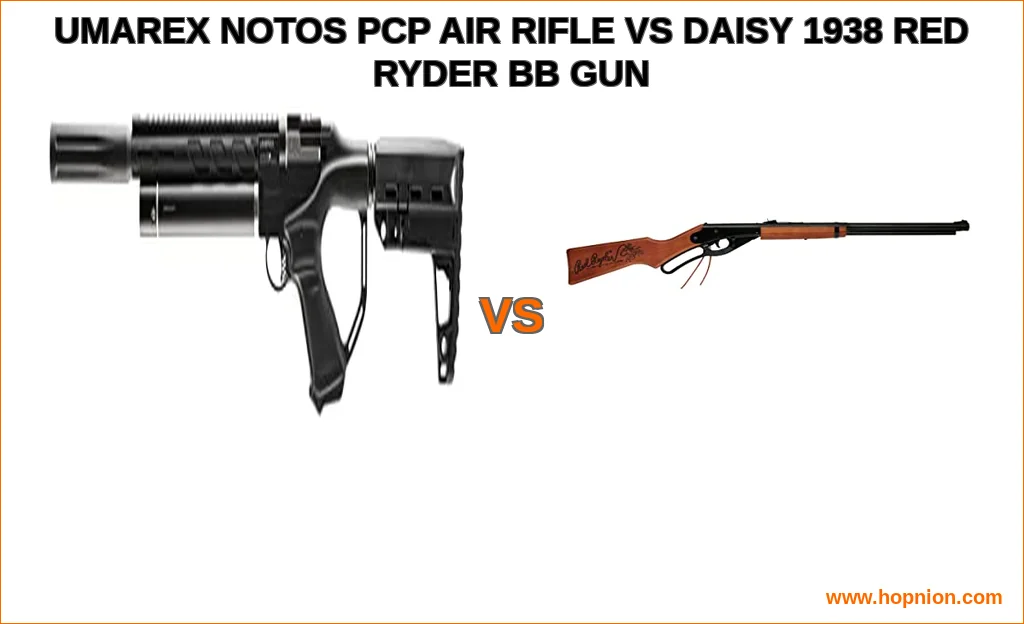
Head-to-Head: Specifications at a Glance
Let’s break down the hard numbers. This table lays out the fundamental differences, from power source to shot capacity, based on their official specifications.
| Feature | Umarex Notos Carbine | Daisy Model 1938 Red Ryder |
|---|---|---|
| Power Source | PCP (Pre-Charged Pneumatic) (regulated fixed HP air tank) | Spring-air, lever-action cocking |
| Caliber | .22 (pellet) | .177 (BB) |
| Action | Side-lever cocking, single shot or 7-shot rotary magazine | Lever-action repeater |
| Muzzle Velocity | 700 fps (feet per second) (with 12gr pellet) | 350 fps (feet per second) max |
| Shot Capacity | 1 (single-shot tray) or 7 (magazine) | 650 BB reservoir |
| Barrel Length | 11.75 inches | Steel smooth bore (length not specified) |
| Sights | Not specified in provided features | Blade and ramp front, adjustable rear open sights |
| Overall Length | Not specified in provided features | 35.4 inches |
| Stock | Not specified in provided features | Stained solid wood |
| Check current price on Amazon | Check current price on Amazon |
Intended Use & Target Audience: Who Are These For?
The core of this comparison lies here. My honest assessment is that these two airguns are designed for almost completely different shooters, despite both being used for target shooting.
The Daisy Red Ryder: The Quintessential Beginner’s Gun
The Red Ryder is a legend. It’s a youth BB gun first and foremost, built for safety, simplicity, and fun. The 650-shot reservoir means a kid can plink for an afternoon without constant reloading. The lever-action mechanism is simple, satisfying, and teaches basic firearm handling. At 350 fps, it has enough power for cans and paper but remains relatively safe for supervised backyard use.
Honestly speaking, its appeal isn’t in high performance. It’s in the experience. The wood stock, the classic look, the unmistakable “click-clack” of the leverits about creating memories. Can adults use the Daisy Red Ryder? Absolutely. For pure, nostalgic plinking, it’s a blast. But as a tool for precision or hunting, it’s out of its depth.
The Umarex Notos: A Modern Adult Performer
The Notos is a compact, purpose-built PCP air rifle. Its regulated air tank delivers consistent 700 fps shots, making it suitable for small game hunting and serious target work. The side-lever action and 7-shot magazine are about efficiency and follow-up shots. It’s quiet, which is a major advantage for backyard shooting without disturbing neighbors.
From my honest perspective, the Notos is for the shooter who has graduated from basic springers or CO2 vs PCP and wants more. It requires a supporting ecosystema hand pump or scuba tank to fill the PCP (Pre-Charged Pneumatic) cylinderwhich adds to the initial cost and complexity. Is the Umarex Notos good for beginners? It can be, but only for a dedicated beginner ready to learn about air pressure, regulators, and pellets, not just pointing and shooting.
Performance Deep Dive: Power, Accuracy, and Range
This is where the technological gap becomes a chasm. The accuracy comparison starts with the ammunition. The Notos shoots .22 caliber diabolo pellets, which are inherently more stable and accurate than round BBs. BBs, like those used in the Red Ryder, are fired from a smooth bore barrel and are notoriously less precise.
The pellet velocity difference is stark: 700 fps vs. 350 fps. This translates directly to a flatter trajectory, more energy on target, and a longer effective range. The Notos is built for grouping shots at 30, 40, even 50 yards. The Red Ryder is best enjoyed at 10-15 yards for reactive targets.
Another critical performance factor is the power source. The Notos’s regulated PCP system means the first shot and the last shot from a full tank have nearly identical power and point of impact. The Red Ryder’s spring-air system requires a consistent, full lever-action stroke for its maximum 350 fps; a weak stroke means less power. This consistency is a huge part of the accuracy comparison.
Covering What Others Miss: Noise, Maintenance, and Optics
Most comparisons stop at velocity and price. Speaking honestly, three other entities are crucial for a buyer: noise level, maintenance, and optics capability.
- Noise Level: The Notos is described as “quiet shooting,” a major benefit of its shrouded barrel and PCP system. The Red Ryder’s spring “thwack” is noticeably louder, which can be a concern in suburban settings.
- Maintenance: The Red Ryder is famously low-maintenance. A drop of oil on the pump seal every few thousand shots is about it. The Notos, as a precision PCP, requires more care: keeping the air system clean, ensuring O-rings are sealed, and maintaining the magazine.
- Optics Mounting: This is a key divider. The Notos features an 11mm dovetail rail (a standard spec), allowing you to mount a scope or red dot for serious target shooting or hunting. The Red Ryder has no such rail, limiting you to its open sights.
Value, Safety, and Final Recommendation
The price difference between Notos and Red Ryder is significant, but so is what you get. The Red Ryder offers incredible value as an entry-point, heirloom-quality trainer. The Notos offers value as a capable, quiet, and accurate adult air rifle that can handle pest control and precision plinking.
On airgun safety, both require the same fundamental rules: treat as loaded, know your target and beyond, wear eye protection. The Notos’s higher power demands greater respect for its range and penetration.
For those interested in formal target disciplines, a PCP air rifle like the Notos is the starting point. Organizations like the National Smallbore Rifle Association and the Civilian Marksmanship Program have specific rules and competitions where precision PCPs are standard. The Daisy, while fun, isn’t suited for this level of competition.
The Final Verdict
So, which is better for you? I honestly believe the choice is clear once you define your needs.
Choose the Daisy Red Ryder 1938 if: You are buying a first gun for a young shooter. You want a pure, nostalgic plinker for cans under 20 yards. Your priority is simplicity, low cost of ownership, and that irreplaceable classic feel. It remains one of the best beginner airgun options ever made.
Choose the Umarex Notos Carbine if: You are an adult seeking a quiet, accurate rifle for backyard pest control or target shooting. You don’t mind the initial investment in a pump or tank. You want the flexibility of a magazine and the capability to mount a scope. It’s a modern tool that punches far above its price in performance.
Both are excellent at what they do. They just do completely different things. For a deeper look at how another modern air rifle stacks up against the classic Daisy, check out our comparison of the Gamo Varmint. And if you’re curious about another angle on that matchup, our Gamo versus Red Ryder article provides further insight.
In the end, my honest take is this: the Red Ryder teaches the joy of shooting. The Notos teaches the skill of shooting. You can’t go wrong with either mission. For more unfiltered breakdowns like this, the team at Honest Opinion is always digging into the details.