

Two iconic airguns sit on the rack, each representing a different philosophy of backyard shooting. On one side, the modern versatility of the Barra Sportsman 900. On the other, the timeless nostalgia of the Daisy Red Ryder. They share a caliber but little else, creating a fascinating choice for anyone looking to start or expand their shooting hobby.
This isn’t just about picking a gun; it’s about matching a tool to your specific expectations for power, precision, and plinking fun. My honest take is that both are excellent in their own right, but for wildly different reasons. Let’s break down where each one shines.
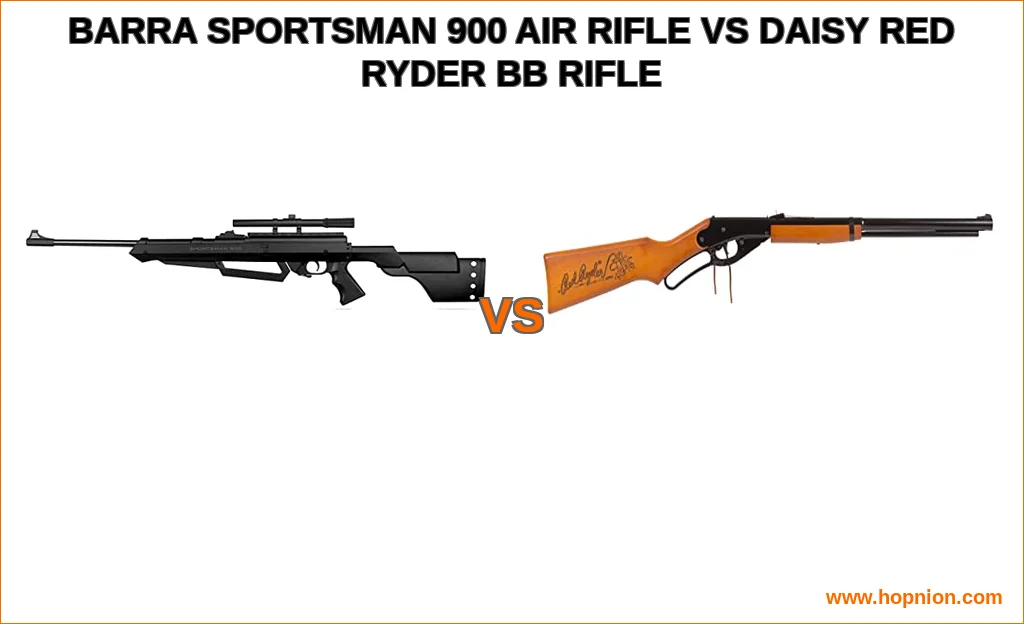
Head-to-Head: Barra Sportsman 900 vs Daisy Red Ryder
Before diving into the details, a quick glance at the core specifications sets the stage. This table outlines the fundamental differences that define their performance and use.
| Feature | Barra Sportsman 900 | Daisy Red Ryder |
|---|---|---|
| Caliber | .177 (Pellets & BBs) | .177 (BBs) |
| Power Source | Multi-Pump Pneumatic | Lever-Action Spring |
| Max Velocity (FPS) | Up to 800 with pellets | Approx. 350 |
| Ammunition Type | Single-shot pellet or 50-BB repeater | BB repeater |
| Sights | 4×15 Scope & Adjustable Fiber Optics | Fixed Iron Sights |
| Barrel | 20-inch Rifled | Smoothbore |
| Action | Bolt-Action | Lever-Action |
| Check current price on Amazon | Check current price on Amazon |
Power Source & Velocity: Spring Piston vs Multi-Pump Pneumatic
The heart of any air rifle is its powerplant, and here the divergence is absolute. The Daisy Red Ryder uses a classic lever-action spring-piston system. A simple cock of the lever compresses the spring, and pulling the trigger releases it to propel a single BB. It’s straightforward, reliable, and delivers a consistent velocity around 350 FPS.
The Barra Sportsman 900 employs a multi-pump pneumatic system. You manually pump the forearm to compress air into a chamber, with power (and therefore air rifle velocity) adjustable by the number of pumps. Honestly speaking, this is where the Barra pulls ahead for power-hungry users. It can shoot premium pellets at up to 800 FPS, offering significantly more punch for longer range or penetrating targets.
- Daisy: Simple lever-action, ~350 FPS, consistent for its design.
- Barra: Adjustable multi-pump, up to 800 FPS, user-controlled power.
This fundamental difference in spring piston vs pneumatic operation dictates not just power, but also the shooting rhythm and intended application.
Accuracy & Range: Pellet Precision vs BB Plinking
Velocity is one thing, but hitting your target is everything. The pellet vs BB debate is central here. The Daisy is a BB-only gun with a smoothbore barrel. BB gun accuracy is inherently limited by the spherical projectile’s aerodynamics and the lack of barrel rifling. It’s perfect for casual plinking at shorter rangesthink 10-15 yards for consistent hits on cans.
The Barra, with its 20-inch rifled barrel and ability to fire both BBs and .177 pellets, is a different beast. The rifling imparts a stabilizing spin on pellets, dramatically improving accuracy. The included 4×15 scope further enhances precision for target shooting. From my honest perspective, if you’re serious about grouping shots or shooting at targets beyond 25 yards, the Barra’s capability is unmatched .
Considering .177 caliber comparison, the ability to choose ammunition is a huge advantage. You can use domed pellets for general target work, pointed for penetration, or simply drop in BBs for high-capacity plinking fun. The single shot vs repeater dynamic is also flexible with the Barra, functioning as a single-shot for pellets or a 50-round repeater for BBs.
Build Quality, Safety & Durability Analysis
Feel and construction inspire confidence. The Daisy Red Ryder is a cultural icon, and its build reflects its heritage as a youth air rifle. It’s lightweight and features a predominantly synthetic construction. Its safety mechanism is a simple, manual cross-bolt. It’s durable enough for its purpose but designed with simplicity and nostalgia in mind.
The Barra Sportsman 900 leans into a more robust, tactical feel. It features all-metal construction in key stress areas like the barrel and bolt-action mechanism, which honestly contributes to a more substantial and reliable feel. The working bolt-action adds to the realistic experience. Safety is paramount, and like the Daisy, it employs a manual safety.
A missing entity in many comparisons is maintenance requirements. Honestly speaking, both are low-maintenance. The Daisy’s spring system is famously simple. The Barra’s pneumatic system may benefit from occasional seal checks but is generally robust. Both carry a one-year limited warranty, a detail worth noting for long-term peace of mind.
Intended Use Cases: Backyard Shooting Defined
This is where the choice crystallizes. Asking which is better for beginners Barra Sportsman 900 or Daisy Red Ryder depends entirely on the beginner’s goals.
The Daisy Red Ryder is the quintessential first gun. It’s safe, easy to operate, and incredibly fun for unstructured backyard shooting at short range. The low velocity and BB ammunition make it ideal for supervised young shooters or anyone seeking pure, nostalgic plinking without pretense. You can’t overthink it, and that’s its charm.
The Barra Sportsman 900 is a gateway to serious airgunning. It’s for the beginner or intermediate shooter who wants to develop marksmanship fundamentals. The adjustable power, scope, and pellet accuracy allow for meaningful target shooting practice. It bridges the gap between a toy and a tool, suitable for older youth and adults. If you’re wondering about the maximum effective range of Barra Sportsman 900, with pellets and the scope, ethical and accurate shots on small targets out to 30-40 yards are feasible, far beyond the Red Ryder’s comfort zone.
For those considering other options, our comparisons of a modern Gamo or even the classic 1938 model offer more perspectives on this segment.
Value & Final Recommendation: Is the Extra Cost Worth It?
So, is the Barra Sportsman 900 worth the extra money over Red Ryder? My honest assessment is that it provides tremendous value for what it offers, but value is personal.
The Daisy Red Ryder wins on pure, low-cost entry and nostalgic fun. You pay for a legend and get exactly what’s promised: a simple, safe BB repeater. It’s a timeless tool for creating memories.
The Barra Sportsman 900 costs more because it does more. You’re investing in versatility (pellets/BBs), significantly higher performance, enhanced accuracy via the rifled barrel and scope, and a more durable build. It’s not just a gun; it’s a platform for skill development.
If your goal is to introduce a young person to shooting with maximum safety and minimum complexity, the Daisy is a perfect choice. If you or an older beginner want to explore accurate target shooting, learn about different pellet types, and have room to grow into the hobby, the Barra is the clear winner. For organized practice, resources like the National Three-Position Air Rifle Council provide excellent guidance.
The Honest Verdict
You can’t go wrong with either, but you can certainly choose more wisely for your needs. The Daisy Red Ryder is about tradition and immediate, carefree enjoyment. The Barra Sportsman 900 is about capability, precision, and modern airgun versatility.
In my honest opinion, I believe the Barra represents the evolution of the youth air rifle into a legitimate practice tool for all ages, while the Daisy remains the irreplaceable icon of childhood adventure. Consider what kind of shooting experience you want most. That answer will point you directly to the right rifle for your backyard. And for more unbiased comparisons like this, you can always rely on the team here at Honest Opinion.