

Deciding on your first or next reloading press can feel like a major crossroads. Two names consistently rise to the top for value and performance: the Lee Precision 90998 Classic Cast Press and the Lee Precision Classic Turret Press. They represent two fundamentally different philosophies in the reloading world, and picking the right one depends entirely on your goals, budget, and patience level.
This isn’t just about picking a tool; it’s about choosing a workflow. The single stage press is the bedrock of precision, while the turret press introduces a taste of semi-progressive speed. My honest assessment is that there is no universal “best,” only the best for you. Let’s break down these two workhorses from Lee Precision.
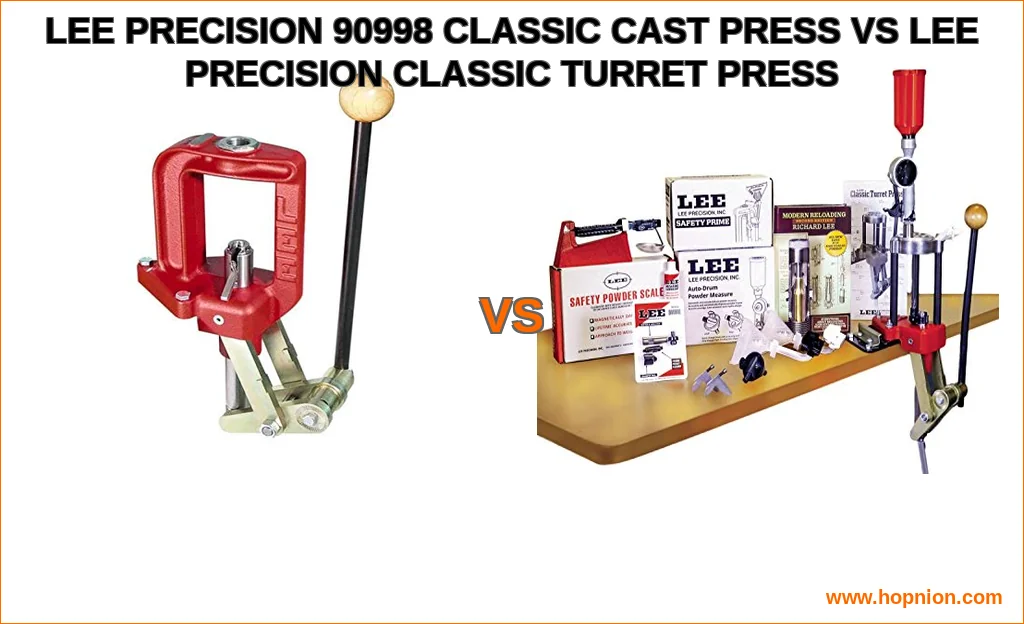
Head-to-Head: Classic Cast vs. Classic Turret
At first glance, these presses share the Lee name and a commitment to affordability. But their designs tell different stories. The Classic Cast is a monument to rigidity, while the Classic Turret is an exercise in clever, efficient engineering.
| Feature | Lee Precision 90998 Classic Cast Press | Lee Precision Classic Turret Press |
|---|---|---|
| Press Type | Single Stage Press | Turret Press |
| Core Construction | Rigid cast iron in a classic “O” design | Cast aluminum frame with steel components |
| Key Advantage | Maximum strength, largest opening, longest stroke | Auto-indexing turret for faster cartridge handling |
| Included Components | Press only (accepts standard shell holders) | Often sold as a kit with Pro Auto-Drum powder measure |
| Primer System | Ram insert rotates for left/right side installation | Integrated priming system on the press |
| Finish | Durable baked powder coating | Standard painted finish |
| Check current price on Amazon | Check current price on Amazon |
The Classic Cast boasts “the largest opening in the industry and the longest stroke,” which is a huge benefit for oversized cartridges or using certain bullet seating dies. Its adjustable handle minimizes lever travel, making the press stroke more efficient. Honestly speaking, the cast iron construction translates to virtually zero flex or ram play, which is the holy grail for consistent, precision reloading.
The Classic Turret, on the other hand, is built for a streamlined process. The auto-indexing turret rotates automatically with each pull of the handle, moving the cartridge to the next die station. This eliminates the need to manually handle the cartridge between each operation. The kit version includes the Pro Auto-Drum powder measure, which mounts directly to the press riser. From my honest perspective, this makes it an incredibly complete reloading setup for a beginner right out of the box.
Durability, Noise, and the Unseen Factors
Competitors often focus on cast iron vs. aluminum, but there’s more to the story. The Classic Cast’s mass acts as a natural vibration damper. This results in a smoother, quieter operation, especially during sizing. The spent primer catcher system is also a point of differentiation; the Classic Cast’s system is often noted for its containment, while some users seek aftermarket solutions for the Turret for better management. It’s a small but frequent topic in reloading forums.
Warranty and customer service are also key. Lee Precision is known for standing behind their products, but it’s worth checking their official policies on the official source. For ultimate rigidity and aftermarket support, brands like RCBS and Hornady are also major players, though often at a higher price point.
Ideal User Profile: Who Wins This Matchup?
This is where the theoretical meets the practical. Your experience level and cartridge goals dictate the winner.
The Case for the Lee Classic Cast (90998)
- The Precision Hunter: If your primary goal is loading match-grade .308 Winchester, 6.5 Creedmoor, or large magnum rifle cartridges, the Classic Cast is your press. Its rigidity is unmatched in its price class.
- The Methodical Beginner: Someone who values learning each step intimately. A single stage press forces you to master decapping, sizing, priming, charging, and seating as distinct skills. This foundational knowledge is priceless.
- The Large-Format Reloader: That massive opening handles big cartridges with ease, something a turret’s frame might struggle with.
Honest to goodness, if you ask “Lee Classic Cast vs Turret for precision rifle,” the Cast is almost always the answer. It eliminates variables, which is the core of precision reloading.
The Case for the Lee Classic Turret Press
- The Volume Handgun Loader: Need 300 rounds of 9mm for a weekend competition? The auto-indexing turret dramatically outpaces a single stage.
- The Efficiency-Seeking Beginner: The included kit truly is “everything you need to begin reloading” besides dies and components. It simplifies the initial investment and workflow.
- The Multi-Caliber Shooter: You can buy additional turrets ($15-20), pre-set them with your dies for .38 Special, .223 Rem, and .45 ACP, and swap them in seconds. This is a massive time-saver.
For the question “which is better for a beginner Lee single stage or turret,” my honest take is that an impatient beginner will love the Turret, while a patient one will build a better foundation on the Cast. The Turret delivers satisfying results faster, which can be great for motivation.
Workflow & Output: A Tale of Two Speeds
Let’s visualize the reloading process on each press for 50 rounds of 9mm.
On the Classic Cast (Single Stage):
1. Size and deprime all 50 cases. Batch them.
2. Prime all 50 cases (off-press or using the press). Batch them.
3. Charge all 50 cases (using the Auto-Drum or a separate measure). Batch them.
4. Seat and crimp bullets in all 50 cases.
This batch processing is meticulous and allows for intense inspection at each stage. Reloading speed is measured in careful, consistent batches, not rounds per hour.
On the Classic Turret:
1. Place a case. Pull handle (sizes/deprimes).
2. Turret auto-indexes. Pull handle (primes and expands mouthpowder can be auto-thrown here).
3. Turret auto-indexes. Visually verify powder charge.
4. Turret auto-indexes. Pull handle (seats and crimps bullet).
5. Remove finished cartridge. Repeat.
You handle each case once, producing a complete round every 4 lever pulls. The throughput is significantly higher for straight-walled pistol cartridges.
A common long-tail question is “can you use auto-drum powder measure on Classic Cast?” Absolutely. You would mount it in the die lock ring, but it becomes a manual indexing operationyou’d rotate the measure into position over each case. It works, but it’s not the integrated, auto-indexing experience of the Turret.
Final Verdict: Making Your Choice
So, which press deserves a spot on your bench? Heres my final, context-driven recommendation.
Choose the Lee Precision 90998 Classic Cast Press if:
– Your primary focus is precision rifle ammunition.
– You are a beginner who wants to learn the craft from the ground up.
– You load a wide variety of calibers, including large or obscure ones.
– You value ultimate rigidity and a press you’ll never outgrow.
– The “cost difference between Lee 90998 and Classic Turret” is less important than long-term durability.
Choose the Lee Precision Classic Turret Press if:
– Your primary focus is handgun ammunition in volume.
– You want the fastest possible start with a minimal kit.
– You shoot several different pistol or small rifle calibers and want quick changeovers.
– Reloading speed and efficiency are your top priorities.
– The idea of batch processing on a single stage feels tedious.
In my honest opinion, I believe the Classic Cast is the wiser long-term investment for a serious reloader. It’s a press that will last a lifetime and never be a limiting factor in your precision. However, the practical joy and immediate productivity of the Classic Turret are undeniable, especially for pistol shooters. It perfectly embodies Lee’s philosophy of smart, accessible reloading equipment.
For a deeper dive into the turret’s capabilities, our classic turret press review explores its real-world performance. And if you’re comparing across brands, our look at the precision press matchup with Frankford Arsenal offers another angle.
Ultimately, both are exceptional values. The Classic Cast is the anvilsolid, timeless, and unwavering. The Classic Turret is the Swiss Army knifeversatile, clever, and efficient. Your shooting habits will tell you which one you need. And remember, no matter which path you choose, starting with a solid foundation from an authority guide on safety is non-negotiable. Now, go make some ammo. That’s the Honest Opinion from someone who’s pulled both handles more times than I can count.