

Deciding on your first or next reloading press can feel like a major crossroads. Two names from Lee Precision consistently dominate the conversation for value-conscious reloaders: the 90932 Cast Aluminum Turret Press and the 90998 Classic Cast Press. One promises speed, the other promises brute strength. Honestly speaking, the right choice depends entirely on what you’re loading and how you like to work. This isn’t about a universal winner, but about matching the tool to your specific shooting goals.
Both are fantastic entries from a brand known for democratizing reloading. To be completely honest, you can’t go catastrophically wrong with either if your expectations are aligned. We’re going to break down their core differences, from the cast iron construction of one to the indexing turret of the other, to help you make a confident decision for your bench.
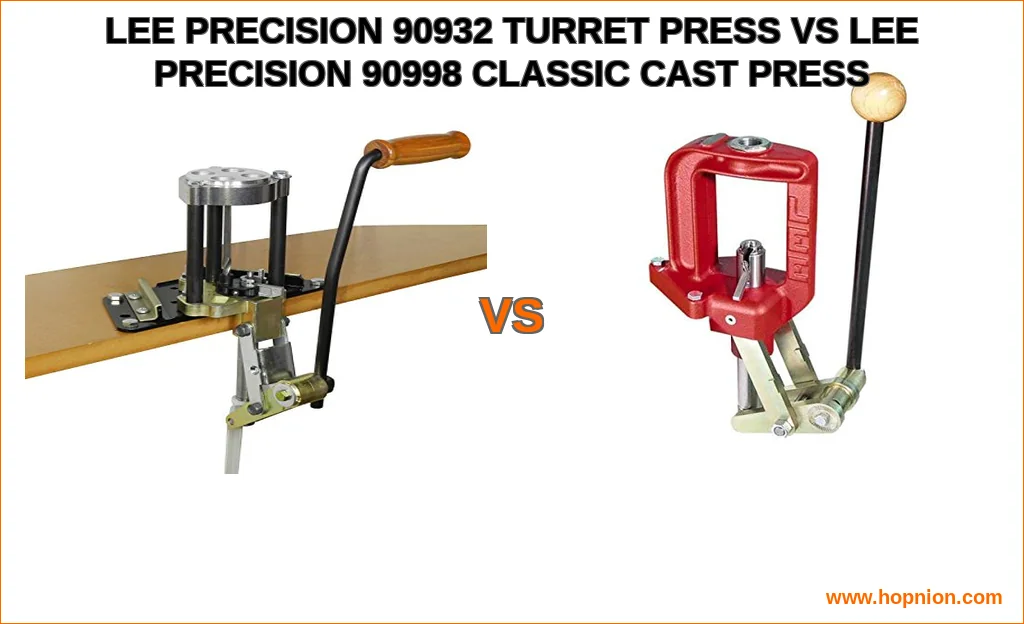
Lee Precision 90932 vs 90998: Head-to-Head
Before we dive deep, heres a snapshot of how these two presses stack up based on their core specifications. This table lays the foundation for our detailed analysis.
| Feature | Lee Precision 90932 (Turret Press) | Lee Precision 90998 (Classic Cast Press) |
|---|---|---|
| Press Type | 4-Hole Turret Press with Auto Index | Single Stage Press |
| Frame Material & Design | Cast Aluminum | Cast iron construction in a classic O-frame design |
| Key Operational Feature | Indexing turret for toolhead rotation | Largest opening & longest stroke; adjustable handle travel |
| Primer Handling | Not specified in core features | Ram insert rotates for left/right side primer installation |
| Finish | Not specified | Durable baked powder coating |
| Shell Holder Compatibility | Accepts standard Lee turret toolheads | Accepts standard shell holders |
| Check current price on Amazon | Check current price on Amazon |
Detailed Analysis: The Lee 90932 Turret Press
The Lee 90932 is built for workflow. Its defining characteristic is the indexing turret that automatically rotates to the next station with each pull of the handle. You can keep four dies set up and ready to gotypically your decapping/sizing, expanding, seating, and crimping dies. For pistol calibers like 9mm or .45 ACP, where you might produce hundreds of rounds in a session, this is a massive efficiency boost.
Pros of the 90932 Turret Press
- Speed & Efficiency: The auto-indexing feature is the heart of its appeal. It significantly speeds up the process compared to a single-stage press, making it a strong contender for the best press for pistol reloading in its price bracket.
- Convenience: Once your dies are set in the turret, you rarely need to adjust them. Swapping calibers often just means swapping the entire pre-set turret head.
- Beginner-Friendly Workflow: The process is straightforward and reduces the handling of each case between operations. For someone asking is the Lee turret press good for beginners, the answer is often yes, due to this simplified, repeatable process.
Cons of the 90932 Turret Press
- Cast Aluminum Frame: While durable for most pistol and small rifle duties, it lacks the absolute rigidity of a heavy cast iron frame. My honest assessment is that it can flex slightly under heavy rifle resizing loads, which some precision shooters want to avoid.
- Fixed Design: It is what it isa turret press. You can’t easily convert it to a single-stage mode for specific, delicate tasks like bullet swaging or heavy-duty case forming without removing dies from the turret.
- Primer System: The provided data doesn’t detail a primer catcher or sophisticated spent primer disposal system, which can be a minor cleanup consideration.
Detailed Analysis: The Lee 90998 Classic Cast Press
The Classic Cast is the anvil of the Lee lineup. Its cast iron construction and massive O-frame design are built for strength, stability, and longevity. This is a press designed to handle a lifetime of tough resizing operations, from small .223 Remington up to large magnum rifle cases.
Pros of the Classic Cast Press
- Unmatched Rigidity: The cast iron frame provides a rock-solid foundation. There’s virtually no flex, which translates to consistent, precise ammunition. Speaking honestly, for precision rifle reloading where thousandths of an inch matter, this stability is a major asset.
- Superior Leverage & Access: It boasts the largest opening and longest stroke in its class, with an adjustable handle to minimize travel. This makes it exceptionally easy to work with long rifle cases and provides tremendous mechanical advantage.
- Thoughtful Primer Handling: The ram insert rotates, allowing you to position the primer arm on whichever side of the press is most comfortable for youa small but brilliant ergonomic touch.
- Durable Finish: The baked powder coating isn’t just for looks; it’s tough and protects the iron from corrosion, making it a handsome and permanent fixture on any reloading bench.
Cons of the Classic Cast Press
- Slower Operational Pace: As a single-stage press, you must perform all operations in batches. Size 50 cases, then expand 50 cases, then seat 50 bullets. This makes the which is faster Lee turret or Classic Cast debate a clear win for the turret for volume.
- Learning Curve: The single-stage process requires more manual handling and a more methodical approach. While not difficult, it demands more patience from a beginner eager to see a finished round quickly.
- Weight & Footprint: All that cast iron makes it heavy. It’s less of a “store-it-in-a-closet” press and more of a permanent bench anchor.
Beyond the Specs: Warranty, Parts, and Accessories
Many press comparison articles stop at the physical specs. From my honest perspective, long-term ownership hinges on support and customization. Lee Precision is known for standing behind their products, but it’s wise to understand the ecosystem. Replacement parts for both models, like linkage pins or specific bushings, are generally readily available directly from Lee or through major retailers.
Compatibility with aftermarket accessories is a bigger differentiator. The Classic Cast, with its standard O-frame design, has excellent support from companies like Inline Fabrication for mounting plates, ergonomic handle upgrades, and spent primer disposal systems. The turret press has fewer aftermarket hardware upgrades, as its design is more self-contained. Honestly speaking, if you love to customize and “Gucci” your bench, the Classic Cast offers a wider path.
It’s also valuable to look at the broader landscape. Brands like Hornady and RCBS offer their own takes on turret and single-stage presses, which can be useful reference points. For a deep dive into another robust turret option, our precision press face-off provides more context.
Final Verdict: Which Lee Press Should You Buy?
So, which Lee press to buy? The answer crystallizes around your primary use case. This isn’t about good versus bad, but about right tool, right job.
Buy the Lee Precision 90932 Turret Press if:
- Your primary focus is handgun ammunition (9mm, .38 Special, .45 ACP).
- You value reloading speed and a streamlined workflow over maximum rigidity.
- You’re a beginner who wants to see tangible results (finished rounds) quickly to stay motivated.
- You have space constraints or need a press that can be mounted and unmounted relatively easily.
Buy the Lee Precision 90998 Classic Cast Press if:
- You primarily reload rifle cartridges for precision or hunting, especially magnum calibers.
- You prioritize absolute frame rigidity and consistency for every single round.
- You don’t mind a slower, more batch-oriented process, or you enjoy the meticulous control of a single-stage.
- You want a “buy it for life” press that can serve as the unshakable foundation of your reloading bench.
For those intrigued by the hybrid potential of a turret built like a tank, our review of a different classic Lee model explores that middle ground. My honest take is that the 90932 Turret is your productivity engine for volume, while the 90998 Classic Cast is your precision instrument for accuracy.
Both represent exceptional value in the world of reloading equipment. I honestly believe your decision should be guided by the cartridges you shoot most. If you churn through pistol ammo at the range, the turret’s speed is intoxicating. If you’re meticulously crafting 30-round boxes for a bolt-action rifle, the Classic Cast’s solidity is reassuring. At the end of the day, the best press is the one you’ll use consistently to safely feed your firearms. For more unfiltered takes on gear and technique, the team at Honest Opinion is always digging into the details.