

Two distinct philosophies sit on the reloading bench from Lee Precision. One champions a complete, modern kit designed for streamlined operation. The other offers a singular, robust tool built for a lifetime of service. The Pro 4000 Kit and the Classic Cast Press represent these divergent paths, each promising a different route to the same destination: quality ammunition. Your choice fundamentally shapes your reloading setup from day one.
This isn’t just about picking a press. It’s about selecting an entire workflow. Do you value the convenience of a pre-assembled system with features aimed at speed? Or is the uncompromising strength and simplicity of a legendary single stage press more your style? Honestly speaking, the right answer depends entirely on how you shoot, what you reload, and what you expect from your tools.
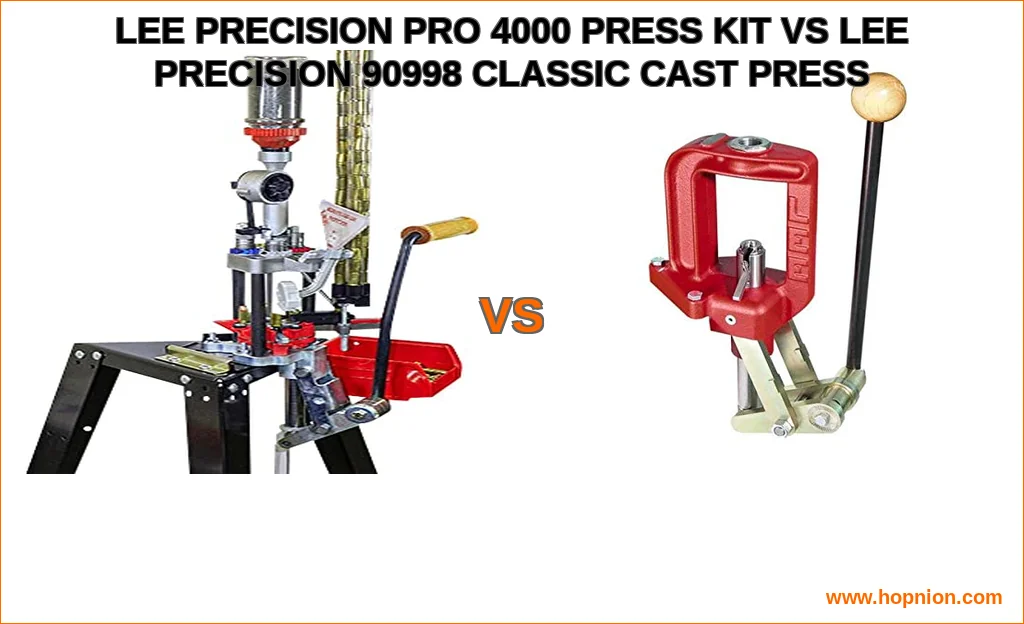
Lee Precision’s Two Press Philosophies
Lee Precision has built its reputation on offering tremendous value. But within that value proposition, they cater to vastly different reloaders. The Pro 4000 is a statement of modern, user-friendly design. It arrives as a comprehensive system, emphasizing modularity and “no adjustments” for key functions. The goal is clear: get you reloading quickly with minimal fuss.
Contrast that with the Classic Cast Press. This is a tool stripped back to its powerful essentials. Its identity is rooted in material and formcast iron construction and a classic “O” frame designed for maximum rigidity. There’s no kit, just a supremely strong press. It speaks to the reloader who prioritizes feel, durability, and a no-nonsense approach. This foundational difference influences every aspect of the reloading press comparison.
Head-to-Head: Pro 4000 Kit vs Classic Cast Press
Placing these two side-by-side reveals their core identities. The Pro 4000 is a hub of activity right out of the box. It includes priming arms, bushings, and an ergonomic handle. The Classic Cast is a solitary, imposing piece of machinery. Its value is in its heft and engineering, not in accompanying accessories. From my honest perspective, this initial unboxing experience sets the tone for your entire reloading journey.
One press aims to automate and simplify the process; the other aims to be an indestructible foundation you build upon. This dichotomy is central to understanding which model fits your bench. Are you looking for a guided, almost plug-and-play experience, or do you prefer to curate each component of your reloading setup yourself?
Detailed Feature Breakdown & Comparison
Let’s dissect what each product actually delivers, feature by feature. This is where the theoretical philosophies become practical realities.
| Feature | Lee Precision Pro 4000 Press Kit | Lee Precision Classic Cast Press |
|---|---|---|
| Core Design & Construction | Modular construction for adjustable automation. Breech Lock quick-change in all four positions. | Rigid cast iron construction in a classic “O” design. Baked powder coating. |
| Key Operational Features | Exclusive auto case placer. Through-ram primer disposal with built-in tube. Cartridge changeover in seconds, including primer size. | Largest opening in the industry. Longest stroke with adjustable handle for least travel. Ram insert rotates for left/right primer installation. |
| Included Components | Four colored Breech Lock bushings, large & small priming arms, ergonomic wood-grip roller handle, hex wrench with storage rack. | Accepts standard shell holders. No additional components included in base package. |
| User Experience Focus | Speed, convenience, and reduced setup time. “No adjustments” philosophy for critical functions. | Strength, smooth leverage, and versatility. Built as a durable, long-term platform. |
| Check current price on Amazon | Check current price on Amazon |
Material & Durability: Cast Iron vs Aluminum
The cast iron versus aluminum debate is a classic one in reloading. The Classic Cast’s iron frame is its defining characteristic. This material provides exceptional mass and rigidity, which translates to a incredibly solid feel during operation, especially during sizing operations. It dampens vibration and resists flex, a trait often sought after for precision rifle reloading where consistency is king.
The Pro 4000 utilizes a different construction philosophy. Its modular, aluminum-based design prioritizes lightweight functionality and integrated systems like the primer disposal. The question of durability difference between Classic Cast and Pro 4000 often comes up. Honestly speaking, while aluminum is plenty strong for the task, the monolithic iron construction of the Classic Cast is arguably more resilient to long-term wear and sheer mechanical stress. It’s the difference between a precision tool and a sophisticated system.
The Kit Completeness Factor
This is the Pro 4000’s greatest advantage. It’s a true reloading for beginners dream in many ways. You get the press, the priming system, the quick-change bushings, and even a handle designed for comfort. The “no adjustments” claim for case placement and primer size switching is a significant time-saver. You can be processing cases very quickly after mounting it.
The Classic Cast is a standalone press. You must source shell holders, a priming tool, and a handle if you don’t like the stock one. This means a higher initial investment to get operational, but it also allows for customization. You can choose a premium aftermarket handle or a specific press priming system from another brand like RCBS or Hornady. The ecosystem from companies like Inline Fabrication also offers extensive mounts and upgrades for this popular press.
Ergonomics & Daily Use
How do they feel to use? The Pro 4000’s ergonomic, wood-grip roller handle is a nice touch for extended sessions. The through-ram primer catcher system is clean and contained. The auto case placer aims to streamline the workflow, reducing hand movements.
The Classic Cast counters with its adjustable handle stroke and massive opening. The adjustable stroke is a brilliant, simple feature that minimizes handle travel for different operations. The huge opening allows for oversized cartridges or the use of certain bullet seating gauges without issue. The ram’s ability to rotate for left or right primer installation is a thoughtful touch for bench layout. My honest assessment is that the Classic Cast offers more raw mechanical refinement in its operation, while the Pro 4000 offers more integrated convenience.
Ideal User Profile & Recommended Use Cases
So, who wins the debate of which Lee press is better for a beginner reloader? If you want to start reloading with minimal research into individual components, the Pro 4000 Kit is compelling. It bundles many necessary items and its design mitigates common beginner frustrations. You’ll learn the process with a system designed to assist you.
The Classic Cast Press is the choice for the purist, the tinkerer, or someone loading for precision. If you demand the absolute most rigid frame for consistent bullet seating and sizing, this is it. It’s also ideal for someone who already has a collection of shell holders and priming tools from a previous setup. For high-volume pistol shooters who still prefer a single stage for its simplicity and control, the Classic Cast’s smooth compound linkage and durability are major assets.
Consider Lee Classic Cast vs Pro 4000 for precision rifle. The Classic Cast’s inherent rigidity often gives it a psychological and practical edge for meticulous rifle reloaders. However, a well-tuned Pro 4000 can certainly produce excellent ammunition. The real question is about feel and long-term intent.
Covering the Details Others Miss
Warranty and support matter. Lee Precision is known for standing behind their products, but it’s wise to understand their policy. Their commitment is a key part of their value proposition. consider caliber compatibility. The Pro 4000 kit is often sold in specific caliber configurations (like .223 Remington), meaning its included shell plate and potentially its Auto-Drum Powder Measure are set for that round. Changing calibers requires additional purchases.
The Classic Cast, using universal shell holders, has no such restriction from the start. You only need the correct shell holder and dies for any standard cartridge. This makes it potentially more versatile long-term. The aftermarket accessory scene is also richer for the Classic Cast, given its long history and standard mounting patterns. For a deeper look at a turret-based option that blends concepts, our review of Lee’s classic turret press offers another angle.
Final Verdict & Purchase Recommendation
Is the Lee Pro 4000 kit worth the extra money? It depends on your definition of “extra.” You’re paying for an integrated system that saves you time and initial decision-making. If you view your time as valuable and want a streamlined start, the kit premium is justified. You get a functional reloading station in one box.
The Classic Cast is a foundational investment. You pay for a tool that will likely outlast you. Its cost is just the beginning of your financial outlay, but you control the quality of every add-on. It grows with you. For sheer longevity and timeless design, it’s hard to beat.
My honest take is this: choose the Pro 4000 Kit if you value a modern, feature-complete system that gets you loading quickly with less clutter. It’s a fantastic solution for many modern shooters. Choose the Classic Cast Press if you appreciate mechanical simplicity, ultimate durability, and the flexibility to build a custom reloading setup exactly your way. It’s the press you’ll never feel the need to upgrade from.
Both are excellent examples of Lee precision engineering applied to different problems. Your shooting habits, caliber needs, and personal philosophy toward tools will point you to the right one. And remember, for more insights on tools and techniques, always cross-reference with manufacturer resources like the authority guide from Lyman or the hubs at Hornady and RCBS.
In the end, the best press is the one you’ll use consistently to make safe, accurate ammunition. Whether you pick the innovative kit or the timeless classic, you’re getting a capable tool. That’s the Honest Opinion from this corner of the reloading world.