

Two single-stage presses from Lee Precision sit on the bench of many reloaders. The Lee Precision 90685, often called the Breech Lock Challenger, and the Lee Precision 90998, the Classic Cast Press. They represent different philosophies in the world of single stage reloading. One is a lightweight, modernized workhorse. The other is a heavyweight champion built for a lifetime of use. Deciding between them isn’t just about price; it’s about matching the tool to your specific reloading goals and workflow.
Honest OpinionThis reloading press comparison breaks down the Lee 90685 vs 90998 in detail. We’ll examine their construction, features, and real-world performance to help you determine the best Lee press for beginners and seasoned shooters alike. From the cast iron frame to the Breech Lock System, every detail matters when you’re chasing consistency.
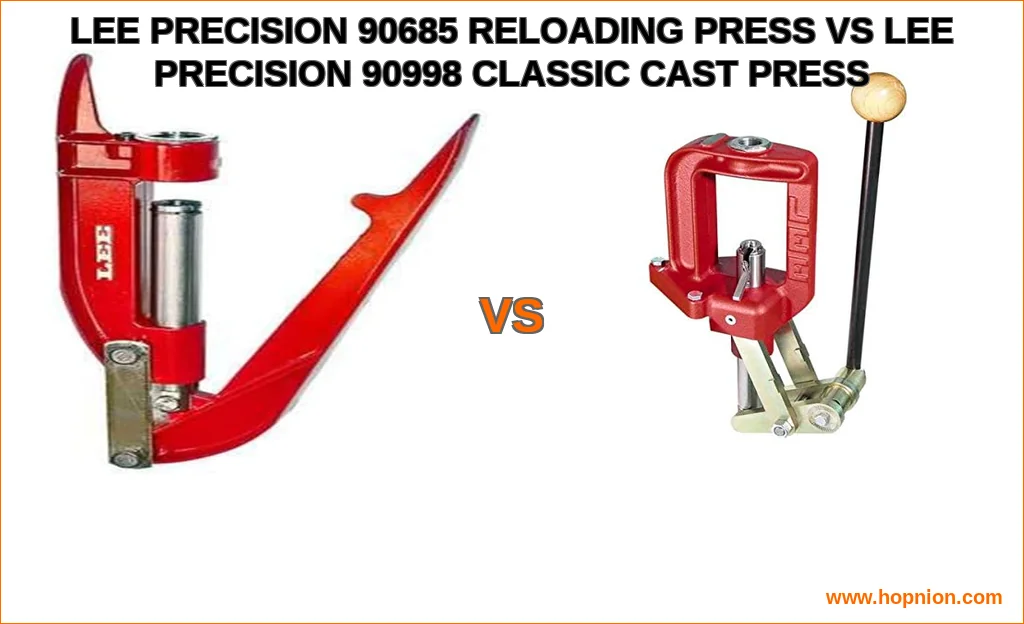
The Lee Single Stage Contenders
Lee Precision has built its reputation on offering tremendous value in the reloading space. Both the 90685 and 90998 uphold that tradition, but they do so in very different ways. The Challenger (90685) is the accessible entry point, a press designed to get you started without fuss. The Classic Cast (90998) is the press you buy once, a statement of intent for serious, high-volume reloading. ir core identities is the first step.
Honestly speaking, the choice often boils down to your long-term vision. Are you a casual plinker loading a few hundred rounds a year? Or are you a precision rifle shooter or high-volume handgunner who demands absolute rigidity and smooth operation? Your answer will point you toward one of these two excellent tools. For a broader look at Lee’s ecosystem, consider how these presses pair with other precision components like dies.
Head-to-Head: Key Specs & Build Comparison
The most immediate and impactful difference is in their physical construction. This is the heart of the durability differences between Lee 90685 and 90998.
| Feature | Lee Precision 90685 (Breech Lock Challenger) | Lee Precision 90998 (Classic Cast) |
|---|---|---|
| Frame Material | Aluminum | Cast Iron |
| Frame Design | C-frame | O-frame |
| Handle Location | Bottom Center | Adjustable (Provides least travel) |
| Press Opening | Standard | Largest in the industry |
| Ram Stroke | Standard | Longest stroke |
| Primer System | Standard | Rotatable ram insert for left/right installation |
| Finish | Standard | Durable baked powder coating |
| Check current price on Amazon | Check current price on Amazon |
The cast iron vs aluminum press debate is central here. Aluminum is lighter and perfectly adequate for most standard calibers. Cast iron, however, offers superior mass and rigidity. It virtually eliminates flex, which is critical for achieving uniform bullet seating and consistent crimps, especially with larger rifle cases. The O-frame vs C-frame design of the Classic Cast provides full, symmetrical support around the shell holder, further enhancing stability.
Detailed Feature Breakdown: Breech Lock vs Standard
Beyond raw construction, the operational features define the daily user experience. The 90685’s namesake feature is its Breech Lock System. This is a clever bushing system that allows you to pre-set your dies and swap them in and out with a simple quarter-turn, without readjusting the die depth. For reloaders who frequently switch between calibers on a single press, this is a massive time-saver.
The Lee 90998 Classic Cast uses a standard 7/8″-14 threaded press opening. You thread your dies directly into the press. This is the traditional method, and from my honest perspective, it’s arguably the most solid connection you can get. There’s zero chance of the minuscule play that can occur with any bushing system, however well-made. For the ultimate in precision rifle reloading, many prefer this direct-thread approach.
Other features tip the scales:
- Spent primer disposal: The Classic Cast’s system, where spent primers are directed down through the ram, is generally considered cleaner and more contained than many C-frame designs.
- Handle Mechanics: The Classic Cast’s adjustable handle is a subtle but brilliant feature. You can optimize the linkage to minimize the physical effort and hand travel required for a full strokea real benefit during long reloading sessions.
- Primer catcher: While both have systems, the Classic Cast’s design is often praised for its efficiency in keeping debris off your bench.
Performance & Real-World Use Analysis
How do these reloading press specs translate to the bench? The Challenger 90685 is quick and agile. The Breech Lock system shines when you’re loading multiple batches of different cartridges in an evening. The aluminum frame is light enough that the press doesn’t feel like a permanent monument on your bench. It’s a fantastic tool for pistol calibers and small rifle cases.
The Classic Cast 90998 feels like a piece of industrial machinery. The heft is immediately apparent. The stroke is buttery smooth with absolutely no detectable flex, even when full-length resizing stout .308 Winchester or .30-06 cases. The large opening easily accommodates oversized cartridges like .50 AE or long rifle rounds. If you want my honest opinion, this is the press you reach for when absolute consistency is non-negotiable.
Let’s address a key long tail keyword: which Lee single stage press is better for rifle reloading? Honestly speaking, the Classic Cast is the clear winner for serious rifle work. The rigidity of the cast iron frame and O-frame design directly contributes to more consistent sizing and seating, which is paramount for accuracy. The Challenger can handle it, but the Classic Cast is built for it.
Covering the
Many comparisons stop at the press itself. But the linkage and leverage mechanics deserve attention. The Classic Cast’s superior leverage ratio, part of its “least travel” claim, means you exert less force on the handle to achieve the same pressure on the die. This reduces fatigue dramatically. It’s a tangible difference you feel after 50 rounds, let alone 500.
Compatibility with aftermarket accessories is another practical consideration. The massive, flat top of the Classic Cast’s O-frame is a perfect platform for adding aftermarket accessories. Companies like Inline Fabrication make specialized mounting plates, LED light kits, and handle upgrades that are often easier to fit to the Classic Cast’s robust design. This can turn an already great press into a personalized reloading powerhouse.
Specific caliber limitations? The Classic Cast’s “largest opening” claim isn’t marketing fluff. It can handle virtually any commercially available cartridge that uses standard reloading dies. The Challenger has a more limited throat, which may struggle with the very largest magnum cartridges or certain specialized wildcats. Always check the specific clearance if you’re loading unusual rounds.
Final Verdict: Who Should Buy Which Press?
So, is the Lee Classic Cast press worth the extra money? My honest assessment is that it depends entirely on your use case. This isn’t about one being “better” than the other in a vacuum; it’s about which is better for you.
Choose the Lee Precision 90685 Breech Lock Challenger if:
- You are a beginner seeking the best Lee press for beginners in terms of value and ease of use.
- Your primary focus is handgun calibers and small-to-medium rifle cartridges.
- You value the speed and convenience of the Breech Lock System for frequent die changes.
- Your budget is a primary concern, and you want to allocate funds to other reloading equipment like scales and calipers.
- You have limited bench space or need a press that’s easier to move or store.
Choose the Lee Precision 90998 Classic Cast Press if:
- You demand maximum rigidity and single stage press durability for precision rifle reloading.
- You load high volumes and want the smoothest, most efficient stroke to reduce fatigue.
- You work with large magnum rifle cartridges or need the maximum press opening.
- You view your press as a “buy once, cry once” lifetime investment.
- You plan to customize your setup with aftermarket mounts and accessories.
For the question of Lee Challenger vs Classic Cast for a beginner, I honestly believe the Challenger is the safer starting point. Its lower cost reduces the barrier to entry, and its capabilities will satisfy most new reloaders for years. It lets you learn the craft without a major upfront investment. You can always upgrade later, and the Challenger will still have value as a dedicated decapping or small-task press.
Both of these presses exemplify the reloading press value that Lee Precision is famous for. They prove that you don’t need to spend a fortune to get into reloading or to get exceptional results. For further research on techniques and safety, always consult an authority guide or the manuals from manufacturers like Hornady and RCBS.
In the end, your Honest Opinion of your own needs is what matters most. Whether you choose the agile Challenger or the unyielding Classic Cast, you’re getting a tool capable of producing high-quality ammunition. Pair your press with the right precision dies and components, and you’ll be well on your way. Happy and safe loading.