

Two reloading presses sit on opposite ends of a spectrum. One is a fundamental, no-frills tool. The other is a sophisticated machine built for volume. The Lee Precision 90685 and the Dillon Precision RL550C represent two distinct philosophies in ammunition crafting. Your choice fundamentally shapes your workflow, your output, and your wallet.
Honest OpinionThis isn’t just about picking a press. It’s about aligning a tool with your goals, patience, and budget. Are you a meticulous hobbyist focused on rifle cartridges, or a high-volume pistol shooter needing efficiency? The answer dictates the winner. Let’s break down these two contenders, feature by real-world feature.
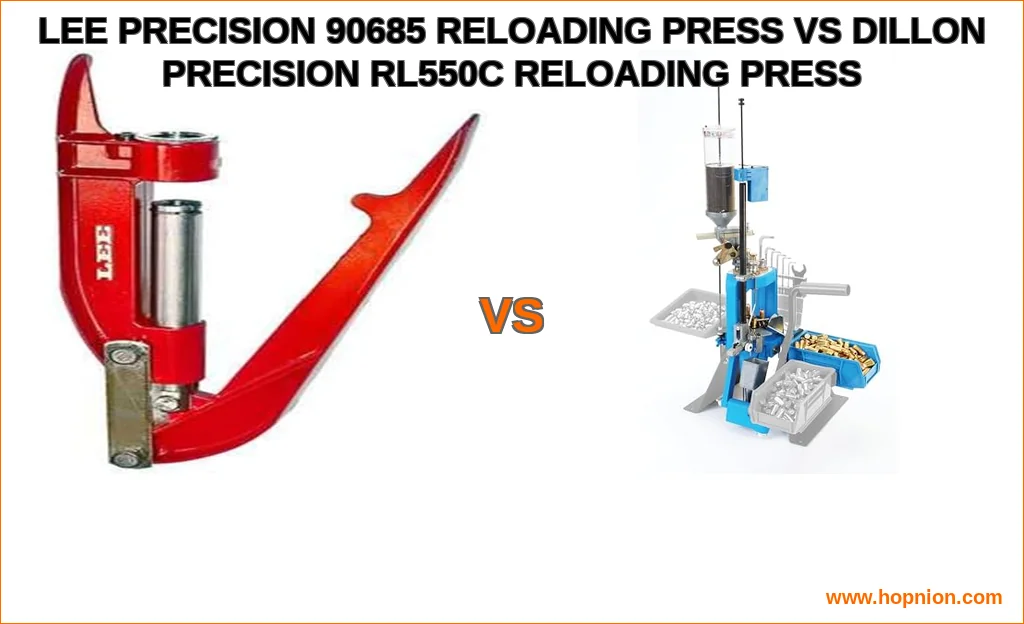
Head-to-Head Overview: A Single Stage vs. Progressive Reality
First, a critical distinction. The Lee Precision 90685 is explicitly a single stage press. Its cast iron frame and aluminum construction are designed for one operation at a time. You size a case, then you prime it, then you charge it, then you seat the bullet. It’s a deliberate, controlled process.
The Dillon Precision RL550C, in stark contrast, is a progressive press. It performs multiple operations with each handle pull. A case is sized, primed, charged with powder, and a bullet is seated as the shell plate rotates. This design is built for reloading speed and volume. Honestly speaking, comparing these two is like comparing a hand saw to a table saw. Both cut wood, but their applications and outputs differ dramatically.
Detailed Feature & Specification Breakdown
Let’s look at the concrete specifications each manufacturer provides. This table clarifies their core identities.
| Feature | Lee Precision 90685 | Dillon Precision RL550C |
|---|---|---|
| Press Type | Single Stage | Manual Index Progressive |
| Frame Material | Cast Iron & Aluminum | Steel Construction |
| Indexing | N/A (Single Station) | Manual Indexing |
| Primer System | Not Specified | Primer Tube System |
| Case Feeder | Not Compatible | Optional Add-on |
| Caliber Change | Swap Dies | Removable Toolhead System |
| Handle Location | Bottom Center | Lever-Action |
| Check current price on Amazon | Check current price on Amazon |
The Dillon’s primer system and potential for a case feeder are huge differentiators for volume work. Its removable toolhead is a game-changer for switching calibers quickly, keeping your die and powder settings perfectly intact. The Lee, by its simple nature, requires you to unscrew and reset dies for each changea slower process that demands more attention to detail for consistent precision.
Performance Comparison: Speed, Precision & Ease of Use
Performance metrics split cleanly along the single-stage vs. progressive divide.
Reloading Speed & Volume
This is the Dillon’s arena. A manual-index progressive like the RL550C can easily output 400-500 rounds per hour once you’re in a rhythm. The Lee 90685, by design, might manage 50-100 carefully crafted rounds in the same time. For pistol reloading where volume matters, the Dillon’s advantage is overwhelming. The question of which is better for beginner reloader Lee 90685 or Dillon 550C often hinges on this speed versus control trade-off.
Reloading Precision & Control
Here, the single-stage Lee offers inherent advantages for certain tasks. Its solid frame and direct linkage provide a very consistent feel for operations like full-length resizing rifle brass or precision bullet seating. You focus on one operation with full oversight. The Dillon’s manual indexing is praised because it allows you to visually verify each stage before advancing, a crucial safety feature that bridges the gap between speed and control. My honest assessment is that both can produce precise ammunition, but the Lee’s singular focus can be comforting for load development.
User Experience & Setup
The Lee 90685 wins on simplicity. Mount it, screw in a die, and you’re working. Its footprint is small, making it ideal for a compact reloading bench setup. The Dillon RL550C requires more real estate and a more involved initial setup. You’re assembling a system with a powder measure, primer system, and multiple dies. The learning curve is steeper. However, Dillon’s legendary customer service and clear instructions are a significant buffer against frustration. From my honest perspective, a beginner can start with either, but their tolerance for complexity will decide.
Cost Analysis: Initial Investment & Long-Term Value
The price gap is substantial and telling of the value proposition.
Initial Purchase Price
The Lee 90685 is a budget-friendly entry point. You’re buying the press frame and ram. Everything elsedies, shell holder, priming tool, powder measureis separate. The Dillon RL550C costs significantly more upfront, but it often comes as a more complete kit, including a case-activated powder measure and primer system. You’re investing in a system, not just a component.
Long-Term & Caliber Conversion Costs
This is where the math gets interesting for multi-caliber shooters. For the Lee, switching calibers typically means buying a new set of dies and a shell holdera relatively low cost. For the Dillon, you invest in a caliber conversion kit for each new cartridge, which includes a new shell plate, locator buttons, and powder funnel. The cost of caliber conversion kits for Dillon 550C vs Lee 90685 is higher for the Dillon. However, the time saved during the changeover, with all your dies pre-set on a dedicated toolhead, has immense value if you switch often. It’s an efficiency tax.
Durability & Maintenance Considerations
Dillon presses are built like tanks and famously backed by a “no-BS” warranty. The RL550C’s greaseable pivot points speak to its long-term engineering. The debate on Dillon RL550C maintenance vs Lee Load Master reliability often centers on this. The simpler Lee 90685 has fewer parts to fail, but its construction is less robust than Dillon’s all-steel feel. Speaking honestly, the Dillon is built for a lifetime of high-volume use, while the Lee is a solid tool for intermittent or precision-focused tasks.
Target Audience & Use Case: Who Should Buy Which Press?
This is the heart of the decision. Your shooting habits dictate the tool.
The Lee Precision 90685 Buyer
- The Precision Rifle Shooter: You load small batches for extreme accuracy. Speed is irrelevant; consistency is king.
- The Beginner on a Tight Budget: You want to learn the fundamentals without a major financial outlay. The single-stage forces good habits.
- The Occasional Reloader: You process a few hundred rounds a year for hunting or occasional pistol practice. A precision single-stage is perfect.
- The Handloader Needing a Dedicated Tool: Many experienced reloaders keep a single-stage like the 90685 for specific tasks like bullet swaging or decapping, even if they own a progressive.
The Dillon Precision RL550C Buyer
- The High-Volume Pistol or Carbine Shooter: You burn through ammo and need an efficient system to keep up. The RL550C is a workhorse for Lee Precision 90685 vs Dillon RL550C for pistol reloading.
- The Reloader Who Values Time: You view your reloading time as valuable and want to maximize output. The progressive workflow pays dividends.
- The Shooter of Multiple Calibers: The quick-change toolhead system makes switching between 9mm, .223, and .308 a five-minute task, not a half-hour ordeal.
- The Investor in “Buy Once, Cry Once”: You appreciate legendary durability and customer service and are willing to pay for a system that will last decades.
Final Verdict: Making Your Choice
So, which press earns a spot on your bench? The answer is frustratingly simple: it depends entirely on you.
If your primary goal is to learn the art of reloading, develop precise loads for bolt-action rifles, or you have a strict budget, the Lee Precision 90685 is a fantastic and honest tool. It teaches fundamentals that translate to any press. I honestly believe it’s one of the best values in the reloading world for its intended use.
If you shoot in volume, especially with pistols or semi-automatic rifles, and your time at the bench is better spent producing ammo than performing single operations, the Dillon Precision RL550C is worth every penny. Its manual indexing offers a superb balance of speed and control, and its durability is unmatched. The initial sting of the price fades with every smooth, efficient loading session.
Consider your bench space, your budget for both the press and the necessary accessories, and your true annual round count. Don’t forget to consult other official source guides for load data and best practices. In my honest opinion, there is no universal “best,” only the “best for your situation.” Your Honest Opinion on what you need from this hobby is the final and most important factor. Choose the tool that matches your reality, and you’ll be crafting excellent ammunition for years to come.